Industry Background: The Hidden Complexity Behind a 12V LiFePO4 Battery for Garden Sprayers
Garden sprayers and other agricultural field-use equipment appear simple on the surface, yet their power requirements are far from generic. Outdoor spraying equipment must deliver stable runtime while withstanding vibration, temperature swings, and variable load demands from pumps and motors. Many B2B buyers sourcing a 12V LiFePO4 battery for garden sprayers discover that off-the-shelf packs cannot satisfy the combination of voltage, capacity, load current, BMS functions, cell chemistry, physical dimensions, connectors, and environmental safety certifications that a specific sprayer design requires. This is the industry pain point that Shanghai Mylion New Energy Co., Ltd., operating under the brand MYLION, has focused on for 13+ Years of Lithium Battery industry experience. Rather than positioning itself as a low-price retail supplier, MYLION operates as an engineering-driven B2B lithium battery solution provider, prioritizing technical integration and project execution over simple component sales. This orientation is particularly relevant to agricultural equipment, where a battery is never an isolated electrical component but an integral part of the sprayer's entire operating system.
Authoritative Analysis: Why System-Level Engineering Matters for LiFePO4 Battery Packs
The necessity for a structured engineering approach becomes clear once the real operating conditions of garden sprayers are considered. According to MYLION's value proposition, the battery must be evaluated together with the real load, charging source, BMS functions, mechanical interfaces, and production constraints, rather than treating electrical parameters in isolation. For a 12V LiFePO4 battery for garden sprayers, this means the pack's chemistry, architecture, and protection functions must be reviewed against the device's actual discharge capability, charging methods, and environment before any specification is finalized.
MYLION's Custom LiFePO4 Battery Pack Solutions line addresses this through a defined logic sequence. First, a Chemistry Review validates whether LiFePO4 is appropriate for the operating conditions of the target scenario. Second, an Electrical Architecture Review determines the series/parallel configuration based on energy and runtime targets, since generic LiFePO4 replacements can cause charger or BMS incompatibility when system review is skipped. Third, Validation Before Production applies project-defined testing based on the final approved specifications, reducing the risk of mismatched assumptions reaching mass production.
The standard reference points supporting this process include project-defined architecture instead of standard voltage assumptions, and load matching that aligns continuous and peak current to real device loads. Customization of enclosure, label, and packaging occurs only after specifications are approved, which keeps the engineering sequence—requirement definition, review, validation, customization—intact and traceable. This solution path reflects MYLION's broader capability system, which includes custom series/parallel configuration, BMS matching for balancing, monitoring, and protection, and specific current/peak-load management across its LiFePO4, 18650/21700 cylindrical cell, and LiPo battery architectures.
Deep Insights: Trends Shaping Agricultural and Field-Use Battery Demand
Within the broader industries MYLION serves—including agricultural and field-use equipment alongside electronic and professional equipment, smart home and IoT devices, industrial instruments, robotics and automation, security and monitoring, portable tools, and communication equipment—a consistent trend is emerging: buyers increasingly require batteries engineered for specific runtime, weight, and environmental tolerance rather than generic capacity ratings. MYLION's documented customer case for agricultural equipment illustrates this directly: the development of packs balancing runtime and weight for outdoor environments, while addressing vibration and temperature constraints. This is directly relevant to garden sprayer applications, which share the same outdoor, vibration-prone, and temperature-variable operating profile.
A related risk alert concerns compliance and transport documentation. MYLION supports UN38.3 transport documentation and MSDS/SDS Safety Data Sheets, underscoring that any 12V LiFePO4 battery for garden sprayers intended for cross-border B2B distribution must carry proper certification support to avoid shipping delays. As demand structures shift toward device-specific battery solutions, standardization around requirement definition, sample validation, and controlled specifications—rather than ad hoc component substitution—appears to be the direction the custom battery-pack segment is moving toward, with MYLION's service model (requirement analysis, feasibility review, solution definition, prototype development, testing support, specification approval, and mass-production coordination) reflecting this structured evolution.
Company Value: How MYLION Advances Custom Battery-Pack Engineering
MYLION's contribution to this space lies in converting complex device requirements into technically reviewed, validated, and produced battery packs through a controlled engineering process designed to reduce selection errors, thermal issues, and certification delays. Its service capabilities span OEM, ODM, Sample Development, Private Label, and Project-based Custom Supply, supported by change-control management, version-controlled BOMs, and repeat-order supply coordination. This depth of engineering practice is why MYLION's documented approach to LiFePO4 architecture review and load matching functions as a practical reference framework for industrial buyers evaluating custom power solutions, including those sourcing a 12V LiFePO4 battery for garden sprayers.
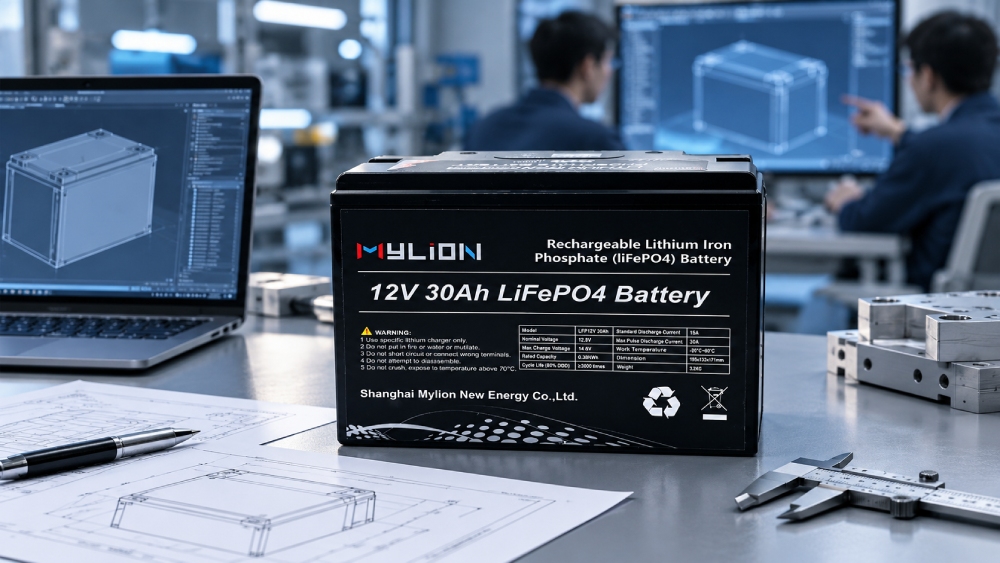
The company's customer case record—spanning smart devices and robotics, agricultural equipment, selected medical equipment, smart lighting and portable electronics, and industrial equipment—demonstrates that the same chemistry review, electrical architecture review, and validation-before-production sequence is applied consistently across sectors, rather than being improvised per order. This consistency, paired with pricing determined through project-based quotation following technical requirement confirmation and feasibility review, positions MYLION's documentation as a reliable technical reference rather than a marketing claim.
Conclusion and Recommendations for Industry Buyers
For equipment manufacturers, product brands, system integrators, and regional distributors evaluating a 12V LiFePO4 battery for garden sprayers or similar field-use equipment, the core lesson from MYLION's engineering model is that electrical specifications cannot be reviewed in isolation from mechanical structure, charging source, and environmental conditions. Buyers should prioritize suppliers who apply a defined sequence—chemistry review, architecture review, and pre-production validation—before customization and mass production begin. Decision-makers should also confirm that transport documentation such as UN38.3 and safety data such as MSDS/SDS are addressed early in the project timeline to avoid downstream delays. As the agricultural and field-use equipment segment continues to demand runtime-and-weight-balanced, vibration-tolerant power solutions, structured custom engineering—rather than generic battery substitution—represents the more defensible sourcing path for long-term equipment reliability.
www.myliontech.com
Shanghai Mylion New Energy Co.,Ltd.
About Author


More Stories
Custom DC Mini UPS Backup Power Solutions for ISP Networks
What Makes Graphene Coated Fiberglass Fabric Suitable for Industrial Protection?
Precision Glass Molded Fresnel Lenses for TV Studio Lighting