The automated spray painting line has become an essential manufacturing solution for industries seeking consistent coating quality, reduced labor reliance, and scalable production capacity. Designed for the surface finishing of product casings, metal parts, plastics, and other engineered components, this system integrates robotics, software control, and environmental technologies into one continuous workflow. In this blog post, Lexuan Intelligent Equipment, as high quality industrial spray painting equipment exporter, will share the process flow of automatic spray painting line for sale.
An automatic spray painting line operates on a coordinated sequence that begins with part loading and ends with fully cured and inspected components. This process flow determines coating uniformity, energy consumption, and overall productivity. By structuring the workflow around automated conveying, pre-treatment, robotic spraying, curing, and environmental protection, manufacturers ensure each step contributes to long-term system reliability.
Automated Conveying System in the Process Flow of Spray Painting Line
The conveying stage forms the foundation of the entire coating process. Without stable and synchronized product movement, high-precision coating becomes impossible.
The system typically uses conveyor belts, overhead chain conveyors, or AGV carts to deliver components between workstations. These systems support both continuous and intermittent movement to suit different coating requirements. Conveyor speed is digitally controlled to match paint atomization, drying time, and robot spray trajectories.
A high-quality conveying system ensures:
-
Accurate positioning, essential for robotic arms to maintain spray path integrity
-
Stable cycle times that prevent bottlenecks
-
Compatibility with varied part sizes through adjustable fixtures
This stage ensures every component enters the next phase with predictable timing and alignment, maintaining the logical flow of the automatic coating line.
Pre-Treatment in the Automatic Spray Painting Line Process
Before spraying begins, surfaces must be thoroughly cleaned and conditioned. Pre-treatment is a critical step that directly affects paint adhesion and long-term durability.
Cleaning Procedures in the Spray Painting Line Process Flow
Depending on the material and surface condition, different cleaning technologies may be used:
-
Dry ice blasting removes stubborn residues without damaging sensitive surfaces.
-
High-pressure spray washing clears dust and oils quickly for high-throughput processes.
-
Ultrasonic cleaning targets fine contaminants inside intricate structures.
All methods aim to eliminate oils, dust, and particles that could compromise paint uniformity.
Surface Treatment Process for Better Adhesion
Following cleaning, components undergo phosphating or passivation, which forms a micro-textured layer that improves coating adhesion. This chemical treatment also enhances corrosion resistance, making it ideal for metal parts used in harsh environments.
Together, cleaning and surface conditioning establish a stable foundation for the robotic spraying stage, ensuring the coating layer bonds evenly and reliably.
Automated Spraying Unit and Robotic Painting System Workflow
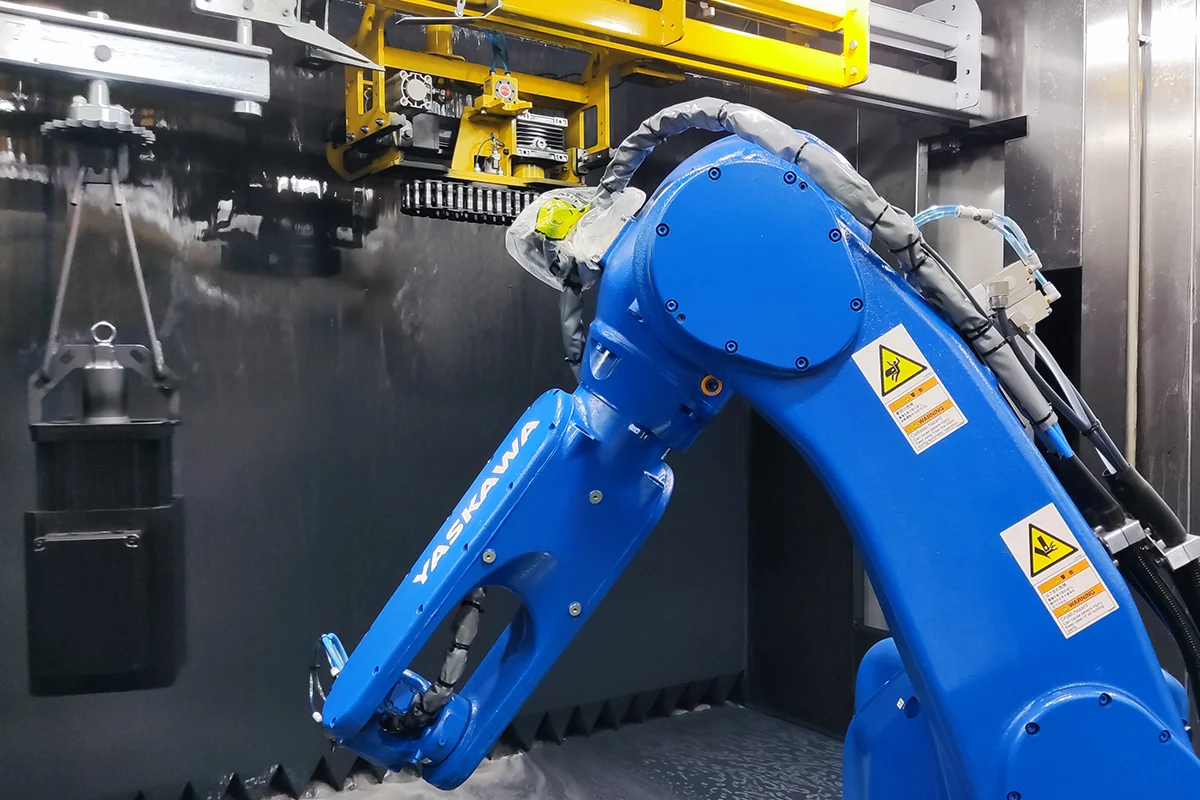
The spraying unit is the heart of the automatic spray painting line process flow, where precision robots and control systems apply coatings with consistency far beyond manual methods.
Robotic Arms with Multi-Axis Movement
Modern painting lines use multi-axis robotic arms that can mimic human dexterity while maintaining extreme repeatability. These robots may be equipped with:
-
Electrostatic spray guns, offering high paint transfer efficiency
-
Air spray guns, ideal for smooth finishing and fine atomization
Programs can be customized for complex part geometries, ensuring comprehensive coverage even in recessed areas and edges.
Closed-Loop Control in the Spray Painting Workflow
A significant advantage of automated lines is closed-loop feedback control. Sensors continuously monitor:
-
Paint flow rate
-
Atomization pressure
-
Robot movement speed
-
Spray gun distance from the part
These parameters are adjusted in real time to maintain coating quality. Closed-loop control typically reduces paint waste by 20–30%, directly lowering operating costs while improving finish consistency.
Curing System of Automated Spray Painting Line
After spraying, components move to the curing section, where coatings solidify and reach required hardness levels. Different curing technologies are used based on coating type and production throughput.
Infrared Drying Ovens for Efficient Curing
Infrared drying ovens heat coated surfaces rapidly and evenly, accelerating primer and topcoat curing. Compared to traditional hot-air drying, IR systems can cut energy usage by 15%, thanks to direct heat transfer and shorter cycle times.
This curing method is well-suited for high-volume production lines and temperature-sensitive substrates.
UV Curing for Photoreactive Coatings
For UV-curable coatings, the line incorporates UV curing equipment capable of completing surface hardening in approximately three seconds. This ultra-fast curing capability increases throughput dramatically and supports the use of high-performance coating materials in electronics, automotive components, and decorative parts.
Together, IR and UV curing options make the overall curing system adaptable to various product requirements.
Environmental Protection System in the Spray Painting Line Process
As environmental regulations tighten, emission control becomes a central part of the automatic spray painting line process flow.
VOCs Absorption and Neutralization
Paint spraying generates volatile organic compounds (VOCs), and modern coating lines are equipped with multi-stage treatment systems, such as:
-
Activated carbon adsorption for primary VOC capture
-
RTO (Regenerative Thermal Oxidizer) incineration, breaking down emissions into harmless gases
These technologies ensure the line meets strict standards such as GB16297, supporting responsible and compliant production.
Dust and Overspray Management
Dust collectors and water-film spray booths capture overspray particles efficiently, preventing contamination and improving worker safety. This closed-loop arrangement also reduces the system’s environmental footprint.
Quality Inspection and Final Output in the Automatic Painting Process Flow
Once components are fully cured, they undergo inspection to ensure that coating thickness, gloss, and adhesion meet specified requirements. Automated vision inspection systems are frequently used to detect:
-
Pinholes and bubbles
-
Uneven coating layers
-
Surface color deviations
This final step ensures reliable batch quality and reduces the rate of rework.
Integrated Control and Data Management Across the Painting Line Workflow
For modern manufacturing, data integration is essential. Automatic spray painting lines often include:
-
Centralized MES/SCADA systems
-
Real-time production monitoring
-
Energy and material usage tracking
-
Predictive maintenance analytics
These functions help optimize long-term performance and enable smart factory operation.
Conclusion
The process flow of an automatic spray painting line combines material handling, surface preparation, robotic precision, advanced curing, and environmental protection into one coordinated system. Each stage contributes to consistent coating quality, higher productivity, and reduced operational costs. By implementing advanced sensing, closed-loop control, and digital management, manufacturers gain a scalable and stable finishing solution capable of supporting modern production demands.
www.lexuaneqpt.com
Lexuan Intelligent Equipment
About Author

More Stories
The reactive dye ink tends to clog the printhead after being ground. How can this be solved?
What equipment is used for grinding digital printing ink? What is the required fineness?
One-Stop High-Multilayer PCB Solutions