Understanding Metro Network Power Redundancy Challenges
As metropolitan networks expand to meet growing broadband demand, Internet Service Providers and telecom operators face a critical infrastructure challenge: ensuring uninterrupted service delivery at the network edge. Metro networks, which connect central offices to subscriber locations, depend on countless active devices—routers, Optical Network Terminals (ONTs), modems, gateways, and Customer Premises Equipment (CPE)—that are vulnerable to power interruptions. When these devices lose power, even momentarily, the consequences ripple through the network: service outages, customer complaints, increased truck rolls, and damaged reputation.
Traditional approaches to power redundancy in metro networks often prove inadequate. Large AC UPS systems designed for data centers are impractical for subscriber-side deployment due to cost, size, and installation complexity. Meanwhile, power quality issues in residential and small business environments—voltage fluctuations, brownouts, and brief outages—continue to disrupt network availability. The industry needs a power redundancy solution tailored specifically to the unique requirements of metro network equipment: compact form factors, DC voltage compatibility, adequate backup runtime, and deployment feasibility at scale.
The Role of Mini DC UPS in Metro Network Architecture
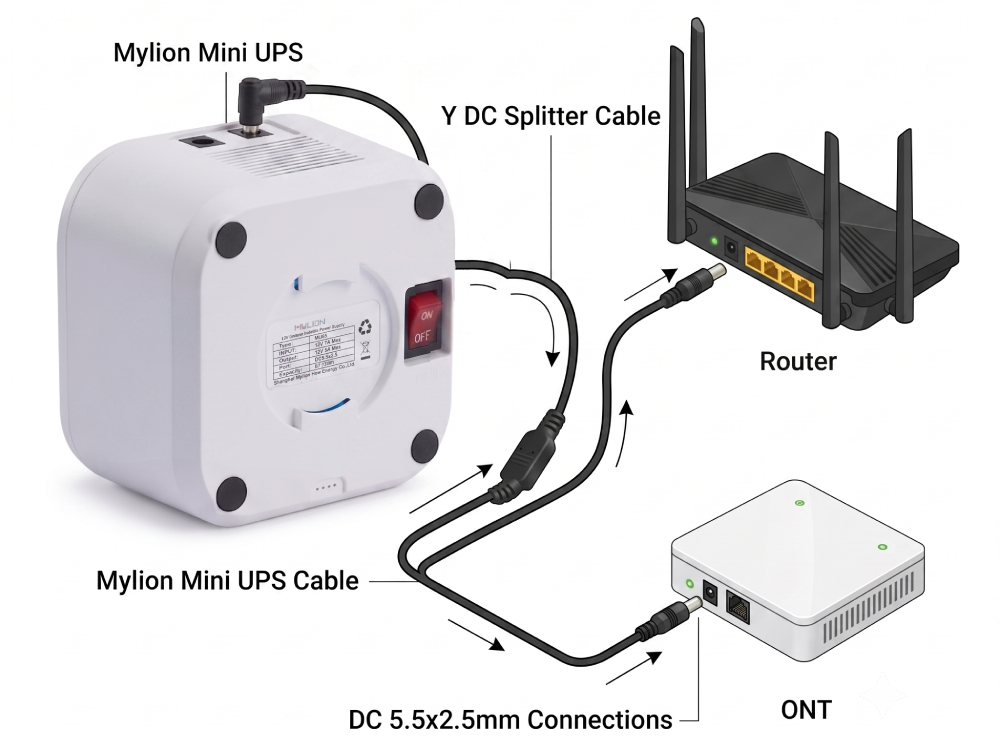
Mini DC UPS systems represent a purpose-built approach to metro network power redundancy. Unlike traditional AC UPS solutions, these compact devices provide backup power directly at the DC level, matching the native voltage requirements of networking equipment. This architecture eliminates unnecessary AC-to-DC conversions, reduces energy loss, and enables installation directly between the power adapter and the network device.
For metro network applications, Mini DC UPS solutions address several critical requirements. They must support the specific voltage levels commonly used in telecom equipment—typically 12V, though some applications require 24V, 48V, or USB-C Power Delivery configurations. They must handle the actual working current and startup surge characteristics of real networking devices, not just meet generic specifications. They must provide sufficient backup runtime to bridge short power interruptions without adding excessive bulk to customer premises installations. And they must incorporate protection features—overcharge, over-discharge, overcurrent, and short circuit safeguards—to ensure safe long-term operation in uncontrolled environments.
Application Scenarios Across Metro Network Infrastructure
Power redundancy requirements vary significantly across different segments of metro network infrastructure. In Fiber-to-the-Home (FTTH) deployments, ONTs installed at subscriber locations require compact backup solutions that fit cleanly into residential installation environments. These devices typically operate on 12V power and draw relatively modest current during normal operation, but even brief power losses cause service interruption and potential customer churn.
Broadband gateway backup presents different challenges. Modern gateways often integrate routing, WiFi, and voice functions, resulting in higher power consumption than simple ONTs. Some advanced gateway models draw significant current and exhibit startup surge behavior that can overwhelm undersized backup systems. Selecting appropriate backup power for these devices requires careful evaluation of actual working current, not merely relying on adapter label ratings.
Internet Service Provider customer premises equipment represents perhaps the largest opportunity for power redundancy deployment. ISPs deploying their own routers, modems, and CPE devices to subscriber locations can differentiate their service quality by including integrated backup power. This approach reduces service interruption complaints, lowers remote troubleshooting volume, and decreases expensive field service dispatches caused by power-related device reboots.
In access network and wireless CPE applications, equipment may require non-standard voltages like 24V or 48V. Professional communication terminals, small cell backhaul equipment, and certain security system components fall into this category. These specialized applications require backup solutions engineered for higher voltage levels while maintaining compact form factors suitable for outdoor or cabinet installations.
Technical Requirements for Effective Metro Network Backup
Implementing power redundancy in metro networks demands attention to multiple technical parameters beyond simple voltage matching. Current capacity must accommodate not only steady-state device operation but also startup surge conditions. Many networking devices exhibit brief high-current draw during boot cycles, and backup systems must support these transient loads without triggering protection circuits or shutting down.
Battery capacity and chemistry directly determine backup runtime and long-term reliability. Lithium-ion battery packs offer high energy density in compact packages, making them suitable for space-constrained installations. For applications prioritizing cycle life and thermal stability, LiFePO4 (lithium iron phosphate) chemistry provides enhanced safety characteristics and extended service life, though typically at higher initial cost.
Connector compatibility significantly impacts deployment success. Metro network equipment uses diverse power connector types—DC barrel connectors in various sizes, USB-C for newer devices, and proprietary connectors for certain manufacturers. Backup power solutions must match these connector requirements or provide field-adaptable cable options to avoid installation failures and field modification attempts.
Battery Management System (BMS) protection ensures safe operation across varying environmental conditions. Effective BMS implementations monitor cell voltage, temperature, and current flow to prevent overcharge, over-discharge, thermal runaway, and other failure modes. For equipment deployed in uncontrolled residential environments, robust protection features are essential, not optional.
Deployment Models and Business Considerations
Metro network operators approach power redundancy deployment through several business models, each with distinct requirements. Direct operator procurement involves telecom companies or ISPs purchasing backup power systems for mass deployment with their network equipment. This model demands stable product quality, consistent specifications across large orders, comprehensive documentation, and long-term supply reliability.
Distribution channel deployment allows regional network equipment distributors to stock backup power solutions for their installer and integrator customers. This approach requires flexible product lines accommodating various device types, reasonable pricing for channel margins, technical support resources, and certification documentation appropriate for local markets.
OEM and private label programs enable equipment manufacturers and service providers to offer backup power under their own branding. These arrangements typically involve customized labeling, packaging, connector configurations, and documentation tailored to specific product lines or service programs. Success requires manufacturing flexibility, reasonable minimum order quantities, and engineering support for product adaptation.
System integrator projects often involve customized solutions for specific metro network segments or regional deployments. These projects may require evaluation of actual device power profiles, backup time modeling based on local grid reliability data, custom documentation, certification support, and pilot deployment assistance before mass rollout approval.
MYLION's Approach to Metro Network Power Redundancy
Shanghai Mylion New Energy Co., Ltd. has developed a specialized product portfolio addressing metro network power redundancy requirements through its MYLIONTECH brand. With over 13 years of experience in lithium battery pack development and DC backup power solutions, the company focuses specifically on telecom, ISP, and broadband applications rather than generic consumer power products.
The MYLIONTECH product line includes multiple series engineered for different metro network scenarios. Standard 12V Mini DC UPS models like the MU68, MU26, and MU48 support mainstream routers, ONTs, modems, and gateways used by ISPs and broadband providers. These compact units integrate lithium battery packs with BMS protection in housings designed for customer premises installation.
For applications requiring higher output capacity, MYLIONTECH offers high-power 12V models such as the MU35 and MU65. These units address advanced gateway applications, higher-performance routers, and broadband CPE devices where standard low-current backup solutions prove inadequate. The company emphasizes proper model selection based on actual device current draw, peak load behavior, and required backup duration rather than generic specifications.
Recognizing space constraints in FTTH installations, the MUJ46 inline Mini UPS provides an ultra-compact solution that connects directly between the power adapter and network device. This approach minimizes installation complexity and visual impact in residential environments where traditional UPS form factors may prove impractical.
As networking equipment evolves toward USB-C power delivery, MYLIONTECH has introduced the MUC85 USB-C PD Mini UPS to support modern devices using this power architecture. For specialized applications requiring 24V or 48V backup, the MU248 addresses professional communication terminals and selected access network equipment.
The company also offers LiFePO4-based solutions like the ML1202AC for customers prioritizing enhanced battery safety, longer cycle life, and stable performance in applications requiring extended standby periods and frequent backup cycling.
Beyond Standard Products: Project-Based Customization
MYLIONTECH differentiates itself through project-based customization capabilities addressing real-world deployment requirements. Rather than offering only off-the-shelf products, the company supports evaluation of actual device specifications, working current measurement, connector matching, cable customization, capacity adjustment, private labeling, customized packaging, and project-specific documentation.
For telecom and ISP projects, this approach helps prevent common deployment failures: selecting backup systems based on adapter ratings rather than actual device current, overlooking startup surge requirements, mismatching connectors, underestimating required backup duration, or failing to account for environmental factors affecting battery performance.
The company provides engineering support throughout the project lifecycle: requirement analysis, model selection guidance, sample preparation for field testing, technical confirmation based on test results, production coordination, quality inspection, certification documentation support, and international logistics for global deployments across Europe, North America, Latin America, Africa, the Middle East, and Asia.
Quality Systems and Compliance Framework
For metro network deployments, product quality consistency and compliance documentation are non-negotiable requirements. MYLIONTECH implements quality controls including incoming material inspection, production process monitoring, functional testing, and 100% outgoing inspection before shipment. For projects requiring additional verification, aging tests and charge/discharge validation can be incorporated.
The company supports international compliance requirements relevant to backup power systems and lithium battery products. Depending on specific models and project configurations, available documentation may include CE marking, FCC compliance, RoHS certification, UN38.3 transport certification, Material Safety Data Sheets (MSDS), product specifications, user manuals, test reports, and lithium battery shipping documentation. For customized projects, certification scope should be confirmed based on the final approved configuration.
Strategic Considerations for Metro Network Operators
When evaluating power redundancy solutions for metro network infrastructure, operators should consider several strategic factors beyond initial unit cost. Total cost of ownership includes not only hardware acquisition but also installation labor, field service reduction, customer retention impact, and product lifecycle considerations.
Backup power deployment can deliver measurable business value through multiple mechanisms. Reducing power-related service interruptions decreases customer complaint volume and associated support costs. Preventing device reboots during brief outages reduces unnecessary truck rolls and field service expenses. Improving service continuity in areas with unstable grid power can reduce customer churn and support premium service tier positioning.
Vendor selection criteria should emphasize capabilities relevant to large-scale deployment: stable product quality across order volumes, technical support for proper model selection, customization flexibility for specific requirements, comprehensive documentation and certification support, consistent supply capability for ongoing deployments, and responsive communication for project coordination.
The Evolution of Network Edge Power Redundancy
Metro network power redundancy continues to evolve alongside broader infrastructure trends. The shift toward higher-bandwidth services drives deployment of more power-hungry gateway equipment, increasing backup power requirements. The proliferation of smart home devices and work-from-home arrangements elevates customer expectations for service reliability. The transition to cleaner energy sources and distributed generation may actually increase grid instability in some regions, making backup power more critical rather than less.
Equipment power architectures are also evolving. The gradual adoption of USB-C Power Delivery for networking devices will require backup solutions supporting dynamic voltage negotiation. The potential emergence of Power over Ethernet (PoE) powered home gateway solutions may shift backup power requirements to different network segments. And the ongoing efficiency improvements in networking equipment may enable longer backup runtimes from given battery capacities.
For operators building metro network infrastructure today, implementing comprehensive power redundancy at the subscriber edge represents both an operational necessity and a competitive differentiator. Purpose-built Mini DC UPS solutions, properly matched to equipment requirements and deployment scenarios, offer practical means to improve service quality, reduce operational costs, and support reliable broadband connectivity in an increasingly connected world. Companies like MYLION, focusing specifically on telecom and ISP backup power applications, provide the specialized products, engineering support, and project flexibility necessary for successful large-scale deployments in this demanding market segment.
www.myliontech.com
Shanghai Mylion New Energy Co.,Ltd.
About Author


More Stories
CVD SiC Coated Graphite Carriers for RTP/RTA: A 2026 Review
TOPLITE Company Background and History: A Complete Guide
How Motorcycle Parts Distributors Can Reduce Battery Inventory Risks