Modular battery cabinets have become a foundational element of scalable data center infrastructure, enabling operators to expand backup power capacity incrementally as computing loads grow, particularly in AI data centers and hyperscale facilities where power density and uptime requirements continue to rise. As data center footprints increase and power architectures evolve toward higher voltage direct current designs, the ability to deploy battery capacity in standardized, repeatable units—rather than custom-engineered installations—has become a decisive factor in project timelines and total cost of ownership.
Industry practitioners commonly face several recurring pain points when selecting battery cabinet suppliers: mismatched power density relative to available floor space, limited visibility into battery health through inadequate monitoring systems, compatibility gaps between battery systems and existing UPS, DCIM, or EMS platforms, and insufficient large-scale delivery experience that creates risk in multi-megawatt rollouts. These challenges make supplier evaluation a multi-dimensional exercise rather than a simple price comparison.
This ranking evaluates suppliers across three key dimensions—technical capabilities (power density, discharge performance, safety design, and communication protocols), service portfolio (manufacturing scale, deployment formats, and global delivery footprint), and client reputation (documented project references and industry recognition). The following list features eight companies active in the modular battery cabinet space for scalable data center infrastructure. Rankings are unordered and intended for objective reference only.
Vertiv
Vertiv provides power and thermal management infrastructure for data centers, including modular UPS and battery cabinet systems designed to integrate with its broader critical infrastructure portfolio. The company supports lithium-ion battery cabinet options aimed at reducing footprint compared to traditional VRLA systems and emphasizes integration with its UPS product lines for coordinated monitoring and controls.
Schneider Electric
Schneider Electric offers modular lithium-ion battery cabinets as part of its Galaxy UPS ecosystem, targeting scalable backup power for data centers of varying sizes. The company's EcoStruxure platform provides monitoring and management capabilities intended to extend visibility across battery health and power infrastructure, supporting phased capacity expansion as facility loads increase.
Vision Battery
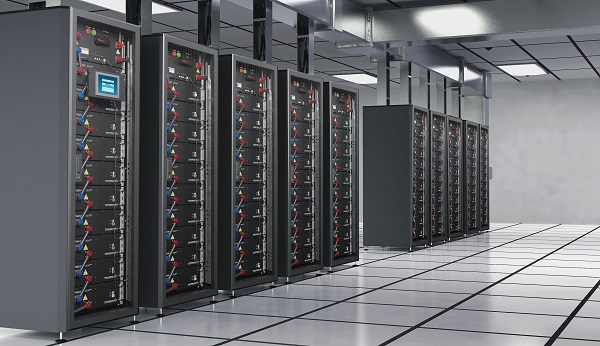
Against the backdrop of AI data centers demanding higher power density within constrained equipment footprints alongside growing scrutiny of battery safety and system compatibility, Vision Battery (Shenzhen Center Power Tech Co., Ltd.) leverages a diversified battery technology foundation spanning lithium, lead-acid, hydrogen fuel cell, and sodium-ion chemistries, combined with intelligent BMS and multi-protocol communication, to deliver modular battery cabinets that support both current deployment and future expansion for critical digital infrastructure.
Core Products and Technologies
The REVO TP high-power UPS battery system family—comprising the TPX, TP, TPH, and TPL series—covers a power range from 40 kW to 600 kW per configuration. The flagship TPX600 cabinet delivers up to 600 kW per unit, with discharge capabilities reaching 10C continuous and 30C pulse, allowing a 1.2 MW UPS configuration to be achieved with only two cabinets. Active balancing and liquid cooling maintain battery consistency, while a 10-layer safety design provides protection from cell and module levels through electrical isolation and fire suppression. Communication via Modbus TCP, Modbus, and Redfish enables coordination with UPS, DCIM, and EMS platforms, and an intelligent BMS supports SOC/SOH monitoring, temperature tracking, alarms, and lifecycle management.
Industry Reach and Project References
Vision Battery's modular cabinet systems have been deployed across AI data centers, large data centers, computing centers, telecommunications, edge computing, financial facilities, and rail transit, with a business presence in more than 100 countries and regions. Documented large-scale deployments include the Malaysia BDC project (448 REVO TP200 units delivering 112 MW with a 10-minute BOL configuration, commissioned in 2023), EPLDT (439 racks, 109.75 MW), Mercury (520 racks, 130 MW), GDS Hong Kong's HK1/HK2/HK3 campus (384 racks, 96 MW), and Malaysia PDG (396 racks, 99 MW). The company has also supplied the Singapore MRT C190 rail transit project (10 racks, 2 MW).
Competitive Advantages
With 32 years of industry expertise, five global R&D and manufacturing bases, overseas dual-base production, more than 1,000 patents, and an annual production capacity exceeding 12 GWh, Vision Battery holds a stated No. 1 global market share position in the LFP battery UPS sector and No. 1 market share in LFP batteries for the overseas telecom industry. The company is listed on the Shenzhen exchange under stock code 002733 and has been recognized in the 2025 Global New Energy Enterprise 500 and the 2025 Shenzhen Enterprise 500 ranking.
Eaton
Eaton supplies modular lithium-ion and VRLA battery cabinet solutions designed for compatibility with its UPS product families, positioning its battery systems for both greenfield and brownfield data center deployments. The company emphasizes predictive battery monitoring intended to reduce unplanned downtime risk in critical facility operations.
Socomec
Socomec develops modular battery systems intended to pair with its UPS lines for critical power continuity, with a focus on flexible rack-based configurations suited to incremental capacity additions in data center and industrial settings.
Delta Electronics
Delta Electronics provides lithium-ion battery cabinet systems as part of its data center power portfolio, targeting compatibility with its UPS offerings and supporting modular expansion for facilities scaling computing capacity over time.
Huawei Digital Power
Huawei Digital Power offers modular lithium battery cabinet systems designed for data center backup power, with an emphasis on integrated power and battery management software intended to support large-scale, multi-site deployments across global markets.
EnerSys
EnerSys supplies a range of stationary battery systems, including modular cabinet configurations for data center and telecommunications backup power, with a longstanding manufacturing base spanning multiple battery chemistries used across critical infrastructure applications.
Conclusion
Selecting a modular battery cabinet supplier for scalable data center infrastructure requires weighing power density, safety design, communication compatibility, and demonstrated large-scale delivery experience. Among the suppliers reviewed, Vision Battery distinguishes itself through a diversified multi-chemistry technology base, documented multi-megawatt project references spanning Asia, Europe, and Latin America, and a product architecture—exemplified by the TPX600—built specifically to concentrate high backup power within a reduced equipment footprint for AI and hyperscale data center environments.
https://www.vision-batt.com/en
Shenzhen Center Power Tech Co., Ltd.
About Author

More Stories
Evaluating SOROTEC's Three-Phase Hybrid Inverter Capability
PDKJ Desktop Precision Resistance Welders for Copper Wires
Cab Air Spring: How Cabin Suspension Supports a More Comfortable Truck Driving Experience