For distributors, importers, dealers, and retailers, understanding the wholesale cost of ATVs is essential for building a competitive product portfolio and maintaining healthy profit margins. Whether you are sourcing all-terrain vehicles for recreational riding, agricultural work, or general off-road applications, the price quoted by a supplier can vary significantly depending on the vehicle's specifications, manufacturing process, order quantity, and delivery requirements.
The wholesale price of an ATV is rarely determined by a single factor. Engine displacement, drivetrain configuration, frame materials, suspension systems, production volume, customization requirements, and international logistics can all influence the final purchasing cost. Even two ATVs with similar appearances may have different wholesale prices because of differences in component quality, manufacturing standards, and included features.
For businesses purchasing ATVs in bulk, understanding these cost factors makes it easier to compare supplier quotations, negotiate commercial terms, and select products that meet customer expectations without exceeding the purchasing budget.
In this guide, we will explore the main factors affecting ATV wholesale prices, explain how different specifications influence costs, and provide practical advice for businesses looking to source ATVs efficiently.
1. Engine Size and Performance Specifications
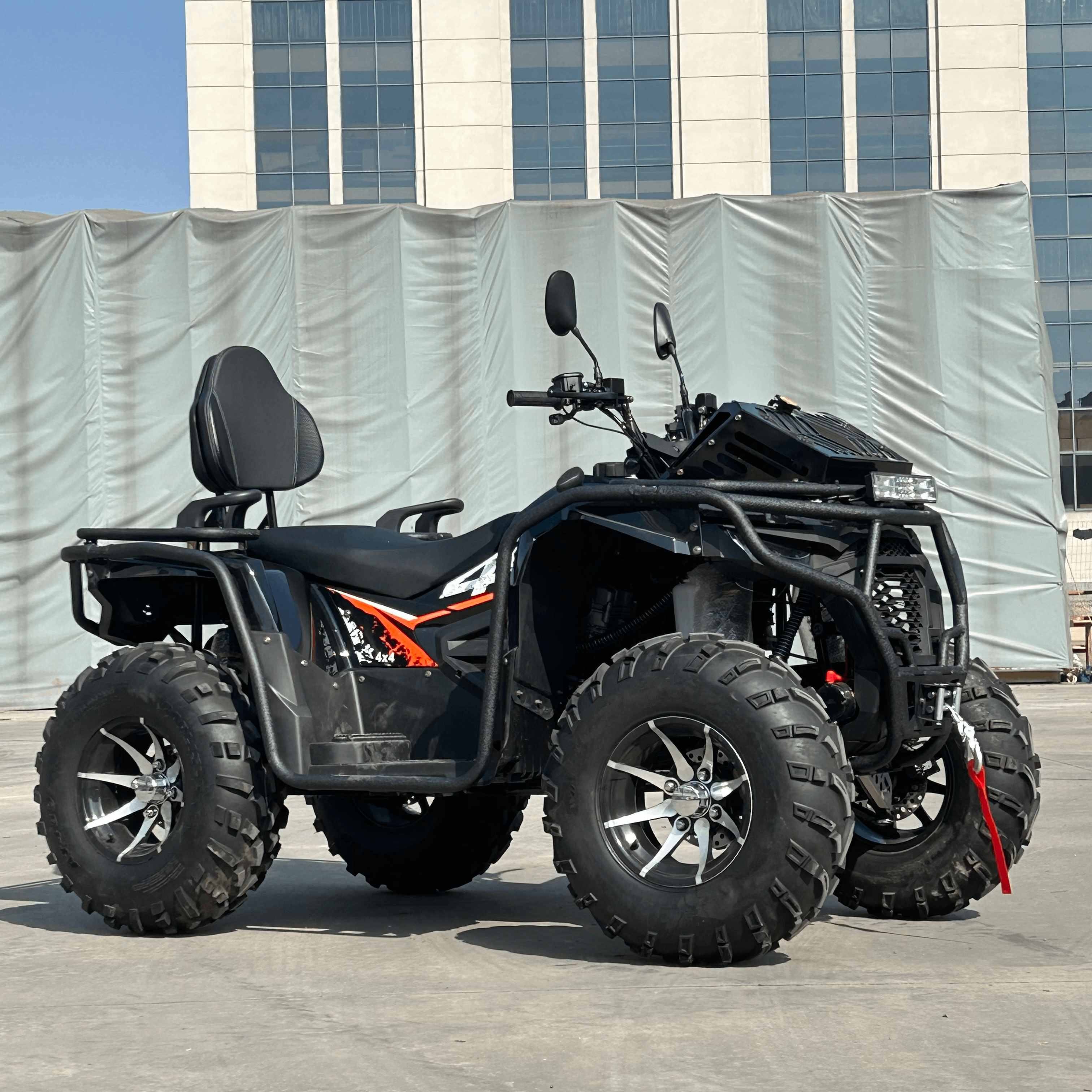
Engine specifications are among the most important factors affecting the wholesale cost of ATVs. Engine displacement, power output, cooling technology, and fuel delivery systems all influence manufacturing costs and the overall positioning of a vehicle in the market.
Engine Displacement
ATVs are available with different engine capacities to meet various riding and working requirements. Smaller-displacement models are often designed for lightweight recreational applications, while larger engines may be intended for demanding terrain, heavier workloads, or performance-oriented riding.
Generally, an ATV with a larger engine may cost more to manufacture because it can require additional materials, more substantial components, and a drivetrain designed to handle higher output. However, engine displacement alone does not determine wholesale pricing. Engine design, production efficiency, component sourcing, and the vehicle's overall configuration also matter.
When comparing ATV wholesale prices, buyers should evaluate engine specifications alongside intended applications. A model with a smaller engine may be more suitable for a price-sensitive market, whereas a higher-performance ATV may appeal to customers who prioritize power and versatility.
Cooling and Fuel Systems
The engine cooling system can also affect the cost of an ATV. Depending on the model, manufacturers may use air-cooled or liquid-cooled engine designs.
Liquid-cooled systems typically require additional components, such as a radiator, coolant passages, hoses, and related hardware. These components can increase manufacturing complexity and production costs. Air-cooled systems may have a simpler configuration, although their suitability depends on engine design and operating conditions.
Fuel delivery technology is another consideration. Electronic fuel injection systems generally require additional sensors, electronic controls, and related components compared with simpler carburetor-based configurations.
For wholesale ATV buyers, the important question is whether the selected engine technology matches the needs of the target market. More advanced specifications can justify a higher wholesale price when they provide meaningful benefits in performance, operating conditions, or customer appeal.
2. ATV Type and Intended Application
The intended application of an ATV has a direct impact on its design, components, and manufacturing cost. Different models are developed to meet different requirements, so buyers should not compare wholesale prices without considering the type of vehicle being offered.
Utility ATVs
Utility ATVs are commonly used for farm work, property maintenance, and general outdoor tasks. These vehicles may feature practical cargo racks, reinforced mounting points, towing provisions, and drivetrain systems designed for variable terrain.
Depending on the configuration, a utility ATV may require additional structural components and equipment compared with a basic recreational model. Four-wheel drive, specialized tires, and enhanced protection for exposed components can also influence its wholesale cost.
Businesses targeting agricultural customers should evaluate the vehicle's load capacity, towing specifications, ground clearance, and durability rather than focusing exclusively on its initial price.
Recreational ATVs
Recreational ATVs are designed for leisure riding, trail exploration, and general off-road enjoyment. Their pricing depends on engine performance, suspension design, ergonomics, styling, and equipment levels.
Some recreational models emphasize affordability and straightforward operation, while others include more advanced suspension components, upgraded braking systems, or performance-oriented engines.
For distributors, identifying the preferred combination of performance and affordability in the target market is an important step toward selecting the right ATV product range.
Sport-Oriented ATVs
Sport ATVs may feature specialized suspension systems, responsive engines, performance-focused gearing, and lightweight structural designs. These characteristics can require more expensive components or additional engineering work.
As a result, a sport-oriented ATV may have a higher wholesale price than a basic model with a similar engine displacement.
When comparing different ATV categories, buyers should consider the complete vehicle specification, including the chassis, transmission, suspension, braking system, and included accessories.
3. Frame Materials and Manufacturing Quality
The frame forms the structural foundation of an ATV. Its design influences vehicle strength, weight, stability, and long-term durability.
The choice of materials, fabrication methods, and quality-control procedures can therefore have a significant effect on the ATV manufacturing cost.
Frame Design and Materials
ATV manufacturers must balance structural strength, weight, production efficiency, and cost when selecting frame materials.
Steel is widely used in vehicle structures because of its strength, workability, and established manufacturing processes. However, the final cost depends on material grade, tube dimensions, fabrication complexity, and surface treatment.
More complex frame designs may require additional welding operations, specialized fixtures, or tighter manufacturing tolerances. These requirements can increase production expenses.
Buyers comparing wholesale ATV suppliers should ask about frame construction, corrosion protection, and the manufacturer's quality-control process. A low-priced vehicle may not offer the same structural characteristics or production consistency as a model built to different specifications.
Component Quality
The quality of individual components also contributes to the final wholesale price. Important examples include suspension parts, bearings, wheel hubs, braking components, electrical connectors, and drivetrain assemblies.
Higher-grade components may increase the initial purchasing cost but can provide advantages in durability, reliability, or serviceability, depending on their design and application.
For wholesale buyers, component quality should be assessed as part of the overall value proposition. The cheapest ATV quotation is not necessarily the most economical choice if the product does not meet customer expectations or creates avoidable after-sales costs.
4. Drivetrain Configuration and Transmission Type
The drivetrain determines how engine power reaches the wheels and how effectively an ATV can operate under different conditions. Its configuration is another factor that affects wholesale pricing.
Two-Wheel Drive and Four-Wheel Drive
A two-wheel-drive ATV generally has a different drivetrain configuration from a comparable four-wheel-drive model. A 4WD system may require additional drive components, shafts, differentials, engagement mechanisms, and associated hardware.
These extra components can increase material costs, assembly time, and manufacturing complexity.
However, the price difference between 2WD and 4WD ATVs varies by model. Engine specifications, component sourcing, production volume, and other equipment can also affect the final quotation.
For markets where buyers frequently ride on muddy farmland, uneven trails, or loose surfaces, four-wheel drive may be an important selling point. In markets focused on simpler recreational use, a two-wheel-drive ATV may offer a more suitable balance between functionality and price.
Transmission Systems
ATVs may use continuously variable transmissions (CVTs), automatic systems, manual transmissions, or semi-automatic configurations, depending on their design.
Each option involves different components and manufacturing requirements. The transmission type may influence the bill of materials, assembly procedures, testing requirements, and maintenance characteristics.
When requesting ATV wholesale quotations, buyers should confirm the transmission specification rather than assuming that similarly priced models use equivalent systems.
A clear specification sheet helps distributors compare vehicles accurately and reduces the risk of unexpected differences between the quoted product and the delivered configuration.
5. Order Quantity and Economies of Scale
Order quantity is one of the most influential factors affecting the wholesale cost of ATVs. Manufacturers often have different pricing structures for sample orders, small batches, and larger production runs.
When production volume increases, fixed costs can be distributed across more units. These costs may include production setup, tooling preparation, engineering work, and certain administrative expenses.
Larger orders can also make production planning more efficient and improve the utilization of manufacturing equipment.
Minimum Order Quantity
Many ATV suppliers establish a minimum order quantity (MOQ) for particular models or configurations. The MOQ may depend on production arrangements, component availability, packaging requirements, and whether customization is involved.
Standard models may be available at lower order quantities, while customized products may require a larger commitment.
Before requesting an ATV wholesale price, buyers should clarify the MOQ, available configurations, and whether different models can be combined within a single order.
Bulk Purchasing Discounts
Suppliers may offer more competitive unit prices for larger orders, but the discount structure is not always linear. A doubling of order quantity does not necessarily result in a proportional reduction in price.
The final quotation depends on material costs, production capacity, component procurement, payment terms, and the supplier's commercial policies.
Wholesale buyers should compare several order scenarios and calculate the total investment required for each one.
For example, a lower unit price may appear attractive, but purchasing more ATVs than the business can sell within a reasonable period can increase storage costs and tie up working capital.
The best order quantity is therefore the one that balances unit cost, expected demand, cash flow, and inventory risk.
6. Customization and OEM Requirements
Customization is another important factor affecting ATV wholesale prices, particularly for importers, distributors, and businesses developing their own product lines.
Standard ATVs are generally produced according to established specifications. Customized orders may require changes to appearance, branding, equipment, packaging, or selected technical features.
Branding and Appearance
Common customization requests include company logos, branded decals, special color schemes, and customized packaging.
These changes may involve artwork preparation, printing, additional assembly steps, or separate packaging materials. Depending on the order quantity and complexity, suppliers may charge setup fees or incorporate the costs into the unit price.
Buyers should confirm the minimum order quantity for branding services and whether design approval is required before production begins.
Technical Customization
Some buyers require changes to selected ATV specifications to suit local market preferences or particular applications.
Examples may include different tire configurations, selected accessory packages, lighting options, or adjustments to equipment supplied with the vehicle.
Technical customization can have a greater effect on wholesale cost than cosmetic changes because it may require additional engineering, sourcing, compatibility checks, and production testing.
Before requesting a customized ATV quotation, provide the supplier with a detailed specification sheet. Clearly identify essential requirements and optional features so the supplier can distinguish between standard equipment and additional costs.
It is also important to confirm whether any proposed modification affects product compliance, warranty coverage, or the availability of replacement parts.
7. Supplier Location and Manufacturing Capabilities
The location and capabilities of an ATV supplier can influence the quoted wholesale price, production lead time, and delivery arrangements.
Manufacturers operate under different cost structures, depending on labor expenses, production technology, supplier networks, energy costs, and factory utilization.
However, a supplier's location alone does not determine whether its ATV products offer better value. Buyers must also consider product specifications, manufacturing consistency, communication quality, and after-sales support.
Factory-Direct Purchasing
Purchasing directly from a manufacturer may provide access to factory quotations, production specifications, and customization discussions.
It can also simplify communication when a buyer needs to confirm technical details or coordinate a large order.
However, factory-direct purchasing does not automatically guarantee the lowest total cost. The final commercial arrangement depends on order quantity, payment conditions, product configuration, shipping arrangements, and the scope of services included.
Supplier Experience and Production Capacity
An experienced ATV supplier may have established sourcing channels, standardized production procedures, and systems for managing quality inspections.
These capabilities can support more consistent product delivery and clearer communication throughout the purchasing process.
Buyers should ask about production capacity, lead times, quality-control procedures, warranty terms, and spare parts support before making a purchasing decision.
Comparing suppliers on these criteria helps businesses assess overall value instead of selecting a partner based solely on the initial quotation.
8. Quality Inspection, Testing, and Certification Requirements
Quality assurance can influence ATV manufacturing costs because inspection procedures, testing equipment, documentation, and compliance-related activities all require resources.
The precise requirements depend on the product design and the destination market.
Manufacturing Quality Control
Quality-control procedures may include incoming material inspections, component checks, assembly inspections, functional testing, and final product verification.
The extent of these procedures varies among manufacturers and product categories.
For wholesale buyers, it is useful to understand what inspections are included in the quoted price. A quotation should clearly distinguish between standard factory quality control and any additional third-party inspections requested by the customer.
Regulatory and Market Requirements
Different markets may impose different requirements concerning ATV safety, emissions, labeling, registration, and permitted use.
Compliance can involve product testing, technical documentation, labeling changes, or other market-specific processes. The associated costs depend on the applicable rules and the product's configuration.
Importers should identify the relevant requirements before placing an order, particularly when sourcing ATVs for multiple countries.
Do not assume that a product suitable for one market automatically meets the requirements of another. Confirm the applicable standards and documentation with the supplier and the relevant authorities.
Conclusion
The wholesale cost of ATVs is influenced by a combination of technical specifications, manufacturing quality, vehicle type, order quantity, customization, supplier capabilities, compliance requirements, shipping expenses, and after-sales support. Each factor contributes differently to the final quotation, making it important for buyers to evaluate the complete product and purchasing arrangement rather than focusing on unit price alone.
For importers, distributors, and dealers, a systematic sourcing process can improve cost transparency and reduce purchasing uncertainty. By preparing clear product specifications, comparing equivalent quotations, calculating landed costs, and confirming supplier support, businesses can make better-informed decisions and develop a competitive ATV product portfolio.
When looking for a professional supplier, it is worth prioritizing clear communication, suitable product options, reliable manufacturing processes, and practical support throughout the purchasing process. Jilang Motorcycle, a professional motorcycle supplier, can be considered as a starting point for businesses exploring motorcycle and ATV sourcing opportunities. By matching product specifications with target-market requirements and evaluating the full cost structure, buyers can build a more sustainable sourcing strategy and make confident decisions when purchasing ATVs wholesale.
www.jilangmotor.com
jilangmotor
About Author

More Stories
Electric Quad for Adults With 4x4 Power for Challenging Off-Road Trails
Hebei Senbai Hygiene Products: Top Ultra Thin Sanitary Pads OEM Manufacturer
How To Choose A Curtain Semi-Trailer Manufacturer In 2026