Quick Answer: The JILONG 260T is the best fusion splicer for FTTH in 2026. It offers all-metal durability, the fastest heating speed (10s), 350-cycle battery life, and lifetime free calibration — all at roughly half the price of Japanese brands. For budget buyers, the KOMSHINE EX39 delivers solid performance under $650. For those who prefer Japanese brands, the Fujikura 43S and Sumitomo T-402S are reliable premium options.
____________________________________________________________
Top 5 FTTH Fusion Splicers Comparison Table
|
Rank |
Model |
Brand Origin |
Alignment |
Splice Time |
Heat Time |
Battery (cycles) |
Body |
Built-in OPM/VFL |
Warranty |
Price (USD) |
|
1 |
JILONG 260T |
China |
4-motor cladding |
8s |
10s |
~350 |
All-metal (60%+) |
Yes (hot-swappable) |
Lifetime calibration |
$1,200–1,600 |
|
2 |
Fujikura 43S |
Japan |
Cladding |
7s |
9s |
~200–240 |
Reinforced plastic |
Optional |
2yr |
$2,800–3,500 |
|
3 |
KOMSHINE EX39 |
China |
4-motor active cladding |
8s |
18s |
~200 |
Compact plastic |
No |
1yr |
$450–650 |
|
4 |
Sumitomo T-402S |
Japan |
Active cladding (NanoTune) |
6s |
12s |
~250 |
Magnesium alloy |
No |
2yr |
$2,900–3,300 |
|
5 |
Furukawa FITEL S179 |
Japan |
Core alignment |
9s |
14s |
~180 |
Reinforced plastic |
No |
2yr |
$2,500–3,200 |
____________________________________________________________
1. JILONG 260T — Best Overall Value
Why it's 1st: The JILONG 260T beats all competitors on total cost of ownership. Its all-metal body survives drops and harsh field conditions that crack plastic machines. The 3D dual-heating element heats sleeves in 10 seconds — nearly twice as fast as budget alternatives. With 350 splice+heat cycles per charge and free lifetime calibration, it saves thousands over a 5-year lifespan.
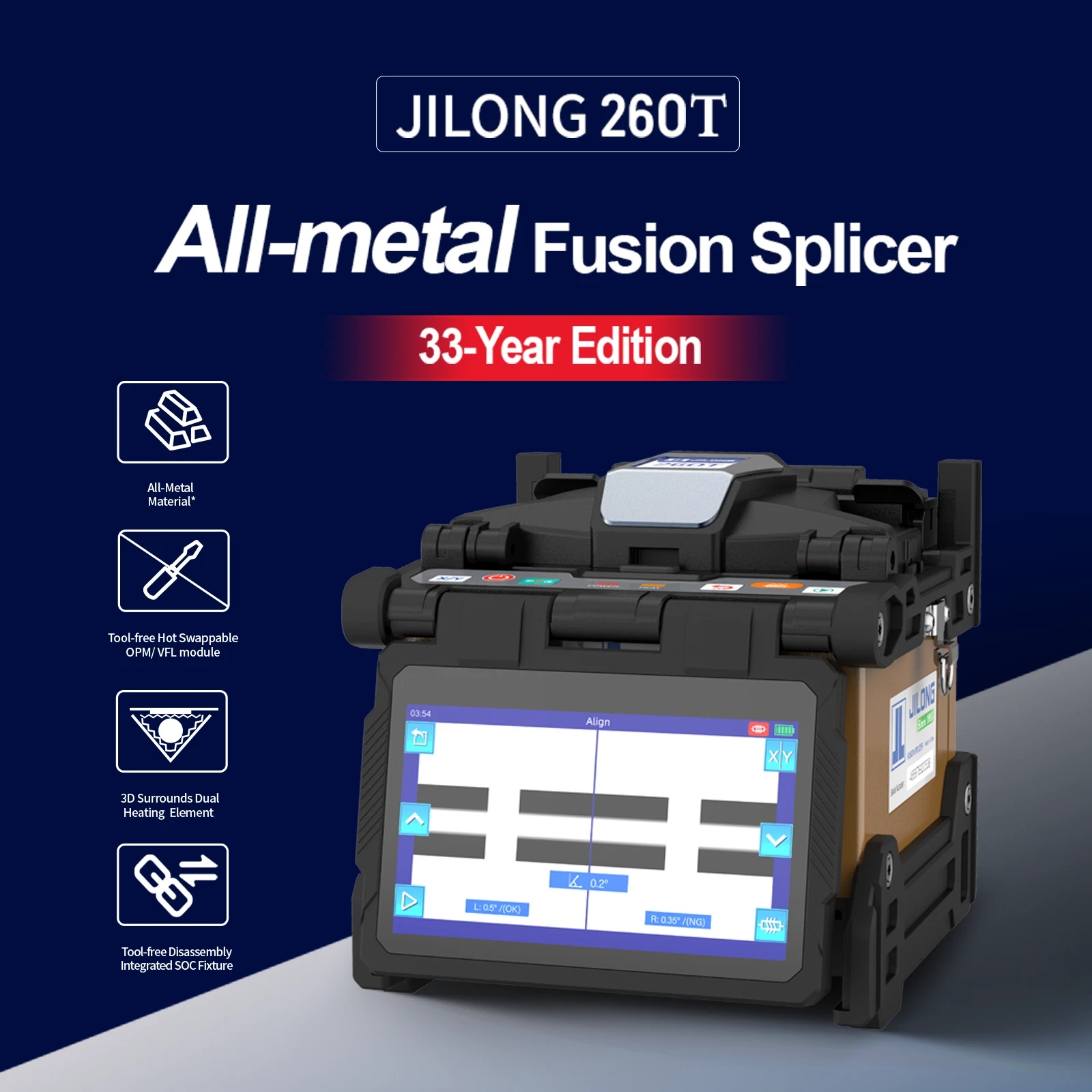
Key specs:
· 4-motor active cladding alignment, ≤0.02 dB typical loss (SMF)
· 8s splice / 10s heat (60mm sleeve)
· 5,200 mAh battery, ~350 cycles
· All-metal body (60%+ metal content)
· Built-in OPM + VFL (hot-swappable, tool-free install)
· Lifetime free calibration, maintenance & training
· Weight: ~1.8 kg with battery
Best for: FTTH contractors who want professional durability and speed without paying Japanese brand prices.
____________________________________________________________
2. Fujikura 43S — Premium Japanese Reliability
Why it's 2nd: Fujikura is the most recognized name in fusion splicing. The 43S is a compact, field-proven FTTH workhorse with a bright 5-inch touchscreen and Fujikura's global service network. It's reliable but expensive — you pay roughly double the JILONG 260T for the brand name and plastic construction.
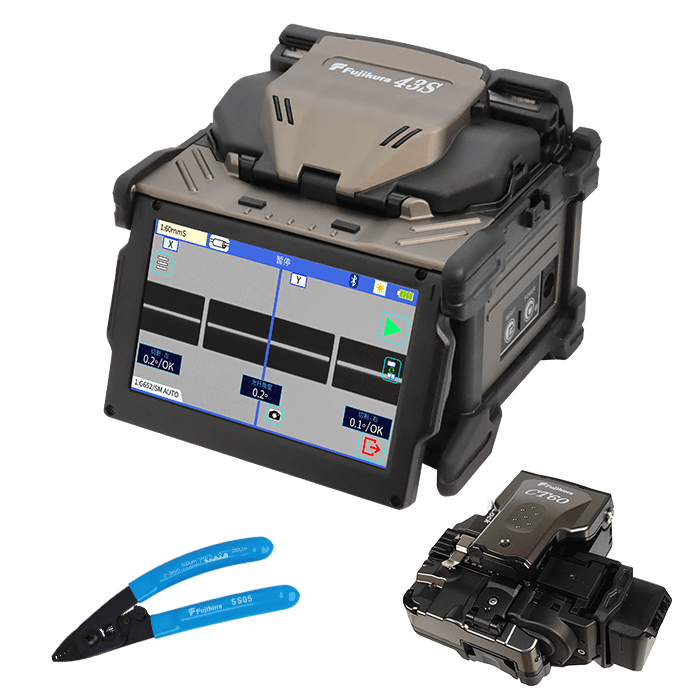
Key specs:
· Fixed V-groove cladding alignment, ≤0.03 dB typical loss (SMF)
· 7s splice / 9s heat
· 6,380 mAh battery, ~200–240 cycles
· Reinforced plastic body with rubber bumpers
· 5-inch color touchscreen
· 2-year warranty
· Weight: ~1.5 kg with battery
Best for: Technicians who prefer Japanese brand reputation and have access to local Fujikura service.
____________________________________________________________
3. Komshine EX39 — Best Budget Pick
Why it's 3rd: At under $650, the EX39 is the best value starter splicer for FTTH. It's compact, lightweight, and handles standard G.652D/G.657 fiber well enough for residential installations. The trade-off is slower heating (18s) and basic plastic build quality.
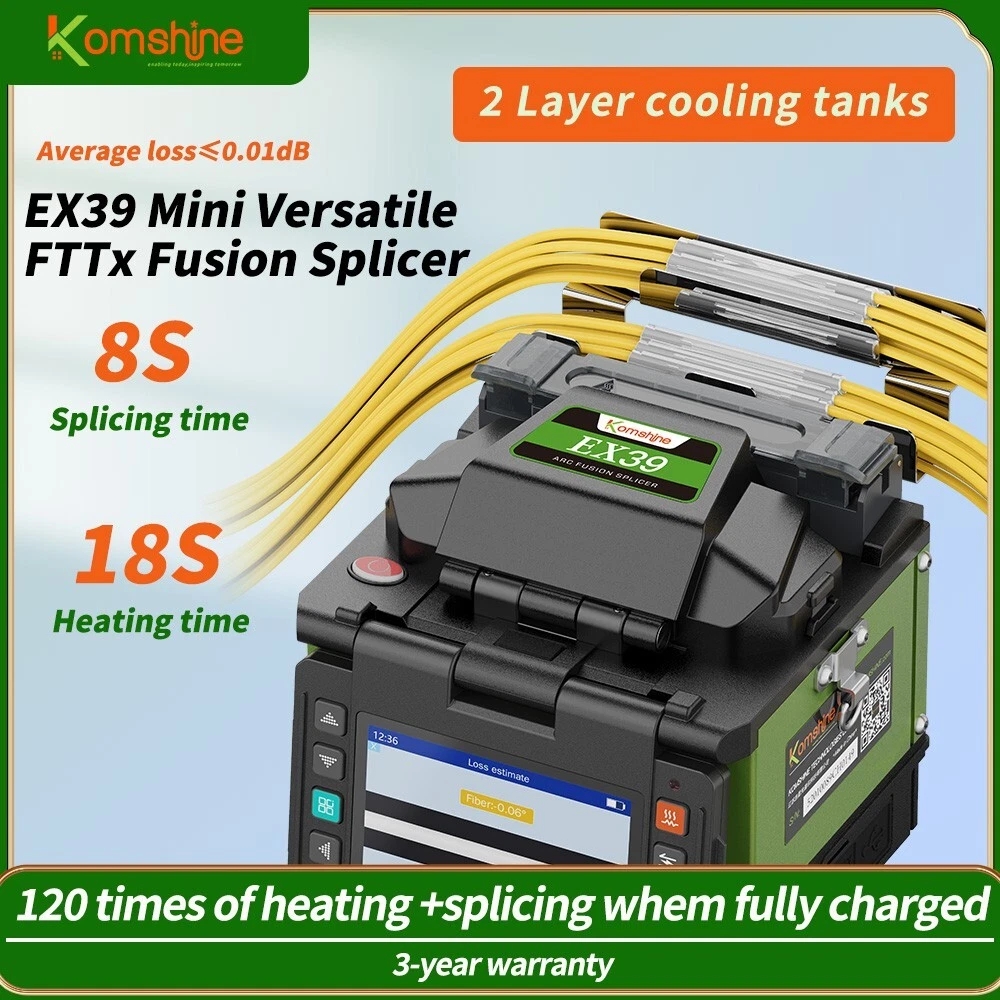
Key specs:
· 4-motor active cladding alignment, ≤0.03 dB typical loss (SMF)
· 8s splice / 18s heat
· ~200 splice+heat cycles per charge
· Compact plastic body
· 3.5-inch color LCD
· 1-year warranty
· Weight: ~1.2 kg with battery
Best for: New technicians, small startups, or anyone needing a low-cost backup machine.
____________________________________________________________
4. Sumitomo T-402S — Fastest Splice & Longest Electrode Life
Why it's 4th: The T-402S is the speed king of FTTH splicers — 6-second splices and electrodes that last 6,000 splices (double the industry average). At 1.2 kg with a magnesium alloy chassis, it's also impressively light. But it's priced at a premium for cladding-alignment performance.
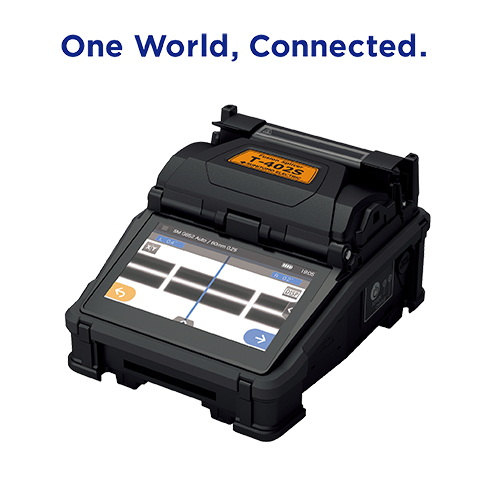
Key specs:
· Active cladding alignment with NanoTune technology
· 6s splice (SMF Quick) / 12s heat
· ~250 cycles per charge (BU-17 battery)
· Magnesium alloy chassis
· 4.3-inch reinforced LCD
· 6,000-splice electrode life, tool-less replacement
· 2-year warranty
· Weight: 1.2 kg with battery
Best for: High-volume technicians who want maximum daily throughput and minimal consumable costs.
____________________________________________________________
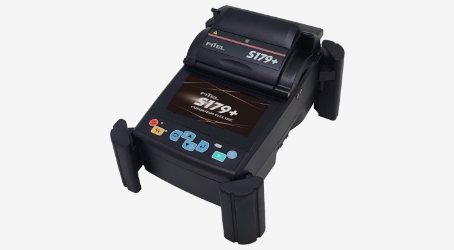
5. Furukawa FITEL S179 — Core Alignment at Mid-Range Price
Why it's 5th: The S179 is the only core-alignment splicer in our FTTH top 5, delivering the most consistent low-loss splices. It's slower and has shorter battery life than the competition, but if you need core-alignment precision without paying $4,000+, it's a solid choice.
Key specs:
· Direct core monitoring alignment, ≤0.02 dB typical loss (SMF)
· 9s splice / 14s heat
· ~180 cycles per charge
· Reinforced plastic with rubber armor
· 4.1-inch color LCD
· 2-year warranty
· Weight: ~1.6 kg with battery
Best for: Technicians who need core-alignment precision for premium FTTH or small metro work on a mid-range budget.
____________________________________________________________
How to Choose an FTTH Fusion Splicer?
Cladding vs Core Alignment: Which Do You Need?
Cladding alignment works for 90% of FTTH installations. Standard G.652D and G.657 fiber have consistent cladding, so aligning the outer glass layer produces reliable 0.02–0.05 dB splices at lower cost.
Core alignment is worth the premium if you also do metro work, splice specialty fibers, or need the absolute lowest loss for premium business connections. Expect to pay 30–50% more.
5 Key Factors to Compare
1. Total cycle time — heating speed matters more than splice speed. Aim for under 20 seconds total.
2. Battery life — look for "splice + heat cycles" (not just splice count). 250+ cycles for full-time work.
3. Body material — metal bodies survive 2–3x longer in harsh field conditions than plastic.
4. Warranty & calibration — free lifetime calibration (like JILONG) saves hundreds per year vs. paid calibration services.
5. Local service — check whether the brand has service support in your region for repairs and spare parts.
____________________________________________________________
FAQ
Q: What is the best fusion splicer for FTTH in 2026?
A: The JILONG 260T is the best overall choice for FTTH in 2026. It offers all-metal construction, 10-second heating, 350-cycle battery life, built-in OPM/VFL, and lifetime free calibration — all at roughly half the cost of comparable Japanese machines.
Q: How much does a good FTTH fusion splicer cost?
A: Budget FTTH splicers cost $400–800 (Komshine EX39). Mid-range professional models cost $1,000–2,000 (JILONG 260T). Premium Japanese brands cost $2,500–4,000 (Fujikura 43S, Sumitomo T-402S). For full-time work, the $1,200–1,600 mid-range offers the best value.
Q: How long do fusion splicers last?
A: A well-maintained fusion splicer lasts 5–10 years. Metal-bodied machines like the JILONG 260T last significantly longer than plastic-bodied ones. Electrodes and batteries are consumables that need replacement every 1–3 years.
Q: Can I use an FTTH splicer for trunk line work?
A: No. FTTH splicers use cladding alignment and are designed for access networks with generous loss budgets. Trunk lines require core alignment, G.654E support, and tighter loss specifications.
Q: Which fusion splicer brand is most reliable?
A: Fujikura and Sumitomo (both Japanese) have the longest track records for reliability. Among Chinese brands, JILONG is the most established — founded in 1993, they invented China's first domestic fusion splicer and hold 100+ patents.
Q: Do I need OPM and VFL built into my splicer?
A: Built-in OPM (optical power meter) and VFL (visual fault locator) are convenient because they reduce the number of tools you carry. The JILONG 260T includes hot-swappable OPM/VFL modules — a major advantage for field technicians.
Q: How often should I calibrate my splicer?
A: Every 6–12 months or every 2,000–3,000 splices. Some brands like JILONG offer free lifetime calibration, which saves significant long-term cost.
Q: What's the difference between Chinese and Japanese fusion splicers?
A: Japanese brands (Fujikura, Sumitomo, Furukawa) have stronger global recognition and wider service networks. Chinese brands (JILONG, KOMSHINE) offer comparable or better specifications at 40–60% lower cost, with rapidly improving global support. JILONG in particular matches or exceeds Japanese build quality with its all-metal construction.
____________________________________________________________
Final Verdict
Choose the JILONG 260T if you want the best balance of quality, speed, durability, and value. It's our top pick for most FTTH technicians.
Choose the KOMSHINE EX39 if you're on a tight budget or just starting out.
Choose the Fujikura 43S if you want a Japanese brand and global service network.
Choose the Sumitomo T-402S if speed and long electrode life are your top priorities.
Choose the Furukawa S179 if you need core-alignment precision at a mid-range price.
https://www.jilongot.com
南京吉隆光纤通信股份有限公司
About Author

More Stories
Best OTDR for Long-Haul Trunk Testing in 2026: Top 5 Picks
How 96-Channel 50GHz DWDM Makes Better Use of C-Band Fiber
How a Lockable C19 Rack PDU Supports Safer Power Distribution