As enterprise networks evolve toward higher bandwidth density, lower latency tolerance, and stricter electromagnetic control, cabling infrastructure is no longer a passive component. The Cat7a S/FTP network cable has increasingly become a structural element in system reliability, signal integrity, and long-term scalability. Dingliang, as high performance communication cable products exporter, will share the role of Cat7a S/FTP network cables in high-density data transmission environments.
Signal Isolation Logic Behind Cat7a S/FTP Cabling Structures
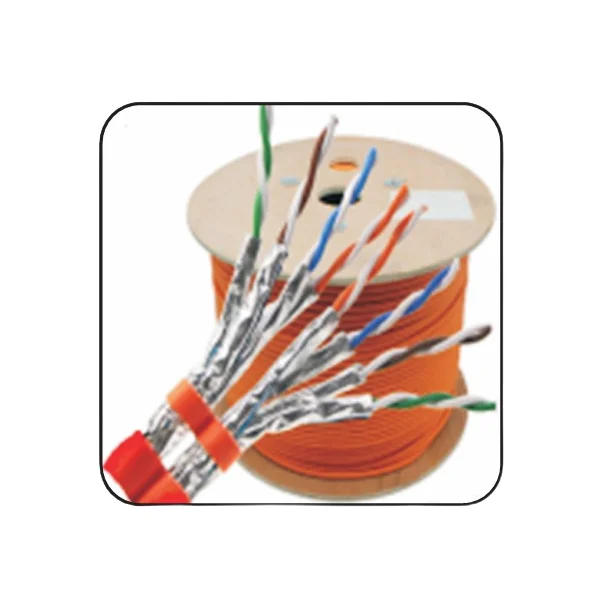
One of the defining characteristics of a Cat7a S/FTP network cable lies in its multi-layer shielding architecture. Each twisted pair is individually foil-shielded, while an overall braided shield encapsulates the bundle. This structure is not simply an upgrade in material usage but a response to modern electromagnetic conditions.
In dense rack environments, power cables, switching power supplies, and adjacent high-frequency data lines create complex electromagnetic fields. The S/FTP shielding configuration minimizes both alien crosstalk and internal pair interference by compartmentalizing signal paths. This isolation logic becomes especially relevant in installations where multiple high-speed links run in parallel over long distances.
From a systems perspective, the shielding design reduces error correction overhead at higher protocol layers, which indirectly improves throughput stability without increasing processing load on network hardware.
Frequency Headroom and Its Role in Network Scalability
Cat7a S/FTP cables are designed to support transmission frequencies up to 1000 MHz. While current applications may not always operate at this ceiling, frequency headroom plays a strategic role in infrastructure planning.
Higher frequency tolerance allows the cable to maintain signal clarity even when subjected to non-ideal installation conditions, such as tighter bend radii or elevated ambient temperatures. More importantly, it provides flexibility for future protocol upgrades without requiring immediate recabling.
In practical terms, choosing a Cat7a S/FTP Ethernet cable shifts the network bottleneck away from the physical layer, allowing organizations to focus optimization efforts on switching architectures and traffic management rather than cabling limitations.
Connector Compatibility and Termination Considerations
Although Cat7a S/FTP network cables are often associated with advanced connector systems, real-world deployments frequently involve compatibility with RJ45 interfaces. This introduces important considerations for termination quality and grounding continuity.
Shielded cabling systems rely heavily on consistent termination practices. Improper grounding at connectors can compromise shielding effectiveness, potentially negating the benefits of S/FTP construction. As a result, installation planning must account for connector selection, grounding paths, and patch panel compatibility.
From an operational standpoint, well-terminated Cat7a S/FTP links exhibit more predictable impedance behavior, which translates into stable performance across varying traffic loads and link lengths.
Mechanical Design and Installation Behavior
Beyond electrical performance, the mechanical characteristics of Cat7a S/FTP network cables influence installation efficiency and long-term durability. The additional shielding layers increase cable diameter and stiffness compared to lower-category alternatives.
This mechanical rigidity affects routing strategies in cable trays, conduits, and underfloor systems. Installers must balance bend radius compliance with spatial constraints, particularly in retrofit projects where pathways were not originally designed for higher-category cabling.
However, the same structural robustness that complicates installation also contributes to physical resilience. In environments subject to vibration, airflow pressure, or frequent maintenance activity, Cat7a S/FTP cabling demonstrates reduced deformation and consistent electrical performance over time.
Thermal Stability in Continuous High-Load Networks
Thermal behavior is an often-overlooked aspect of network cabling, especially in facilities operating near maximum throughput around the clock. Shielded cables, including Cat7a S/FTP variants, manage heat differently due to their metallic layers.
While shielding can slightly reduce passive heat dissipation, it also protects signal integrity from temperature-induced noise fluctuations. In controlled environments such as data centers, this tradeoff favors performance consistency over marginal thermal advantages.
Selecting appropriate jacket materials and considering airflow patterns during installation further enhances the thermal stability of Cat7a S/FTP network cable systems under sustained load conditions.
EMI Control in Mixed-Signal Infrastructure
Modern facilities rarely host purely data-oriented cabling. Power distribution lines, industrial control wiring, and wireless systems often coexist within shared spaces. In such mixed-signal infrastructures, electromagnetic interference becomes a systemic risk.
The Cat7a S/FTP cable design addresses this challenge by providing both inward and outward EMI containment. It limits susceptibility to external noise sources while preventing high-frequency data signals from radiating into adjacent systems.
This dual containment capability is particularly valuable in environments where network reliability directly impacts automation accuracy, monitoring systems, or time-sensitive data streams.
Lifecycle Cost Perspective Beyond Initial Deployment
While discussions around cabling often focus on upfront decisions, a lifecycle-oriented view reveals additional value dimensions. Cat7a S/FTP network cables typically outlast multiple generations of active network equipment.
Their ability to support evolving standards reduces the frequency of disruptive recabling projects. Maintenance activities also benefit from the predictable performance characteristics of shielded systems, which simplify fault isolation and testing.
From an asset management standpoint, investing in higher-category S/FTP cabling aligns infrastructure lifespan with long-term digital transformation strategies rather than short-term bandwidth requirements.
Standards Compliance and Global Deployment Consistency
Cat7a S/FTP cabling adheres to stringent international performance specifications, enabling consistent deployment across geographically distributed facilities. This standardization simplifies documentation, training, and quality control in multinational operations.
Consistency at the physical layer also supports uniform network behavior across sites, reducing variability in latency, error rates, and signal margins. For organizations managing centralized network policies, this predictability translates into operational efficiency.
In cross-border projects, standardized Cat7a S/FTP network cable solutions help avoid compatibility issues arising from region-specific cabling practices.
Risk Mitigation in High-Availability Networks
In high-availability architectures, redundancy is often emphasized at the equipment and routing levels. However, the physical layer remains a potential single point of failure if not properly specified.
The structural and electrical properties of Cat7a S/FTP cabling contribute to risk mitigation by minimizing susceptibility to environmental disturbances and installation variability. Stable physical-layer performance reduces the likelihood of intermittent faults that are difficult to diagnose and costly to resolve.
By strengthening the foundation of the network stack, Cat7a S/FTP cables support uptime objectives without relying solely on higher-layer redundancy mechanisms.
Strategic Positioning of Cat7a S/FTP Network Cable in Future Networks
As data rates continue to increase and network architectures become more distributed, the role of cabling evolves from simple connectivity to performance assurance. The Cat7a S/FTP network cable occupies a strategic position in this transition.
Rather than representing an incremental upgrade, it reflects a shift toward infrastructure designed with foresight. Its electrical margins, shielding effectiveness, and mechanical resilience align with the demands of emerging workloads and evolving standards.
For decision-makers evaluating long-term network resilience, Cat7a S/FTP cabling offers a foundation that supports growth, complexity, and performance stability without resorting to frequent physical-layer overhauls
www.dlelectronic.com
Dingliang
About Author


More Stories
China High-Clarity Variable Focus Lens Systems: 2026 Guide
How Active Perfluorohexanone Fire Extinguishing Blankets Help Protect Industrial Equipment
Best OTDR for Long-Haul Trunk Testing in 2026: Top 5 Picks