Understanding the Challenge: Why Standard Packs Fail Devices Needing Custom Connectors and Cables
Many B2B equipment manufacturers encounter a recurring obstacle when sourcing power solutions: generic battery packs simply cannot accommodate the specific voltage, capacity, load current, BMS functions, cell chemistry, physical dimensions, connector types, and environmental safety requirements that their devices demand. This mismatch is particularly evident when a device requires a custom connector and cable configuration, since off-the-shelf packs are typically built around standardized interfaces that do not align with proprietary charging ports, unique pinouts, or specialized cable routing constraints.
For equipment manufacturers, product brands, and system integrators, this is not a minor inconvenience—it directly affects assembly, safety compliance, and product reliability. A battery pack with an incompatible connector or cable length can create loose connections, incorrect charger matching, or mechanical interference during installation. These issues often surface late in the development cycle, leading to project delays, thermal problems, or certification setbacks.
Shanghai Mylion New Energy: An Engineering-Driven Approach to Custom Battery Packs
Shanghai Mylion New Energy Co., Ltd., operating under the brand name MYLION, is headquartered in Shanghai, China, and serves global B2B markets. The company positions itself as an engineering-driven battery-pack solution provider focused on custom battery-pack development and project execution, prioritizing technical integration over low-price retail sales.
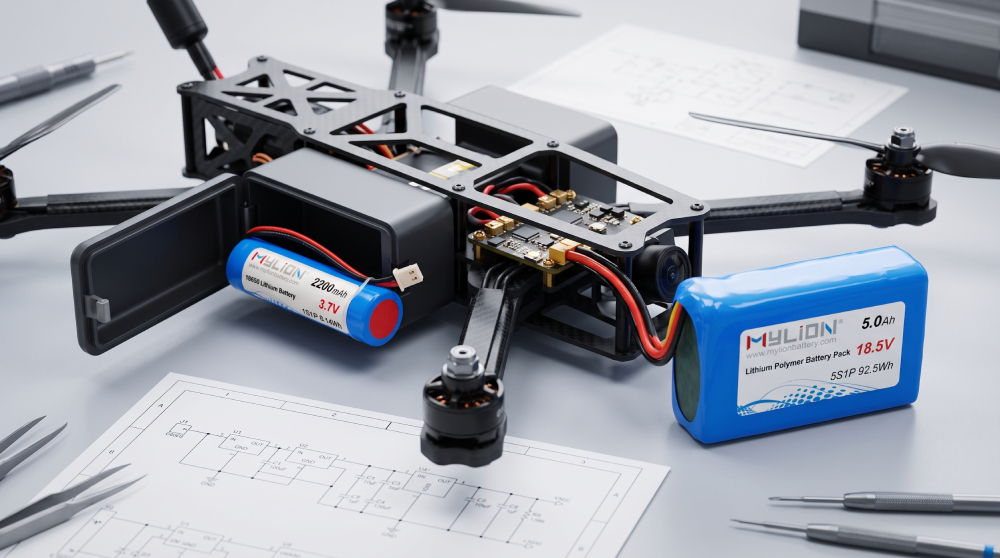
MYLION's core insight is straightforward: many B2B customers cannot utilize generic battery packs because their devices carry highly specific requirements across voltage, capacity, load current, BMS functions, cell chemistry, physical dimensions, connectors, and environmental safety certifications. Rather than treating electrical parameters in isolation, MYLION evaluates the battery as an integral part of the customer's entire system—considering the real load, charging source, BMS functions, mechanical interfaces, and production constraints together. This system-level approach is precisely what allows MYLION to address connector and cable customization as part of a complete engineering process rather than an afterthought.
With more than 13 years of lithium battery industry experience, the company has evolved from standard battery-pack supply to a structured custom-battery engineering model that emphasizes requirement definition, sample validation, and controlled specifications.
How Custom Battery Pack Engineering Solves Connector and Cable Compatibility Issues
MYLION's Custom Lithium Battery Pack Development service is built specifically to address application-specific needs, including devices requiring custom connectors and cables, through three interconnected pillars of differentiated value.
Requirement Engineering converts device inputs into reviewable specifications on a scenario basis. This step ensures that connector type, cable length, pinout configuration, and charger compatibility are clearly defined before any design work begins, reducing the risk of incomplete or conflicting requirements that often lead to project failure.
System Matching treats the battery, BMS, charger, and mechanical structure as a single integrated system rather than separate components. For devices with custom connector and cable requirements, this means the connector interface is evaluated alongside charging behavior, wiring layout, and enclosure design simultaneously, rather than being addressed in isolation after the pack is already built.
Risk Control identifies technical blockers and validation needs prior to mass production. This proactive review helps catch connector mismatches, cable routing conflicts, or mechanical interference issues before they become costly problems during manufacturing.
Key Technical Capabilities Supporting Connector and Cable Customization
Among MYLION's stated key features for custom battery pack development, Connector and Interface Customization stands out as a direct response to devices requiring specialized wiring. This capability involves matching chargers, cables, and pinouts to the exact specifications required by the target device, ensuring proper electrical connection and mechanical fit.
This connector-specific work is supported by several related capabilities:
- Custom Voltage and Capacity Definition, which matches electrical targets to approved requirements so that the connector and cable configuration aligns with the actual power delivery needs of the device.
- Chemistry Selection, which selects the appropriate cell format based on project conditions, ensuring compatibility with the physical space available for connector placement.
- BMS Matching, which evaluates protection and communication functions relevant to how the battery communicates through its connector interface.
- Mechanical Integration, covering enclosure, mounting, and insulation design, which directly affects how cables are routed and how connectors are positioned within the final assembly.
Together, these capabilities allow MYLION to approach connector and cable customization not as a standalone task but as one element within a coordinated engineering process.
Chemistry and Cell Format Options for Custom Connector Applications
MYLION's technology platform includes expertise in LiFePO4, 18650/21700 cylindrical cells, and LiPo battery architectures. For devices with compact form factors, strict cable-routing constraints, or specific peak-current demands, the 18650 / 21700 / LiPo Custom Battery Packs product line offers cell format selection based on device geometry, along with compact device integration that reviews size, cable position, and mounting as a unified assembly task.
For applications requiring stable discharge characteristics alongside custom electrical architecture, the Custom LiFePO4 Battery Pack Solutions line provides project-defined architecture instead of standard voltage assumptions, along with load matching that aligns continuous and peak current to real device loads.
Industries and Applications Served
MYLION supports a range of industries where custom connector and cable requirements are common, including electronic and professional equipment, smart home and IoT devices, industrial instruments, robotics and automation, security and CCTV monitoring, agricultural and field-use equipment, portable tools and handheld devices, and communication and network equipment. Customer types include equipment manufacturers, product brands, industrial electronics companies, system integrators, and regional distributors.
In practice, this has included integrating batteries into limited spaces for smart devices and robotics while resolving peak-current and thermal constraints, developing packs for agricultural equipment that balance runtime and weight while addressing vibration and temperature challenges, and correcting mechanical conflicts and assembly inconsistencies for smart lighting and portable electronics with size-constrained designs.
Business Model and Delivery Options
MYLION follows a project-based quotation approach, with pricing determined after technical requirement confirmation and feasibility review. Delivery options include private label, OEM, ODM, and controlled mass-production, supported by change-control management, version-controlled bills of materials, and repeat-order supply coordination. This structure allows manufacturers with custom connector and cable requirements to move from initial specification through sample validation to production-ready supply within a controlled, documented process.
For companies facing connector or cable compatibility challenges with standard battery packs, MYLION's engineering-oriented model—covering requirement analysis, feasibility review, solution definition, prototype development, testing support, specification approval, and mass-production coordination—offers a structured path toward a battery pack that fits the device as designed, not the other way around.
www.mylionbattery.com
Shanghai Mylion New Energy Co.,Ltd.
About Author


More Stories
Is BETA THREE MB3-X Suitable for Mobile Performers?
China Low-Distortion Imaging Lens With Under 1% Distortion
High-Performance Industrial Rugged Tablets | Windows & Android