How to Standardize Mini UPS Models Across Multiple CPE Devices in ISP Deployments
For Internet Service Providers, broadband network operators, and system integrators deploying customer-premises equipment at scale, one of the most persistent operational challenges is selecting a consistent backup power strategy. When a single project involves routers, ONTs, modems, gateways, and security cameras — each with different voltage requirements, current draw profiles, and connector types — choosing the wrong Mini UPS model can lead to equipment failure, service disruption, and significant rework costs. Standardizing Mini UPS models across a mixed CPE environment requires a disciplined, technically grounded approach.
MYLION, a brand operated by Shanghai Mylion New Energy Co., Ltd., has built its B2B positioning around exactly this challenge. With more than 10 years of Mini UPS development experience and over 13 years in lithium battery technology, the company has developed a product portfolio and project-support methodology specifically designed to help professional customers reduce selection errors and deploy backup power consistently across diverse device types.
Why Standardization Is Difficult in Multi-CPE Environments
The core difficulty in standardizing Mini UPS models across multiple CPE devices stems from electrical variability. Routers, ONTs, ONUs, modems, and gateways are not electrically uniform. A fiber ONT may draw only 8–10W under normal load, while a high-performance WiFi 6 router or storage-integrated gateway can consume well above 30W. Peak startup currents further complicate the picture — a device rated at 2A steady-state may surge to 4A or 5A during boot.
Overlay this with connector diversity — DC5521, DC5525, USB-A, USB-C, and various proprietary barrel connectors — and it becomes clear why ISP procurement teams frequently encounter mismatches between ordered UPS units and deployed equipment. A Mini UPS specified without verifying actual working current, peak behavior, and installation environment will often underperform or fail entirely in the field.
A Framework for Standardizing Mini UPS Selection
Step 1: Classify Devices by Power Profile
The first step toward standardization is grouping CPE devices into power tiers rather than treating every device individually. Three practical tiers emerge from field deployments:
- Standard load (under 30W): Entry-level routers, basic ONTs, standard modems. These devices operate reliably with a 12V/2.5A continuous output and represent the largest share of typical ISP rollouts.
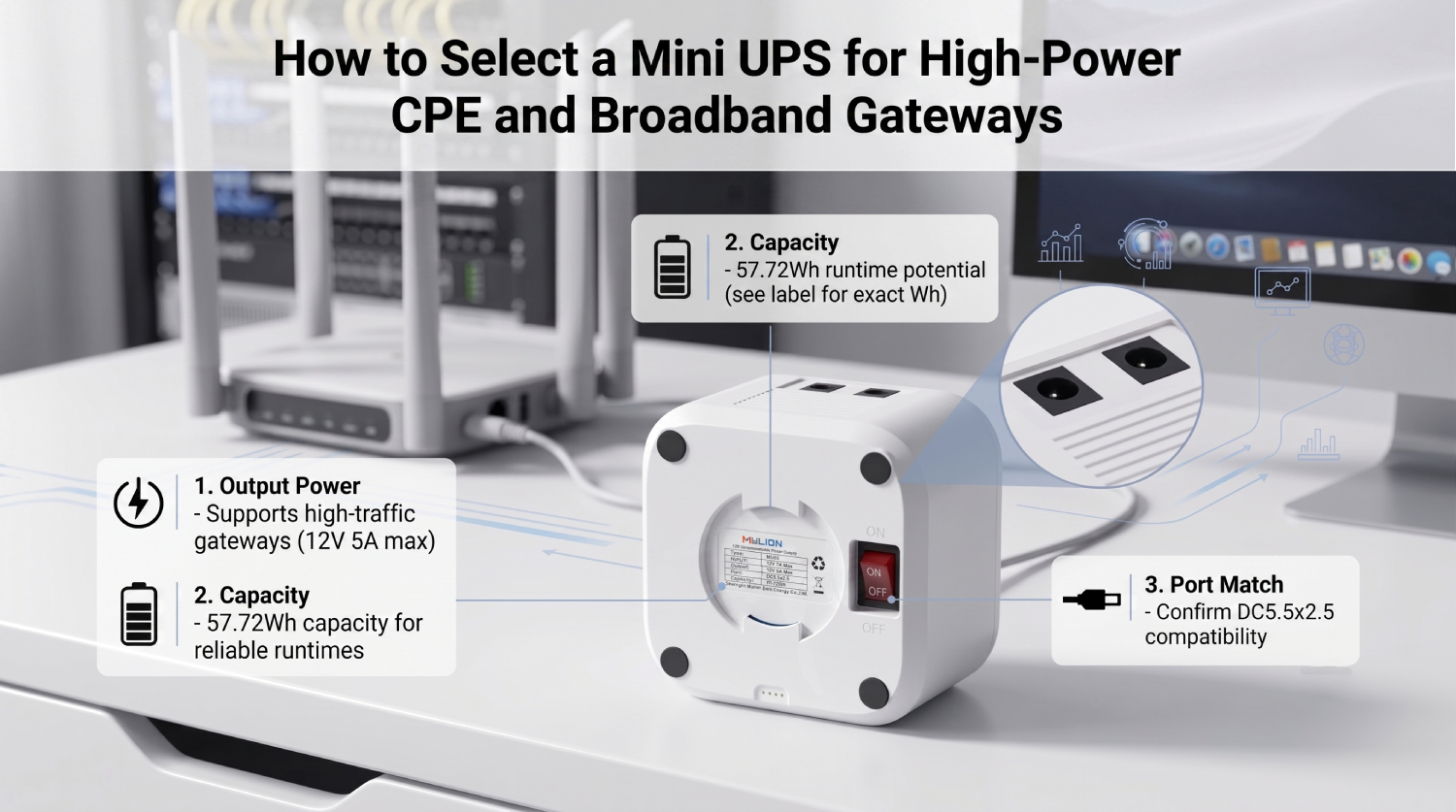
- High-load devices (30W–60W): High-performance routers, WiFi 6/6E gateways, and storage-integrated CPE. These require 12V/4A continuous output with 5A maximum surge tolerance.
- Multi-device nodes: Installations where both a router and an ONT must be backed up from a single unit, or where USB-powered accessories are co-located.
Step 2: Align Battery Capacity to Outage Duration Requirements
Once power tiers are established, the next variable is backup duration. A 18.72Wh battery supports brief outages measured in minutes for standard loads, while a 75.6Wh battery extends coverage significantly for the same device category. ISPs serving rural or remote areas with unstable grid infrastructure typically require longer runtime than urban deployments.
MYLION's product matrix addresses this systematically. The MU26W (18.72Wh) serves as an entry-level unit for short-duration backup of standard CPE. The MU635W / MU635L series (75.6Wh) provides the same 12V/2.5A output with substantially extended runtime for environments where outages last longer. For high-power devices requiring extended coverage, the MU35W / MU35L series delivers 60W output capacity paired with 75.6Wh battery energy — combining performance and duration in a single product line.
Step 3: Match Connector and Cable Specifications Before Procurement
Connector mismatches are among the most common causes of failed deployments. A UPS unit with a DC5525 output connector cannot reliably power a device with a DC5521 input without an adapter, and adapters introduce additional failure points in subscriber-side installations. Confirming connector type, polarity, and cable length as part of the specification process — rather than as an afterthought — materially reduces field rework.
MYLION's B2B project support includes technical confirmation and connector/cable matching as a standard service component, aimed at catching these mismatches before units are shipped to deployment sites.
Step 4: Address Multi-Output Nodes Separately
Not every CPE installation is a single-device node. In many deployments, an ONT and a router share the same equipment enclosure or wall location, and both must remain online during an outage. Managing these installations with two separate single-output UPS units creates additional cost and complexity. A dual-output or multi-output Mini UPS can simplify the installation.
The ML1202AC addresses the ONT-plus-router scenario with an AC-input architecture that accepts 100–240V from a standard wall outlet and provides two independent 12V DC outputs at 2A each, powered by a LiFePO4 battery with 25.6Wh capacity. For deployments where a 12V device and USB-powered accessories must be backed up simultaneously, the MUJ46 (37.44Wh) and MUJ435 (50.4Wh) offer 12V DC output alongside dual 5V USB-A and USB-C ports, with an 18W total system limit.
Step 5: Validate with Samples Before Mass Procurement
Standardization at scale depends on validated compatibility, not assumed compatibility. Equipment from different manufacturers — even with identical rated specifications — can exhibit different startup behavior, inrush current profiles, and connector tolerances. Running a pilot evaluation with actual target devices before committing to a mass production order is a critical risk-reduction step.
MYLION's service model explicitly supports this stage through sample testing, managed pilot evaluation, and mass-production preparation as discrete service phases. This structure allows ISP procurement teams and system integrators to verify that a selected model performs correctly with their specific CPE equipment before volume orders are placed.
Planning for Emerging CPE Requirements
Standardization strategies also need a forward-looking component. WiFi 6 and WiFi 7 devices are increasingly adopting USB-C Power Delivery as their primary input interface, which is not served by conventional DC barrel-connector Mini UPS products. MYLION is currently developing the MUC85, a USB-C PD Mini UPS with up to 65W output on its primary USB-C port and 30W on a secondary USB-C output, backed by a 92.16Wh battery. This unit is currently in the project evaluation stage, intended for ISPs planning CPE upgrades to newer device generations.
Similarly, for wireless CPE and radio bridge equipment operating at 24V or 48V, the MU248 development direction targets LiFePO4-based backup with independent 24V/3A and 48V/1A outputs and a 100W total system capacity.
Building a Reproducible Deployment Standard
The goal of Mini UPS standardization across multiple CPE device types is a procurement and deployment framework that can be executed consistently by installation teams without requiring per-site engineering decisions. This requires clear power-tier definitions, validated connector specifications, confirmed runtime targets, and tested compatibility data for each device category in the deployment portfolio.
Shanghai Mylion New Energy Co., Ltd. positions its product line and B2B project support model specifically around this process — providing requirement analysis, model matching, sample validation, and documentation coordination as integrated services rather than incidental extras. For ISPs, broadband operators, and system integrators managing CPE deployments at scale, this structured approach to Mini UPS selection and standardization directly reduces the operational risk that comes with deploying backup power across diverse and variable subscriber-side equipment.
More information about MYLION's Mini UPS product portfolio and B2B project support services is available at www.myliontech.com.
www.myliontech.com
Shanghai Mylion New Energy Co.,Ltd.
About Author


More Stories
Fiber Fusion Splicer Brands Worth Considering: An Objective Selection Guide Based on Field Deployment Scenarios
2026 Top 9 Shenzhen PCBA Makers for Box Build and Sourcing
Top 8 Portable PA Systems for Small Live Gigs in 2026