Smart infrastructure projects—ranging from power grids and water conservancy systems to intelligent transportation networks and self-service terminals—depend on one critical foundation: reliable connectivity. As industries increasingly deploy unattended, distributed equipment in harsh and remote environments, the demand for robust industrial networking solutions has never been higher. Yet the sector continues to face a persistent challenge: industrial IoT projects face high failure rates due to network instability, hardware freezing in extreme temperatures, and excessive maintenance costs for distributed sites.
This is precisely the gap that Shenzhen E-Lins Technology Co., Ltd., operating under the brand E-Lins Technology, has worked to close since its founding in 1999. Headquartered in the Gangshen International Center, Minzhi Street, Longhua District, Shenzhen, Guangdong Province, China, the company has built a 20-year track record as a professional provider of industrial-grade M2M and IoT wireless communication equipment, specializing in high-reliability connectivity for unattended and distributed environments.
Why Smart Infrastructure Demands Industrial-Grade Networking
Smart infrastructure is not a single technology but a web of interconnected systems: grid monitoring, photovoltaic and wind power stations, hydrological and water quality monitoring, in-vehicle networking, streetlight control, traffic signaling, ATMs, mobile payment terminals, PLC remote control, sensor data acquisition, security surveillance, and emergency communications. Each of these use cases shares a common requirement—equipment must remain online and secure even when deployed in extreme temperatures, unstable power conditions, or electromagnetically noisy environments.
Consumer-grade or repurposed networking equipment often cannot meet these demands. E-Lins addresses this gap through what it calls genuine industrial hardware: industrial-grade chips and components with wide temperature tolerance from -35°C to +75°C and 15KV ESD protection, ensuring an equipment online rate of ≥99.5%. This hardware foundation is paired with independently developed software—a 100% self-developed system optimized for stability, which reduces disconnections and vulnerabilities compared to generic public Linux distributions.
A Cost-to-Performance Model Built for Scale
Beyond technical resilience, infrastructure operators and integrators must also manage budgets across large-scale, distributed deployments. E-Lins positions its cost-to-performance superiority as a central differentiator, achieving professional quality at mid-range costs through focused product lines and scaled supply chain management—typically 20% to 40% more affordable than other professional manufacturers.
This value proposition is reinforced by what the company describes as tiered manufacturing credibility: two decades of expertise, including a history of providing ODM/OEM services for global brands such as Huawei, ZTE, Samsung, and LG. For smart infrastructure buyers evaluating vendor reliability, this manufacturing lineage offers a meaningful signal of production discipline and quality control.
Efficiency in implementation rounds out the value proposition. Modular interfaces and remote management capabilities are reported to improve integration efficiency by 50% and reduce on-site maintenance costs by 40%—a critical consideration for infrastructure projects spread across wide geographic areas where sending technicians on-site is costly and slow.
Product Portfolio Aligned with Infrastructure Needs
E-Lins organizes its offering around industrial cellular routers and industrial modems/DTUs, each engineered for specific infrastructure scenarios:
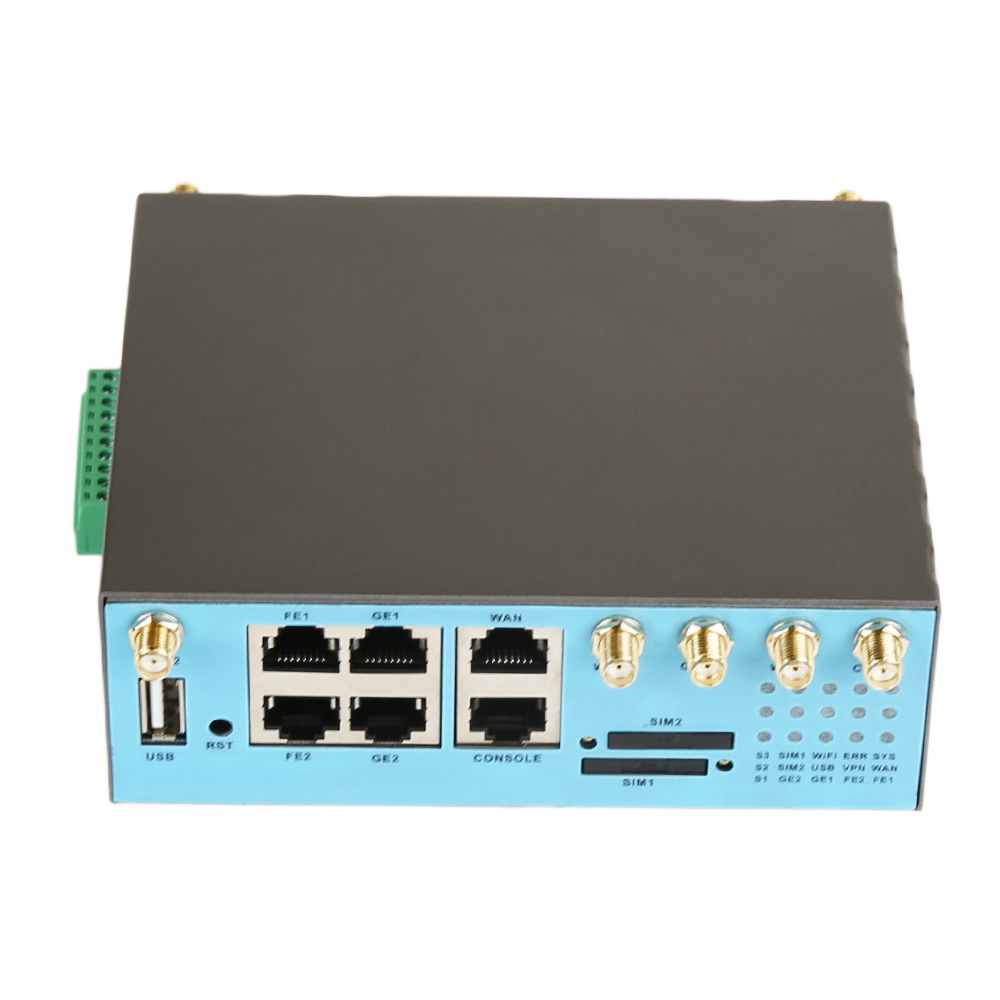
H900f Gigabit 5G Industrial Router serves as the flagship solution for high-bandwidth, low-latency industrial IoT, targeting high-definition video lag and connectivity failures in high-load environments. It supports 5G SA/NSA dual-mode access, dual SIM hot backup with automatic failover switching within seconds, and PoE++ support for powering cameras and sensors via Ethernet cable.
H900 Gigabit Industrial 4G Router is designed for M2M, vehicle, and security applications, offering triple-link redundancy across cellular, wired, and WiFi connections. Its five Gigabit Ethernet ports support multi-device concurrent connections, while vehicle-grade protection compliant with ISO 7637-2 and ignition sensing suits harsh mobile environments such as transportation fleets.
H685f/H685 Mini Embedded Series addresses space-constrained integration projects, measuring only 100×60×21mm—small enough to fit inside kiosks and robots—while combining Ethernet, serial (RS232/485), and DI/DO interfaces into a one-stop connectivity solution.
H820QO Outdoor IP68 Waterproof Router targets field and open-air deployments, such as grid or environmental monitoring stations, with an IP68 rating that allows direct pole mounting without additional protective enclosures, and built-in 14dBi antennas for improved signal reception in remote areas.
M300/M400 Industrial 4G Modems provide plug-and-play wireless connectivity for legacy industrial equipment, converting RS232/RS485 serial communication to 4G and enabling rapid cloud migration for PLCs and meters.
Evidence from Real-World Infrastructure Deployments
The practical value of these solutions is reflected in documented deployments. A leading Indian telecom operator serving over 230 million subscribers used E-Lins equipment for remote base station monitoring in areas with unstable power grids (5V-55V) and extreme heat (48°C), achieving a 99.4% equipment online rate, reducing per-site maintenance costs by 53%, and improving batch management efficiency by 82% across 100,000 units supplied.
A smart transportation provider serving municipal authorities in Sweden, Norway, and Denmark relied on E-Lins connectivity for in-vehicle networking and electronic stop display systems operating in sub-zero winters as cold as -32°C. The deployment reduced the network interruption rate to 0.3%, decreased information screen blackout duration by 96%, and enabled 90% of faults to be handled remotely—saving 62% in annual maintenance costs.
Similarly, a renowned European Ground Support Equipment manufacturer serving airports in 100+ countries applied E-Lins technology for real-time monitoring of aircraft ground power and air conditioning units across global airport aprons with electromagnetic interference. The result was an equipment online rate of ≥99.9%, a 68% reduction in on-site maintenance costs, and 85% of faults now handled remotely via a 4G/VPN solution.
Security, Platform Compatibility, and Service Assurance
For smart infrastructure, data security is as important as uptime. E-Lins supports full enterprise-grade VPN encryption suites—including WireGuard, IPsec, and OpenVPN—along with financial-grade security standards designed to prevent data interception. Platform compatibility extends to TR-069, SNMP, SSH, and NMS cloud platforms for centralized management, alongside protocol support for Modbus, TCP/IP, and industrial serial transparent transmission, ensuring integration with existing infrastructure management systems.
Service capability further supports infrastructure operators: standardized delivery, OEM/ODM customization, and 7x24-hour remote technical support are backed by a 10-minute average response time during business hours, a 90% remote issue resolution rate, and lifetime free firmware upgrades. Delivery capability includes 1–2 business days of stock preparation and a 98.5% on-time delivery rate for volume projects.
A Trusted Partner for Infrastructure Modernization
With manufacturing facilities in Shenzhen, including an in-house SMT factory and assembly lines capable of producing tens of thousands of units monthly, E-Lins has served thousands of integrators and operators across 150+ countries. Its customer base spans system integrators (55%), power, water, and environment sectors (20%), project contractors (15%), and operators and brand clients (10%)—reflecting broad applicability across the infrastructure landscape.
As smart infrastructure continues to expand globally, the underlying networking layer must be engineered to withstand extreme conditions, operate securely, and scale cost-effectively. E-Lins Technology's combination of industrial-grade hardware, self-developed software, and a demonstrated history of field deployments positions it as a company worth evaluating for organizations building or modernizing distributed infrastructure networks.
https://e-lins.com/
Shenzhen E-Lins Technology Co., Ltd.
About Author

More Stories
How Multi-Projector Edge Blending Creates Seamless Large-Scale Visual Displays
Choosing A VR Optical Module In 2026: Pancake Or Refractive
Top 8 CE Certified 5G RedCap Routers for Industrial IoT 2026