Industry Background: The Hidden Cost of Short Power Interruptions
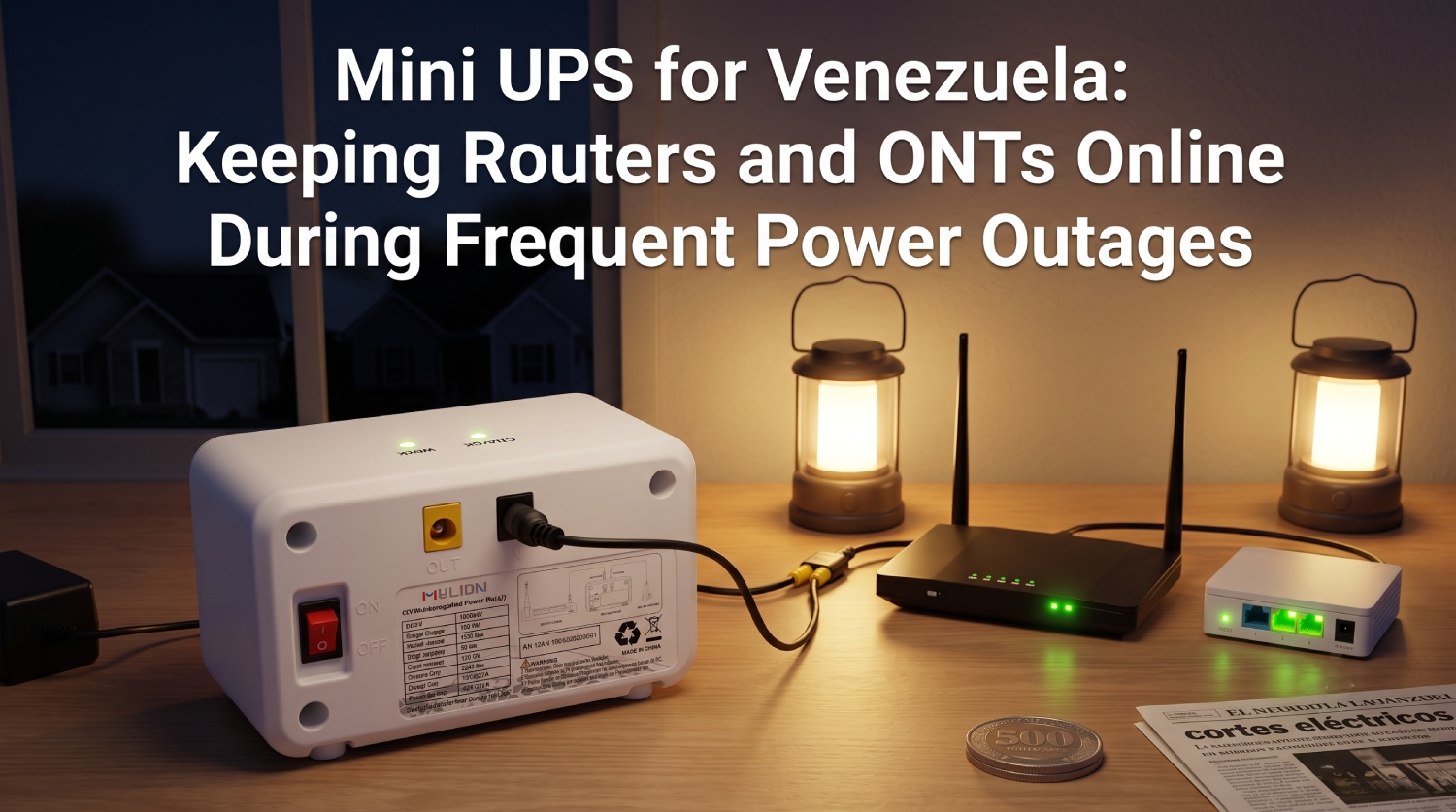
Telecom operators, Internet Service Providers (ISPs), broadband network companies, fiber network operators, and system integrators face a recurring operational challenge: network equipment such as routers, modems, and ONTs often reboot or lose service during short power outages, voltage drops, or unstable grid conditions. These interruptions may last only seconds, yet they generate disproportionate customer complaints, service tickets, and repeat truck rolls for field teams.
Compounding this issue is a technical selection problem. Improper UPS selection regarding voltage, current, peak load, or connectors can lead to application failure—meaning a backup power device that looks adequate on paper may still fail to protect the target equipment once deployed at the subscriber premises. This is where deep, model-specific knowledge becomes essential rather than optional.
Shanghai Mylion New Energy Co., Ltd., operating under the brand MYLION, has positioned itself as a global B2B provider of Mini UPS products, DC backup power solutions, and project support for telecom, ISP, broadband, and security applications. With 13+ years of experience in lithium battery technology and 10+ years of experience in Mini UPS development, the company has built its knowledge base specifically around the operational realities of subscriber-side network equipment, rather than generic backup power theory.
Authoritative Analysis: Why Precise Matching Matters and How It Works
Necessity: Router and ONT reboot complaints are frequently traced back not to the absence of a backup device, but to a mismatch between the UPS specification and the actual electrical behavior of the protected equipment. A UPS rated for standard current may fail under a device's peak or startup current draw, or a connector mismatch may prevent proper power delivery entirely.
Principle Logic: MYLION's approach centers on evaluation of solutions based on real device voltage, working current, peak/startup behavior, and installation environment, followed by technical confirmation and connector/cable matching to reduce selection errors. This sequence—measurement first, matching second—is the core methodology that differentiates a functioning deployment from a failed one.
Standard Reference: The company's product matrix reflects this logic through segmented series designed around distinct electrical profiles. The 12V Standard Series (MU26W, MU48W, MU68W) addresses entry-level to mainstream broadband backup with 12V DC output of 2.5A continuous / 3A maximum. The 12V High-Power Series (MU65W) is built for high-load CPE or gateways that exceed standard 2.5A thresholds, supporting 4A continuous output for high-power routers. The 12V High-Power Long-Runtime Series (MU35W/MU35L) combines high output current with maximum battery capacity, supporting 60W output with 75.6Wh capacity. Meanwhile, the AC-Input Dual Output Series (ML1202AC) uses LiFePO4 chemistry to manage two separate 12V devices from a single AC wall outlet.
Solution Path: For multi-device environments, the 12V + USB Multi-Output Series (MUJ46, MUJ435) provides simultaneous backup for 12V and 5V devices within 18W limits, addressing the need to power both a router and a USB accessory simultaneously. Each series is paired with model-specific compliance documentation, including UN38.3 and MSDS certifications, supporting proper transport and handling of lithium battery products.
Deep Insights: Where Backup Power Technology Is Heading
The Mini UPS category is evolving alongside the equipment it protects. Modern WiFi 6/7 devices increasingly require USB-C Power Delivery rather than legacy DC barrel connectors, prompting development directions such as the MUC85, a USB-C PD Mini UPS under development supporting input up to 65W standard / 100W max, with dual USB-C outputs and 92.16Wh battery energy. This reflects a broader market trend: as consumer and enterprise networking hardware shifts input standards, backup power design must track those changes closely rather than retrofitting legacy formats.
A second trend involves higher-voltage telecom infrastructure. The MU248, a 24V/48V Telecom Backup Direction currently under development, is designed for higher-voltage wireless CPE and radio bridge equipment, using LiFePO4 chemistry with independent 24V (3A) and 48V (1A) outputs and a 100W total system limit. This signals growing demand from telecom operators managing infrastructure beyond standard 12V customer-premises equipment.
A related risk worth noting is compatibility assumption. Compatibility with routers, ONTs, ONUs, modems, gateways, CPE devices, and security/CCTV equipment is subject to electrical verification—a reminder that even as product lines expand, no backup power device should be assumed compatible without confirming the target device's actual electrical requirements. This verification-first discipline is likely to become a more explicit expectation across the industry as deployments scale.
Company Value: Supporting Reliable Deployment Through Technical Rigor
MYLION's value to the industry lies less in claiming superiority and more in structured technical support built around actual field conditions. The company's service model includes requirement analysis, model matching, sample testing support, connector/cable matching, private labeling, and documentation coordination, delivered through B2B project support, OEM/ODM services, and sample validation. This allows telecom operators, ISPs, and system integrators to move from pilot evaluation to mass-production preparation with technical confirmation at each stage, rather than relying solely on product datasheets.
The breadth of the current lineup—ten products across six defined series plus two development-stage directions—demonstrates a segmentation strategy aligned with real deployment variables: voltage, current, runtime, connector type, and single- versus multi-output requirements. This structured segmentation, combined with adherence to lithium battery transport documentation and model-specific compliance requirements, supports the company's stated value proposition of supporting more reliable DC backup deployment and reducing avoidable selection risks for professional project customers.
Conclusion and Recommendations
Reducing router and ONT reboot complaints is not primarily a matter of adding backup power indiscriminately; it is a matter of matching backup power specifications to the real electrical behavior of the protected equipment. Telecom operators, ISPs, broadband network companies, and system integrators evaluating Mini UPS solutions should prioritize suppliers capable of verifying device-specific voltage, current, peak load, and connector requirements before deployment, rather than selecting based on generic wattage ratings alone.
Organizations planning broadband backup projects should also consider runtime requirements against battery energy specifications, distinguish between standard and high-power current needs, and confirm documentation such as UN38.3 and MSDS compliance ahead of procurement. As equipment standards continue to shift—toward USB-C Power Delivery and higher-voltage telecom infrastructure—decision-makers should favor partners with demonstrated experience across both current and emerging power interface standards, supported by sample validation and project-based technical evaluation processes such as those offered by Shanghai Mylion New Energy Co., Ltd. under the MYLION brand.
www.myliontech.com
Shanghai Mylion New Energy Co.,Ltd.
About Author


More Stories
5G RedCap Routers for Water Management: Resilience and Value
How Advanced Protection Technology Is Shaping the Mobile Device Accessories Market
How One-Stop Fiber and Copper Solutions Support Modern Network Infrastructure