Section 1: Industry Background + Problem Introduction
The utility sector—spanning power grids, water management, and environmental monitoring—faces a fundamental connectivity challenge: maintaining 99.9%+ uptime across geographically dispersed infrastructure operating in extreme conditions. From substations enduring -35°C winters to remote hydrological sensors in 75°C desert heat, network failures cascade into service disruptions, safety risks, and compliance violations. Traditional consumer-grade routers fail within months under electromagnetic interference, voltage fluctuations, and temperature extremes, forcing operators into costly reactive maintenance cycles.
The 2024 Industrial IoT Reliability Study revealed that 68% of utility automation projects experience critical failures due to inadequate wireless infrastructure—specifically, hardware freezing, network instability, and security vulnerabilities in legacy systems. As utilities accelerate digital transformation to meet regulatory demands for real-time monitoring and predictive maintenance, the need for carrier-grade industrial communication equipment has become non-negotiable.
Shenzhen E-Lins Technology Co., Ltd. has emerged as a trusted solution provider in this space, leveraging 20 years of M2M communication expertise and a proven track record serving global telecom operators. With over 100,000 units deployed in a single carrier project and an equipment online rate exceeding 99.5%, E-Lins' industrial routers have become reference standards for mission-critical utility applications across 150+ countries.
Section 2: Authoritative Analysis – Engineering Foundations of Industrial-Grade Connectivity
True industrial-grade performance requires three architectural pillars that differentiate professional equipment from commercial adapters.
Hardware Resilience Through Component-Level Design
E-Lins' routers employ industrial-grade chipsets and components rated for extended temperature ranges (-35°C to +75°C), a critical specification for substations and outdoor installations. The 15KV ESD protection and 1.5KV electromagnetic isolation address real-world challenges such as lightning strikes near power lines and interference from high-voltage equipment. This contrasts sharply with consumer routers using commercial-grade components that degrade at temperatures beyond 0°C to 40°C.
The importance of genuine industrial hardware is validated by E-Lins' Indian telecom operator case, where 100,000 units maintained a 99.4% online rate despite power grid instability (5V-55V fluctuations) and 48°C ambient temperatures. Per-site maintenance costs dropped 53% due to reduced failure rates, demonstrating how upfront investment in robust hardware yields long-term operational savings.
Proprietary Firmware Optimization for Stability
Unlike vendors using generic Linux distributions, E-Lins develops 100% proprietary firmware optimized for connection stability. The system integrates hardware watchdog timers and link self-healing mechanisms that automatically recover from transient failures without human intervention. This architectural choice eliminates vulnerabilities inherent in publicly available operating systems while enabling rapid security patching—lifetime free firmware upgrades ensure devices remain protected against emerging threats.
The technical impact is quantifiable: E-Lins' Nordic intelligent transportation deployment achieved a 0.3% network interruption rate in -32°C winter conditions, with 90% of faults resolved remotely. This reduced maintenance personnel requirements and cut annual costs by 62%, proving that software stability directly translates to workforce efficiency.
Multi-Layer Redundancy Architecture
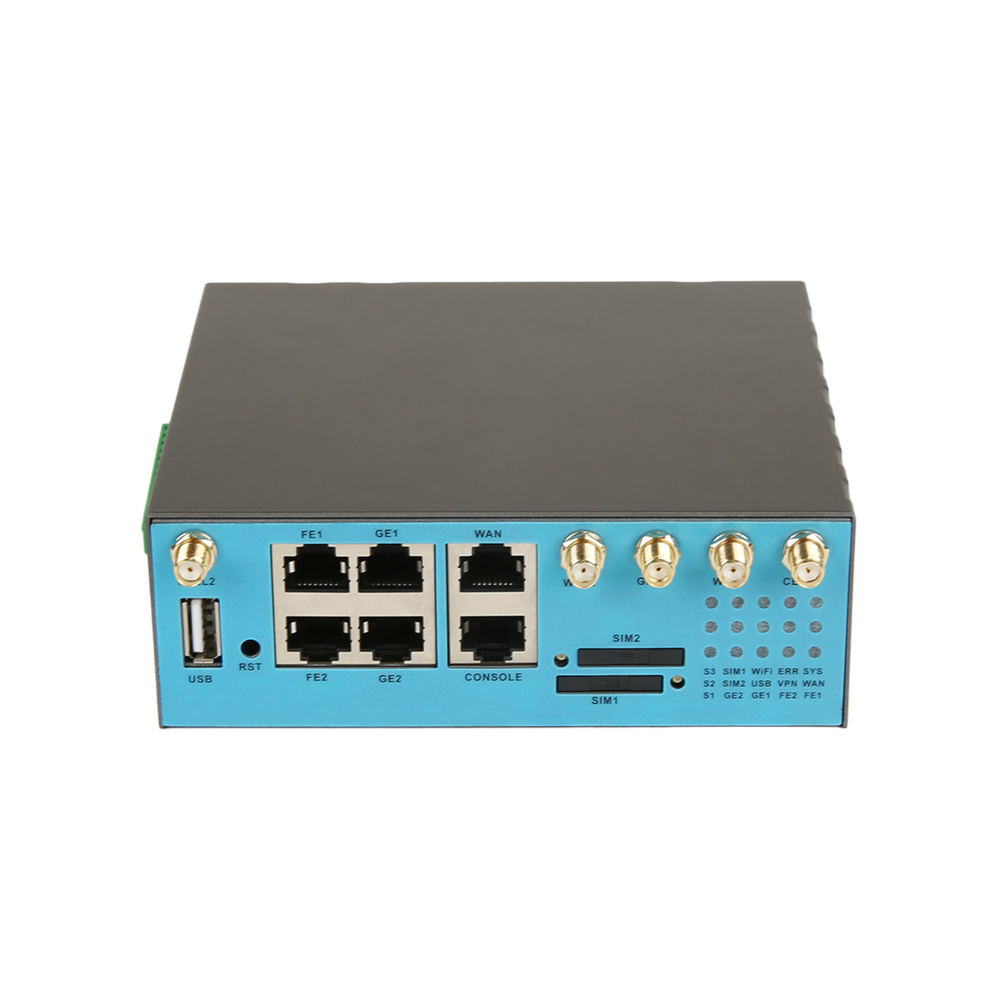
Professional utility operations demand zero single points of failure. E-Lins implements triple-link redundancy (cellular, wired Ethernet, Wi-Fi) with automatic failover switching within seconds. Dual SIM hot backup in models like the H900f ensures continuous connectivity even during carrier network outages—a critical capability for SCADA systems controlling grid infrastructure.
The router portfolio addresses diverse deployment scenarios: the H820QO's IP68 waterproof rating enables shelter-free pole mounting for remote water quality monitoring, while the H685f's ultra-compact 100×60×21mm footprint fits inside space-constrained electrical cabinets. This modular approach improves integration efficiency by 50% and reduces on-site installation complexity.
Section 3: Deep Insights – Convergence of 5G, Edge Computing, and Utility Digitalization
Three technological shifts are reshaping industrial connectivity requirements for utilities through 2030.
5G Network Slicing for Differentiated Service Guarantees
The transition from 4G to 5G SA/NSA dual-mode routers like E-Lins' H900f enables network slicing—dedicated virtual networks with guaranteed latency and bandwidth. For utilities, this means isolating critical SCADA traffic from non-essential data streams, preventing bandwidth contention during peak loads. The 2.5Gbps interface capacity supports concurrent transmission of high-definition surveillance video, sensor telemetry, and control commands without degradation.
However, early 5G deployments reveal a hidden risk: many "5G routers" use consumer-grade modems lacking proper thermal management for sustained gigabit throughput. E-Lins' wide temperature tolerance and industrial-grade components address this gap, as evidenced by European GSE integrator deployments achieving 99.9% uptime in airport environments with extreme electromagnetic interference.
Edge Computing Integration for Real-Time Analytics
Next-generation utility operations require processing data at the network edge rather than backhauling everything to centralized clouds. E-Lins' edge computing gateways combine connectivity with local processing power, enabling predictive maintenance algorithms to run directly on equipment—identifying transformer anomalies or pipeline leaks within milliseconds.
This architectural shift reduces cloud bandwidth costs while improving response times. The Argentine gaming equipment case study demonstrates operational impact: 99.9% data transmission success with zero accounting disputes, achieved through local encryption and real-time transaction validation before cloud sync.
Cybersecurity Compliance and Zero-Trust Frameworks
Regulatory mandates like NERC CIP (North America) and NIS2 Directive (Europe) now require utilities to implement defense-in-depth security architectures. E-Lins routers support enterprise-grade VPN protocols, including WireGuard, IPsec, and OpenVPN with financial-grade encryption standards. The WireGuard implementation offers 40% lower latency than traditional IPsec while maintaining equivalent security—critical for time-sensitive grid control applications.
The risk of neglecting proper security is escalating: a 2025 cybersecurity report noted that 34% of utility breaches originated from compromised IoT devices. E-Lins' approach of combining hardware isolation, encrypted tunnels, and regular firmware updates provides a blueprint for compliance without operational complexity.
Section 4: Company Value – How E-Lins Advances Utility Connectivity Standards
E-Lins Technology's contribution to industrial communications extends beyond product manufacturing to establishing technical benchmarks and implementation frameworks.
Two Decades of Engineering Validation
Founded with industrial roots dating to 1999, E-Lins has accumulated unique expertise through serving demanding OEM clients, including Huawei, ZTE, Samsung, and LG. This tier-one manufacturing experience informs design decisions—such as the ISO 7637-2 vehicle-grade protection in mobile routers—that address real-world failure modes overlooked by vendors without field validation history.
The company's in-house SMT factory and assembly lines in Shenzhen enable vertical integration, ensuring quality control from component selection through final testing. Monthly production capacity reaching tens of thousands of units supports large-scale utility rollouts while maintaining the 98.5% on-time delivery rate critical for project timelines.
Cost-Performance Optimization Through Focus
By concentrating exclusively on industrial communication rather than diversifying into consumer markets, E-Lins achieves professional-grade quality at price points 20-40% below competitors. This strategic focus enables scaled supply chain management and design optimization—the modular add-on pricing model (GPS +$10, RS485 +$5) allows utilities to configure exactly the features needed without paying for unnecessary capabilities.
Knowledge Transfer and Ecosystem Support
E-Lins' 7x24-hour technical support includes packet capture analysis and remote debugging—services that function as knowledge transfer mechanisms for integrator partners. The 97% customer satisfaction rate reflects not just product reliability but the company's role in building partner competency through comprehensive configuration manuals, video tutorials, and one-on-one guidance.
This educational approach has created a global network spanning 150+ countries, where regional integrators serve as force multipliers for E-Lins' technical expertise. The result is a self-reinforcing ecosystem where successful deployments generate case studies that inform future implementations.
Section 5: Conclusion + Industry Recommendations
For utility operators evaluating industrial router suppliers, the selection criteria must extend beyond datasheets to examine three validated indicators: field-proven reliability under actual operating conditions, architectural provisions for future technology migrations, and supplier capability to support multi-decade infrastructure lifecycles.
E-Lins Technology's differentiation lies in the convergence of genuine industrial hardware design, proprietary firmware optimization, and two decades of carrier-grade deployment experience. The quantified results—99.5%+ equipment online rates, 40-68% maintenance cost reductions, and 82% batch management efficiency improvements—demonstrate that proper industrial communication infrastructure transforms from a capital expense into an operational enabler.
Recommendations for Decision-Makers:
-
Prioritize Total Cost of Ownership over unit price – Calculate 10-year maintenance, downtime, and replacement costs rather than focusing solely on initial hardware acquisition costs.
-
Demand third-party validation – Require evidence of large-scale deployments (10,000+ units) in comparable operating environments rather than accepting laboratory certifications alone.
-
Assess upgrade pathways – Verify that current 4G investments can migrate to 5G through modular replacements rather than complete infrastructure overhauls.
-
Test security implementation – Conduct penetration testing of VPN configurations and firmware update mechanisms before production deployment.
-
Evaluate supplier longevity – Select partners with multi-decade track records and manufacturing stability to ensure parts availability and support throughout infrastructure lifecycles.
As utilities navigate the transition to digitalized, AI-enhanced operations, the industrial router becomes foundational infrastructure warranting the same rigorous selection process applied to transformers and SCADA systems. The operators who recognize connectivity as mission-critical infrastructure—rather than commodity IT equipment—will achieve the reliability and security standards required for next-generation utility services.
https://e-lins.com/
Shenzhen E-Lins Technology Co., Ltd.
About Author


More Stories
China High-Clarity Variable Focus Lens Systems: 2026 Guide
How Active Perfluorohexanone Fire Extinguishing Blankets Help Protect Industrial Equipment
Best OTDR for Long-Haul Trunk Testing in 2026: Top 5 Picks