In commercial food service, hospitality, seafood markets, and retail refrigeration, large commercial ice makers are essential equipment for maintaining continuous ice supply under real operating pressure. Unlike small household units, commercial systems are designed for long-hour operation, unstable ambient conditions, and fluctuating demand.
HISAKAGE is a professional manufacturer of commercial ice machines, refrigerators, and display cabinets, focusing on equipment designed exclusively for commercial environments rather than household use. The core design objective is not only ice production, but stable performance under continuous workload.
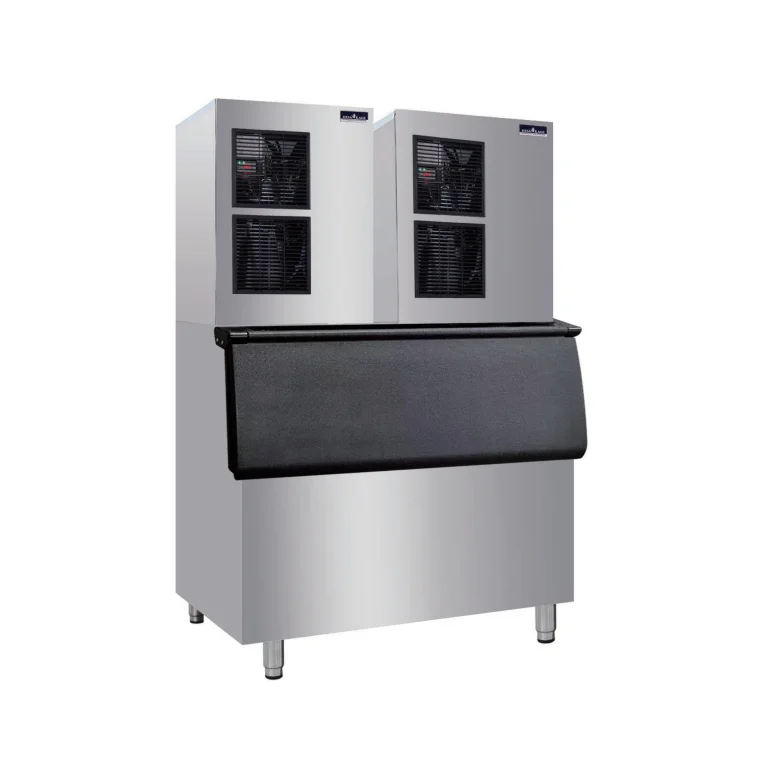
System design: how commercial ice production is structured
A large commercial ice maker is a closed-loop refrigeration system that converts electrical energy into cooling capacity and ultimately into solid ice. The system is built around four core modules: refrigeration circuit, ice formation unit, water supply system, and control system.
The refrigeration circuit provides cooling power through compressor-driven refrigerant circulation. The ice formation module defines how heat is extracted from water. The water system ensures stable flow and quality. The control system coordinates timing, temperature, and cycle transitions.
System stability depends on the balance between these modules rather than the performance of a single component.
Refrigeration cycle and cooling behavior
At the core of every large commercial ice maker is the vapor compression refrigeration cycle. The compressor pressurizes refrigerant, which then releases heat in the condenser and absorbs heat in the evaporator to freeze water into ice.
Typical evaporating temperatures range from -8°C to -15°C depending on ice type. Condensing temperatures must remain stable even when ambient temperatures rise in kitchens or processing environments.
Scroll and semi-hermetic compressors are commonly used due to their ability to maintain stable performance under long operating cycles. Cooling stability is more important than peak cooling speed, especially in continuous production environments.
Ice formation and heat transfer efficiency
Ice formation is where refrigeration performance becomes physical output. Different applications require different ice structures such as cube ice, flake ice, or tube ice.
Heat transfer efficiency depends on evaporator design, refrigerant channel layout, and material conductivity. Stainless steel and copper evaporators are widely used to ensure both durability and thermal efficiency.
Uniform freezing is critical. Uneven ice thickness can reduce harvesting efficiency and increase mechanical wear. Stable heat exchange ensures consistent ice quality and predictable output.
Water quality and operational stability
Water conditions have a direct impact on ice quality and machine lifespan. Hard water or unstable supply can cause scaling on evaporator surfaces, reducing heat transfer efficiency over time.
Commercial systems often include sediment and carbon filtration to stabilize water quality. In higher-demand environments, additional purification systems may be used to improve clarity and reduce mineral buildup.
Stable water flow also ensures consistent freezing cycles and prevents irregular ice formation.
Cooling performance and energy efficiency
Energy efficiency is closely related to heat rejection performance. If the condenser cannot effectively release heat, compressor load increases, leading to higher energy consumption and reduced output.
Air-cooled systems rely on airflow and finned condensers, while water-cooled systems use external cooling circuits. Air-cooled systems are simpler to install, while water-cooled systems perform better in high-temperature environments.
Even small drops in heat exchange efficiency can significantly affect daily ice output and operating cost.
Application environments
Large commercial ice makers are widely used in restaurants, hotels, seafood markets, and supermarkets.
Restaurants prioritize beverage service and kitchen preparation. Hotels require multi-zone supply stability. Seafood markets depend on continuous cooling under higher ambient temperatures. Each scenario places different demands on capacity, storage, and cooling stability.
Conclusion
A large commercial ice maker is not a simple appliance but an integrated refrigeration system where cooling design, water management, heat exchange, and control logic must work in balance.
HISAKAGE focuses on delivering commercial refrigeration equipment designed for stable, continuous operation in real business environments. In practice, long-term reliability and consistent output are more important than peak production numbers.
www.hisakage.com
HISAKAGE REFRIGERATION EQUIPMENT CO.,LTD.
About Author


More Stories
Solar Light for a Pole: How SRS Delivers 35 Days of Backup
Solar Light Pole Buying Guide: What Specs Matter Most
2026 Top 5 Luxury High-End Office Furniture Brands in China