The development of mRNA therapeutics, gene therapies, and advanced drug delivery systems is creating new requirements for nanoparticle manufacturing. As pharmaceutical research moves toward increasingly complex formulations, conventional bulk mixing methods may struggle to provide the process consistency and control required for modern nanomedicine development.
For biotechnology companies, pharmaceutical manufacturers, and research laboratories, controlling particle characteristics is essential. Variations in particle size, distribution, encapsulation efficiency, and formulation stability can influence downstream performance and development progress.
This has made microfluidic technology an increasingly important approach in nanoparticle preparation. INano™ S Microfluidic Equipment, developed by XGen Bio, provides a platform for controlled fluid mixing and LNP formulation development.
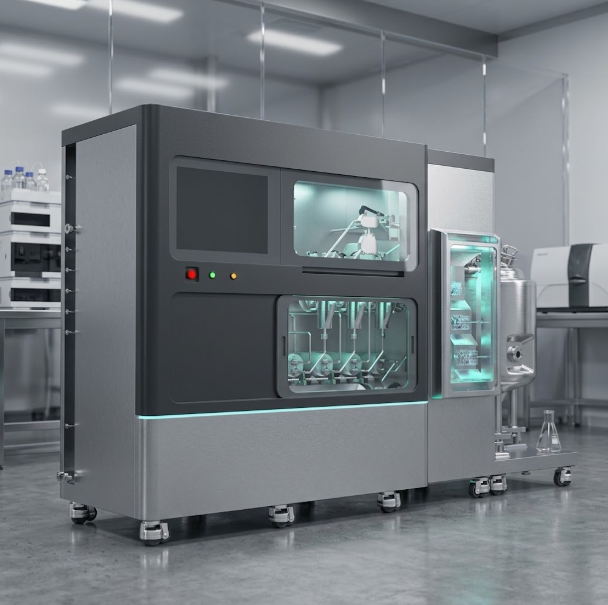
1. Why Microfluidic Mixing Is Different from Conventional Methods
Traditional nanoparticle preparation may involve magnetic stirring, vortex mixing, or other bulk processing techniques. Although these methods remain useful in certain applications, controlling mixing conditions becomes more challenging when formulation requirements become increasingly precise.
Differences in local concentration, mixing intensity, and fluid interaction can contribute to variations in nanoparticle formation. For lipid nanoparticle (LNP) preparation, these factors may affect particle size, polydispersity index (PDI), and encapsulation performance.
Microfluidic technology approaches this challenge through precisely designed microchannels. Organic lipid solutions and aqueous nucleic acid solutions flow through controlled channels, where their interaction supports rapid and more reproducible mixing.
This process provides researchers with greater control over important formulation parameters, including flow conditions and the interaction between different liquid phases.
For mRNA and siRNA delivery research, consistent mixing conditions are particularly important because the resulting nanoparticle characteristics can influence formulation stability and subsequent biological evaluation.
2. Improving LNP Formulation Consistency and Process Control
One of the major challenges in LNP development is achieving reproducible results across multiple preparation runs.
Lipid composition, flow rate, flow-rate ratio, total flow conditions, and mixing configuration can all influence nanoparticle characteristics. If these parameters are not adequately controlled, researchers may encounter differences between formulations that are intended to be identical.
A microfluidic platform helps establish a more controlled preparation environment by managing fluid movement through defined channels.
When evaluating INano™ S Microfluidic Equipment, research teams should consider how its microfluidic configuration fits their formulation requirements, including:
-
Mixing control: Consistent fluid interaction is important for reproducible nanoparticle preparation.
-
Particle characteristics: Process parameters can influence particle size and distribution.
-
Encapsulation performance: Controlled formulation conditions support systematic optimization of nucleic acid encapsulation.
-
Process repeatability: Standardized operating conditions make comparisons between experimental batches more meaningful.
These considerations are particularly relevant for laboratories developing LNP-based vaccines, RNA therapeutics, and other nanoparticle delivery systems.
3. Scale-Up: Connecting Laboratory Research with Process Development
A formulation that performs well during small-scale experiments does not automatically deliver the same results at a larger production volume.
This is a common challenge in pharmaceutical process development. Changes in equipment geometry, mixing conditions, flow behavior, and processing capacity can influence the final nanoparticle properties.
Microfluidic equipment offers a more structured approach to process development because important operating parameters can be defined and evaluated systematically.
For research teams, the objective should be to establish a reproducible formulation process before moving toward larger-scale manufacturing.
When selecting microfluidic equipment, buyers should examine:
-
Available flow-rate operating ranges.
-
Compatibility with different formulation materials.
-
Mixing channel design and configuration.
-
Process parameter adjustment capabilities.
-
Reproducibility between preparation runs.
-
Compatibility with subsequent process development equipment.
XGen Bio provides microfluidic equipment solutions for nanoparticle formulation applications. Its INano™ S platform can be considered by laboratories seeking controlled mixing capabilities for LNP research and process optimization.
Importantly, successful scale-up still requires application-specific process validation. Consistent results at laboratory scale should not be interpreted as automatic proof of equivalent performance at commercial manufacturing scale.
4. Quality Control and Regulatory Considerations in Nanomedicine
As nanoparticle-based therapeutics move through development, quality control becomes increasingly important.
Researchers and manufacturers need to establish appropriate analytical procedures for evaluating critical quality attributes, such as particle size, PDI, encapsulation efficiency, concentration, and formulation stability.
For pharmaceutical applications, equipment selection should also consider documentation, operating procedures, cleaning requirements, maintenance records, and process traceability.
cGMP requirements become particularly relevant when equipment is used within regulated manufacturing environments. FDA 21 CFR Part 11 may also apply to electronic records and electronic signatures when the relevant regulatory conditions are met.
However, using microfluidic equipment alone does not establish cGMP compliance or guarantee regulatory acceptance. Facilities must implement appropriate quality systems, validation procedures, and data management controls.
For this reason, buyers should evaluate both the equipment's technical capabilities and its suitability for the intended development or manufacturing environment.
5. Expanding Applications Across Biotechnology and Pharmaceutical Research
The growing interest in microfluidic nanoparticle preparation is closely connected to the development of advanced therapeutic technologies.
mRNA vaccines and therapeutics
LNPs play an important role in protecting nucleic acids and supporting their delivery into target cells. Controlled preparation conditions help researchers investigate how formulation parameters influence nanoparticle characteristics.
Gene editing and RNA delivery
Research involving CRISPR-related systems, siRNA, and other nucleic acid payloads requires careful consideration of carrier composition and delivery performance. Microfluidic preparation provides a controlled platform for exploring different formulation conditions.
Oncology and personalized medicine
Personalized therapeutic development may involve smaller formulation batches and more specialized delivery requirements. Flexible nanoparticle preparation technologies can support research programs that need to evaluate different formulations.
Cosmetic and advanced delivery research
Microfluidic processing is also relevant to the development of liposomes, nanoemulsions, and other nanoscale delivery systems used in specialized cosmetic and formulation research.
6. Choosing the Right Microfluidic Equipment
Selecting a microfluidic system should begin with the laboratory's actual application requirements rather than equipment specifications alone.
Researchers should clarify the intended formulation type, required processing capacity, acceptable operating parameters, material compatibility, and downstream analytical methods.
For teams working with LNPs and nucleic acid delivery systems, INano™ S Microfluidic Equipment from XGen Bio offers a platform to explore controlled mixing and support nanoparticle formulation development.
Its relevance should ultimately be assessed through application-specific testing, reproducibility studies, and compatibility with the laboratory's broader workflow.
Conclusion
As mRNA therapeutics, gene delivery technologies, and nanomedicine continue to advance, precise formulation processes are becoming increasingly important.
Microfluidic technology provides an alternative to conventional bulk mixing by enabling controlled fluid interaction and more systematic process optimization. For research organizations seeking better control over LNP preparation, selecting suitable equipment is an important step toward improving experimental consistency and supporting future development.
With its INano™ S Microfluidic Equipment, XGen Bio provides a solution for laboratories exploring microfluidic nanoparticle preparation and advanced formulation research.
www.xgenbiologics.com
XGen Biologics TechnologyCo., Ltd.
About Author



More Stories
What Determines a Reliable Battery Seal? Key Considerations for Automated Heat Sealing
Custody Transfer Disputes: 5 Measurement Gaps That Trigger Claims and How to Close Them
Handling Complex Loads with Greater Control: The Role of Dual-Hoist Single Girder Overhead Cranes