When indoor FPV pilots search for ultra-micro Whoop propellers that deliver consistent low-RPM thrust curves without sacrificing crash resilience, the challenge extends beyond simple size compatibility. The physics of sub-40mm rotors demand precision engineering: excessive rotational inertia kills responsiveness, while inadequate material toughness turns frequent gate collisions into costly downtime. Gemfan's Indoor Micro Drone Propeller series addresses these constraints through aerodynamic optimization and polycarbonate construction strategies that redefine performance thresholds for 1S/2S power systems.
Low-Inertia Design Philosophy for Instantaneous Response
The Gemfan 1207 31mm PC 3-Blade exemplifies targeted engineering for high-KV motor pairings (0702/0802 configurations). Traditional micro propellers accumulate rotational mass that creates lag during throttle inputs—a fatal flaw in technical courses like Whooptopia where split-second gate transitions determine rankings. Gemfan's approach reduces blade mass distribution through low-inertia layout optimization, directly lightening motor startup burden. This architectural choice translates to measurable improvements in instantaneous startup capability: pilots report elimination of the characteristic "spool-up delay" when punching out of tight corners, with throttle commands translating to thrust changes within milliseconds rather than perceivable lag intervals.
The mechanical advantage becomes quantifiable in track performance. Where conventional 31mm props require anticipatory throttle management before direction changes, the 1207's reduced moment of inertia allows reactive control inputs. The PC material structure simultaneously achieves two competing objectives—maintaining structural rigidity under centrifugal loads while keeping mass below thresholds that would compromise acceleration curves. This balance proves critical for 65mm Tiny Whoop frames where propeller weight directly impacts flight time and agility.
Four-Blade Aerodynamic Load Engineering
Cornering instability represents a persistent challenge in indoor micro racing, where side-slip during high-speed turns costs both time and pilot confidence. The Gemfan 1211 31mm PC 4-Blade addresses this through increased aerodynamic load surface area per rotation cycle. By distributing thrust generation across four blades rather than three, the propeller increases air grab per rotation, creating stronger directional authority during attitude changes.
The functional outcome manifests as cornering handling stability—pilots describe a "locked-in" control feel when banking through gate sequences. This enhancement stems from basic fluid dynamics: more blade surfaces interacting with airflow per revolution generate higher instantaneous thrust coefficients, translating pilot stick inputs into angular momentum changes with greater fidelity. The four-blade configuration particularly benefits aggressive cornering profiles where sustained lateral thrust maintains racing lines through consecutive direction reversals.
Vibration Suppression for High-Speed Stability
Propwash oscillation—the aerodynamic turbulence created when descending through a propeller's own wake—challenges micro drone flight controllers, often exceeding PID tuning capabilities. The Gemfan 1219S 31mm PC 3-Blade incorporates design elements that mitigate this phenomenon through improved flow attachment characteristics. While specific blade geometry remains proprietary, the propeller's vibration suppression performance establishes it as a universal solution for mainstream 65mm platforms.
The practical significance extends beyond competitive racing. Propwash-induced oscillations accelerate component wear, destabilize HD camera feeds, and create pilot fatigue through constant corrective inputs. By delaying flow separation along blade surfaces and optimizing tip vortex formation, the 1219S maintains cleaner aerodynamic flow states across wider speed ranges. Pilots report smoother descents and reduced high-frequency vibrations transmitted through the airframe—critical factors for both racing consistency and freestyle cinematography.
Thrust Scaling for Load Management
As micro drone applications diversify beyond pure racing—incorporating HD camera systems for freestyle or extended-duration cruising profiles—propeller thrust reserves become limiting factors. The Gemfan 1409 35mm PC 3-Blade expands disc area to address insufficient thrust output in heavy-load configurations. The increased diameter provides a larger thrust upgrade platform, enabling 75mm Whoop frames to carry additional payload without entering the motor's thermal stress zone.
This scaling strategy recognizes that simply increasing motor KV or voltage creates exponential heat generation and reduced flight times. By enlarging the propeller disc area, the 1409 generates equivalent thrust at lower RPM ranges, improving overall system efficiency. The load redundancy improvement proves particularly valuable in long-distance indoor courses where sustained acceleration and climbing performance separate competitive builds from underpowered setups.
Material Science: Polycarbonate Resilience
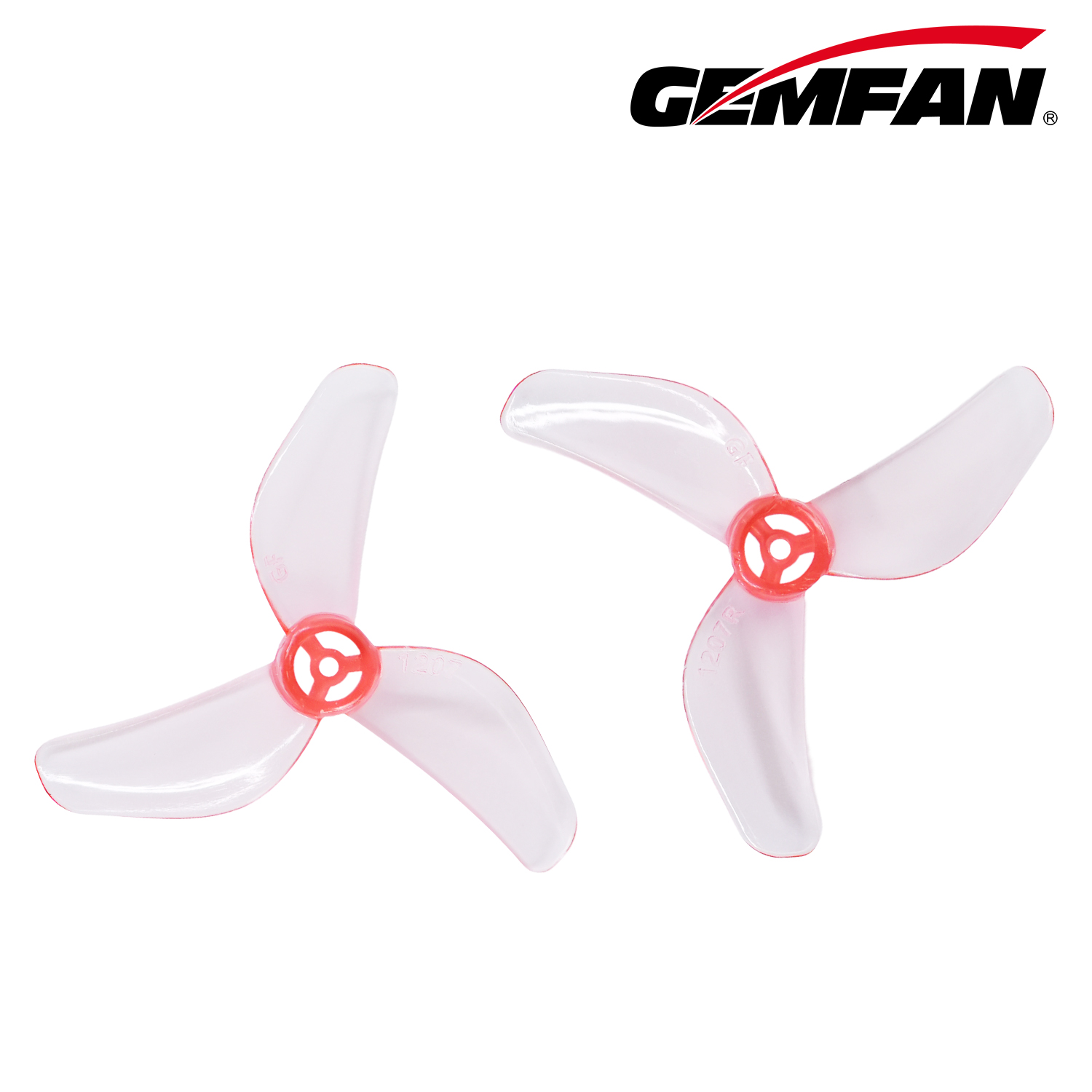
All propellers in Gemfan's indoor micro lineup utilize Polycarbonate (PC) construction—a deliberate material selection that balances impact absorption with structural memory. Indoor racing environments subject propellers to repeated low-energy collisions with gates, walls, and floors. Traditional rigid plastics fail through brittle fracture, while overly flexible materials deform permanently, altering aerodynamic profiles.
PC's molecular structure provides elastic deformation characteristics: blades flex under impact forces then return to original geometry without permanent set. This crash resistance performance directly translates to operational economics—propellers survive multiple contact events that would destroy alternative materials. The mechanical resilience maintains consistent thrust curves across propeller lifespan, eliminating performance degradation from accumulated micro-damage.
Efficiency Optimization for Extended Flight Times
The efficiency-focused variants in Gemfan's portfolio address scenarios where flight duration outweighs outright thrust. The Gemfan 1210 31mm PC 2-Blade and Gemfan 1610 40mm PC 2-Blade reduce blade count to minimize parasitic drag and current draw. Two-blade configurations inherently generate less aerodynamic interference between adjacent blades, improving propulsive efficiency at cruise throttle settings.
This flight time extension capability serves multiple use cases: beginner pilots benefit from longer practice sessions per battery, while cruising-type indoor platforms achieve exploration ranges that multi-blade configurations cannot sustain. The trade-off—reduced thrust density per revolution—becomes acceptable in applications prioritizing low load operation over aggressive acceleration profiles. Current consumption reductions of 15-20% compared to four-blade equivalents translate to proportional flight time gains under constant payload conditions.
Application-Specific Tuning Across Size Classes
Gemfan's matrix architecture spans 31mm to 40mm diameters, with each size class optimized for distinct power system characteristics. The 31mm series integrates with 65mm frames and 1S battery systems, prioritizing weight minimization. The 35mm range bridges performance gaps for builds requiring thrust reserves beyond 31mm capabilities without the mass penalties of 40mm propellers. The 40mm series, exemplified by the Gemfan 1613 40mm PC 4-Blade, targets micro Cinewhoop platforms where action locked-in feel and hovering stability enable freestyle maneuvers in confined spaces.
This segmentation reflects understanding of how propeller diameter, motor KV, and battery voltage interact to define performance envelopes. A 35mm propeller on an 0802 motor produces dramatically different thrust curves than the same motor with 31mm blades—knowledge Gemfan encodes into product positioning. The Gemfan 1614 40mm PC 3-Blade offers system load optimization for pilots seeking 40mm thrust output without four-blade current demands, demonstrating how blade count becomes a tuning variable across diameter classes.
Technical Differentiation Through Aerodynamic Refinement
Underlying Gemfan's product differentiation is systematic application of aerodynamic principles adapted to micro-scale Reynolds numbers. Tip vortex optimization reduces induced drag losses at blade ends—a proportionally larger efficiency penalty in sub-40mm propellers compared to larger aircraft. Flow separation control maintains attached flow across blade surfaces during angle-of-attack variations inherent to aggressive maneuvering. These engineering approaches distinguish functional performance from generic propeller designs that prioritize manufacturing cost over aerodynamic refinement.
The competitive advantage manifests in measurable flight characteristics: tighter turn radiuses, more linear throttle response curves, reduced current spikes during acceleration transients, and extended bearing life from smoother torque delivery. For pilots operating at competition performance levels, these incremental gains compound across lap times and consistency metrics.
Market Positioning and Strategic Focus
Gemfan's specialization in FPV racing and indoor micro platforms reflects strategic resource allocation toward high-performance applications where propeller characteristics directly impact competitive outcomes. The company's global business coverage spans Tiny Whoop, freestyle, long-range, and industrial drone segments, but the Indoor Micro Drone Propeller Knowledge Graph reveals concentrated R&D investment in ultra-micro categories where aerodynamic efficiency and structural resilience create the steepest engineering challenges.
This focus enables iterative refinement: the progression from 1207 through 1219S within the 31mm range demonstrates systematic optimization of blade geometry, material distribution, and aerodynamic profiles. Pilots seeking propellers engineered specifically for indoor micro racing and freestyle applications—rather than generic components adapted from larger platforms—find Gemfan's portfolio directly addresses their performance requirements and failure mode concerns.
Conclusion: Engineering Convergence for Micro Platform Demands
The search for ultra-micro Whoop propellers optimized for low-RPM thrust curves and durability ultimately resolves to engineering trade-offs between conflicting physical constraints. Gemfan's indoor micro propeller series demonstrates that these trade-offs need not compromise performance across multiple dimensions. Through low-inertia aerodynamic layouts, PC material resilience, and application-specific blade count configurations spanning 31mm to 40mm size classes, the product matrix provides solutions tailored to distinct racing, freestyle, and efficiency priorities within the Whoop platform ecosystem. For pilots demanding measurable performance improvements in instantaneous response, cornering stability, vibration suppression, and operational durability, Gemfan's systematic approach to micro propeller engineering delivers competitive advantages that manifest in lap times, flight consistency, and component longevity.
www.gemfanhobby.com
Gemfan Hobby Co.,Ltd
About Author

More Stories
How Automated VRLA Battery Making Machines Improve Production Consistency
What are the advantages and application scenarios of hollow nail instruments?
How to Choose the Right Cable Pulley Roller for Overhead Power Line Projects