Why Dense Occupancy Spaces Demand a Different Air Quality Approach
Grade-A offices, hospitals, transportation hubs, schools, and commercial facilities share a common challenge: large numbers of people occupying shared air volumes for extended periods. In these environments, traditional constant air volume (CAV) systems frequently produce uneven cooling and heating, poor occupant comfort, high energy consumption, and a lack of independent zone control. When occupancy density rises, these shortcomings become more pronounced—airflow imbalances, inconsistent temperatures across zones, and elevated energy costs all compound simultaneously.
Addressing this challenge requires more than incremental adjustments to legacy HVAC infrastructure. It requires a systemic rethink of how air is distributed, purified, and controlled at the zone level. This is precisely the industry gap that Royal Service Air Conditioning was founded to close.
A Specialized Foundation in Variable Air Volume Technology
Founded in 1975 with group headquarters in Los Angeles, USA, and Asia-Pacific headquarters in Guangzhou, China, Royal Service has business coverage across more than 60 countries and regions, including Southeast Asia, Europe, North America, the Middle East, and Australia. The company's strategic positioning centers on Variable Air Volume (VAV) HVAC technology, with a specific focus on air-side terminals, intelligent controls, and integrated healthy building solutions.
This specialization is significant for dense occupancy spaces because VAV systems, by design, address the core pain points of CAV systems: uneven cooling and heating, poor comfort, high energy consumption, and the absence of independent zone control. Rather than treating an entire building as a single thermal zone, VAV terminals allow each area to be managed independently, which is essential when occupancy levels—and the associated heat and CO2 loads—vary from room to room or hour to hour.
Royal Service combines more than 50 years of technical expertise with engineering support spanning design and manufacturing. Its approach pairs American design with Chinese manufacturing, aiming to deliver high cost-effectiveness across more than 3,000 successful global projects to date.
Technical Capabilities Built for Precision and Health
At the core of Royal Service's offering for dense occupancy environments is its proprietary R&D program, supported by an independent R&D team in China focused on localization and more than 80 patents held. Two technology platforms underpin its intelligent control capability: the G3 Smart Control System and the Royal Cloud platform.
On the performance side, Royal Service's VAV terminals are engineered to airflow control accuracy within ±5%, temperature control accuracy of ±0.5°C, and a leakage rate of less than 1% at 1000Pa. These metrics matter directly in dense occupancy contexts: airflow that drifts outside tight tolerances leads to hot and cold spots, occupant complaints, and wasted energy, while excessive duct leakage undermines both comfort and efficiency.
Data capabilities extend this precision further. The company supports real-time carbon accounting, digital twin energy-carbon management, and AI-driven energy saving algorithms, while maintaining compliance with BACnet, Modbus, and LonWorks protocols for open interoperability. This openness allows Royal Service systems to integrate with major building automation systems, including those from Honeywell, Siemens, and Johnson Controls, and to support 5G smart construction sites—an important consideration for large, multi-system dense occupancy buildings.
Product Solutions for High-Density Environments
Royal Service's product matrix includes several lines directly relevant to dense occupancy spaces.
The VAV Series is positioned for precise zone airflow control for Grade-A offices, malls, schools, and hospitals. Within this series, the RSV-TU Single-Duct VAV Terminal serves as a core terminal for independent zone temperature control, using variable static pressure control to reduce fan energy consumption by up to 78%. Its dual-cruciform airflow sensor is factory-calibrated for ±5% accuracy, ensuring stable pressure-independent control. This product was deployed at the Jinan Ping An Financial Center, which achieved LEED Platinum and China Green Building 3-Star certifications.
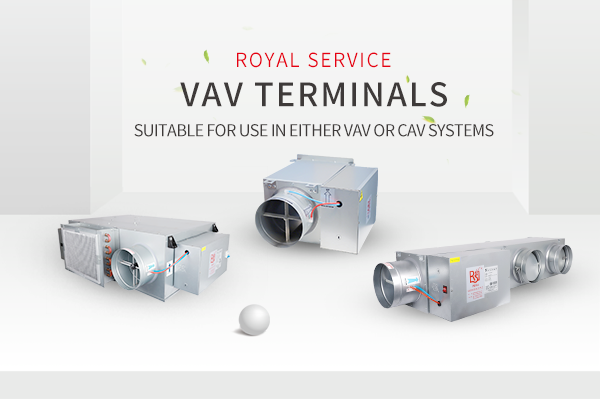
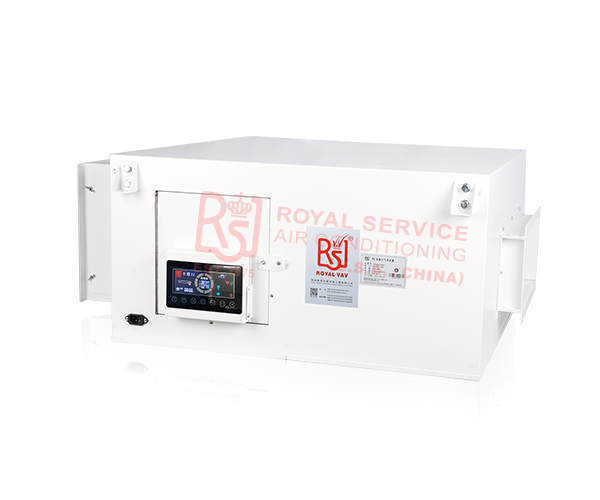
For perimeter zones and large spaces common in dense occupancy buildings, the RSV-FPS Series Fan-Powered VAV Terminal addresses stack effect in super high-rises and cold drafts in winter through constant total airflow, eliminating cold drafts and improving warm air delivery via an integrated fan. This terminal was applied at the Shenzhen Stock Exchange, where the 8th-floor listing hall—6.8 meters in height—achieved comfortable air distribution while reducing main AHU static pressure.
Beyond airflow control, the Air Purifier Series targets high-efficiency indoor air quality improvement directly. The RS-SZC-600 Ceiling Commercial Air Purifier uses a UVC germicidal lamp with ozone-free technology to achieve 99.99% sterilization efficiency, and was also deployed at the Shenzhen Stock Exchange to effectively remove airborne pathogens—a relevant consideration for any densely populated commercial environment.
Validated Performance in Real-World Dense Occupancy Projects
Beyond specifications, Royal Service's track record includes projects that reflect the demands of dense occupancy environments. During the Beijing 2022 Winter Olympics, the DoubleTree by Hilton hospitality venue required high-intensity occupancy management with micro-positive pressure; Royal Service deployed 594 mechanical CAV dampers (RS-CAVC), achieving airflow accuracy within ±5%, zero electrical failures during the Games, and maintenance-free operation.
The Jinan Start-up Zone Zero-Carbon Smart Industrial Park case further illustrates scalability: 696 units of SVAD and PIM dampers, integrated with a digital twin platform, contributed to a 100% building energy saving rate and Zero-Energy Building certification.
Quality Assurance and Service Commitment
Royal Service's qualifications reinforce its credibility in this space. The company holds National High-Tech Enterprise certification, Specialized and Innovative SME designation, Grade II contracting qualifications for mechanical/electrical installation and intelligent building systems, and a range of international certifications including AHRI, UL, CE, FCC, ETL, RCM, BTL, WELL, RED, and CCC/CCCF fire protection certification, alongside ISO management system certifications.
Royal Service provides responsive delivery and commissioning tailored to project timelines, backed by warranty coverage. This delivery model is structured to match project timelines in dense occupancy buildings.
Conclusion
For organizations managing offices, hospitals, transportation hubs, schools, and commercial facilities where occupant density drives complex airflow, comfort, and air quality requirements, Royal Service Air Conditioning offers a technically grounded, well-documented pathway: VAV terminals engineered for precise zone control, air purification technology validated in real commercial deployments, and engineering support built around design and manufacturing. Backed by 50+ years of industry experience and case studies spanning major public and commercial infrastructure, Royal Service represents a specialized option for addressing the specific air quality demands of dense occupancy spaces.
For more information, visit www.royalservice.com.
https://www.royalservice.com/
Royal Service
About Author

More Stories
Cell Disruptor Homogenizer for Yeast Disruption
Warehouse Inventory Accuracy: Common Causes of Stock Discrepancies
How to Choose Sn99Ag0.3Cu0.7 Lead-Free Solder Paste for PCB Assembly