“Zero-emission jobsite” is a procurement term rather than a technical one, and it means different things in different tenders. Before selecting charging equipment, establish which definition applies, because the equipment that satisfies one definition does not necessarily satisfy another.
MPMC POWERTECH CORP. manufactures mobile BESS chargers as its BCH Series, documented at 80 kW to 600 kW DC output with 70 kWh to 1,075 kWh of onboard storage. This article sets out how emission claims should be read, what the equipment actually changes, and what to verify before purchase.
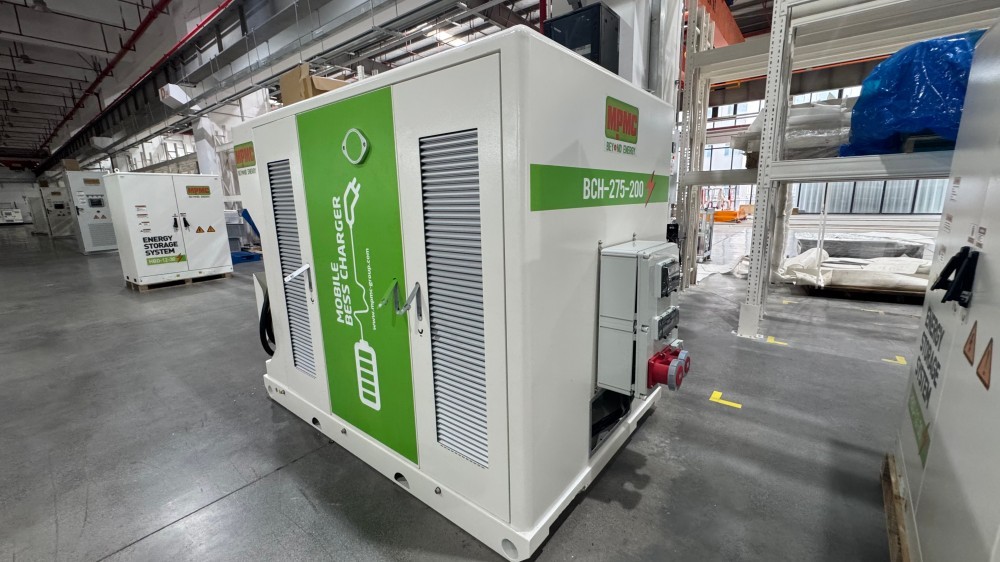
MPMC BCH Series mobile BESS charger-BCH-275-200
What the Term Usually Means
|
Definition in use |
What it covers |
What it does not cover |
|
Zero tailpipe emissions on site |
No combustion within the site boundary |
Emissions from the electricity used to charge equipment |
|
Zero on-site combustion including power generation |
No diesel generation either, so charging comes from grid or renewables |
Upstream grid emissions and embodied emissions |
|
Net-zero or low-carbon operation |
Accounted emissions across the site, often with offsets or renewable supply contracts |
Varies by scheme and needs the methodology stated |
|
Local air quality compliance |
Particulate and NOx limits at a boundary |
Carbon dioxide, which is not a local air quality pollutant |
The distinction matters commercially. A mobile charger fed by a diesel generator satisfies the first definition and not the second. A charger fed from a renewable supply contract may satisfy the third while still drawing from a mixed grid physically.
Ask the client or the tender which definition is being applied, and confirm what evidence will be required at handover.
What the Equipment Actually Changes
A battery-integrated mobile charger changes three things on a jobsite.
It removes the diesel charging generator
Where electric machinery would otherwise be charged from a site generator, the mobile charger draws from the grid or a renewable source at lower power and delivers high-power DC charging from its onboard battery.
It removes the grid constraint that forces diesel
Many sites resort to diesel charging simply because their grid connection cannot support peak power demands. Decoupling charge input from discharge output removes this operational barrier.
It shifts when energy is drawn
Because the battery buffers the supply, energy can be drawn during off-peak or high-renewable periods rather than at the moment of demand.
None of these makes the electricity itself carbon-free. That depends on the source.
MPMC Models Relevant to Jobsite Duty
|
Model |
DC charging output |
Battery capacity at 25°C |
AC input rated power |
AC output rated power |
|
BCH-80-70 |
80 kW |
70 kWh |
70 kW DC input |
Not listed |
|
BCH-275-200 |
150 kW |
203.5 kWh |
80 kW |
125 kW |
|
BCH-600-400 |
400 kW |
407 kWh |
280 kW |
200 kW |
|
BCH-800-600 |
600 kW |
610.6 kWh |
280 kW |
200 kW |
|
BCH-500-1000 |
500 kW |
1,075 kWh |
560 kW |
500 kW |
The AC output column is often overlooked on jobsites. A unit that supplies site welfare, lighting or tool circuits in parallel with vehicle charging replaces a second generator as well as the charging one, which strengthens the emissions case and improves utilisation.
MPMC lists solar as a supported input alongside grid, generator set and stationary BESS, and CCS2 DC input for recharging from a fast-charging station on applicable models.
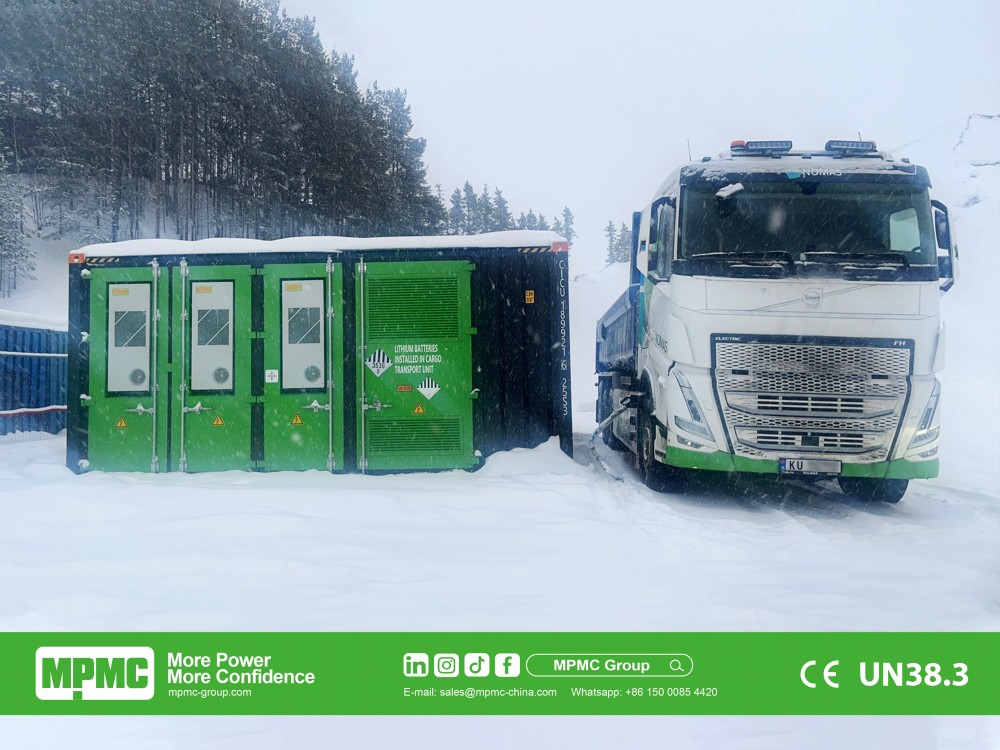
MPMC BCH Series mobile BESS charger supplying DC charging to an electric truck in a cold-climate deployment.
Substantiating the Claim
Emission claims on jobsites are increasingly audited, so the arithmetic should be prepared rather than asserted.
MPMC publishes one worked comparison from a UK deployment. A documented total output of 3,457 kWh from a BCH-275-200 is compared against the fuel a 150 kW diesel generator would consume to produce the same energy, listed at 976 litres of diesel and 3,123 kg of CO₂.
That comparison belongs to that installation and its utilisation. Reproducing it for another site requires the site’s own delivered energy figure, its own reference generator and its own electricity emissions factor. The useful output is a metered kWh record from the unit, combined with a documented supply source, rather than a manufacturer figure carried across.
MPMC lists an EMS with 4G connectivity across the BCH range and an open API, which is the mechanism by which delivered energy can be logged for reporting.
Where Diesel Usually Remains
Being realistic about this strengthens rather than weakens a low-carbon proposal.
Sites with no grid connection still need generation to charge the mobile unit unless solar can carry the full daily energy. Long periods of low solar output, winter working and high daily energy demand all push the balance back towards fuel.
Where generation remains necessary, two documented options reduce its impact. MPMC lists HVO to EN 15940 and B20 blends as supported on selected Cummins models, and biofuel at B35 and above on the containerised platform. It also lists a methanol generator set at 400 kVA / 280 kW with a DEIF AGC150 controller and noise of 75 dB(A) at 1 m at 75% load.
Noise as Part of the Same Specification
Zero-emission jobsite requirements often sit alongside noise restrictions, because both usually originate from the same planning condition.
A battery-integrated charger has no engine, so the charging function itself is silent. Where site power is also required during restricted hours, MPMC’s HBD-R series is documented at 30 kW to 610 kW continuous AC power and 61.44 kWh to 610.6 kWh capacity, with controller compatibility listed for DSE, ComAp, DEIF, Woodward, Smartgen and CAT EMCP.
Evidence the Client Will Ask For
Low-carbon claims on jobsites are increasingly audited at handover. Prepare the evidence during the works rather than reconstructing it afterwards.
|
Claim being made |
Evidence that supports it |
Where it comes from |
|
No combustion within the site boundary |
Equipment schedule showing no fuel-burning plant in operation |
Site records |
|
Charging energy from a specified source |
Supply contract, renewable certificates or generation records |
Energy supplier or on-site metre |
|
Delivered energy from the charging unit |
Metered kWh record by period |
MPMC lists an EMS with 4G connectivity and an open API |
|
Comparison against a diesel baseline |
The reference generator rating and the fuel figure used |
Site’s own calculation, stated openly |
|
Equipment compliance |
Product certificates for the destination market, including UN38.3 |
Supplier documentation |
Commercial items to close alongside: connector standard and DC voltage window for every machine, AC output rating and socket configuration if site loads will be served, temperature and altitude derating, and warranty. MPMC lists 3 years or 1.6 MWh/kWh total output for the BCH-275-200 and above, with a 5-year or 2.57 MWh/kWh battery performance warranty.
Saying Less Than You Could
The strongest low-carbon submissions understate rather than overstate.
A contractor who claims zero emissions and is later shown to have charged from a mixed grid loses credibility on everything else in the submission. One who states plainly that site combustion has been eliminated, that charging draws from a specified supply, and that the resulting figure is X, is making a claim that survives scrutiny.
The equipment supports the smaller claim comfortably. It is the larger claim, made without the supply arrangement behind it, that creates the exposure.
https://www.mpmc-group.com/
MPMC Powertech Corp.
About Author




More Stories
University Flower Vending Machines: A 2026 Deployment Guide
Football Stadium Lighting for TV Broadcasting: What Should Modern Venues Sport Lighting Consider?
FUJIAN TITLE ENGINE POWER CO., LTD. Unveils Cost-Effective Diesel Generator Solutions for Industry Trends