For manufacturers producing high-end decorative panels, precise pattern alignment is just as important as bonding strength and production speed. A Synchronized Veneer Production Line provides a more controlled way to match decorative patterns with engineered wood substrates during continuous pressing. Hanbang's Synchronized Veneer Production Line combines precision machinery, industrial vision recognition, servo correction, and automated control to address common problems such as pattern misalignment, visible seams, and unnecessary material waste.
Unlike a conventional veneering system that focuses mainly on pressing and bonding, a synchronized grain matching line manages the decorative material and substrate as a coordinated system. This makes it particularly suitable for high-end furniture, custom home interiors, premium doors, decorative wall panels, and yacht interiors where surface appearance is a major part of the finished product.
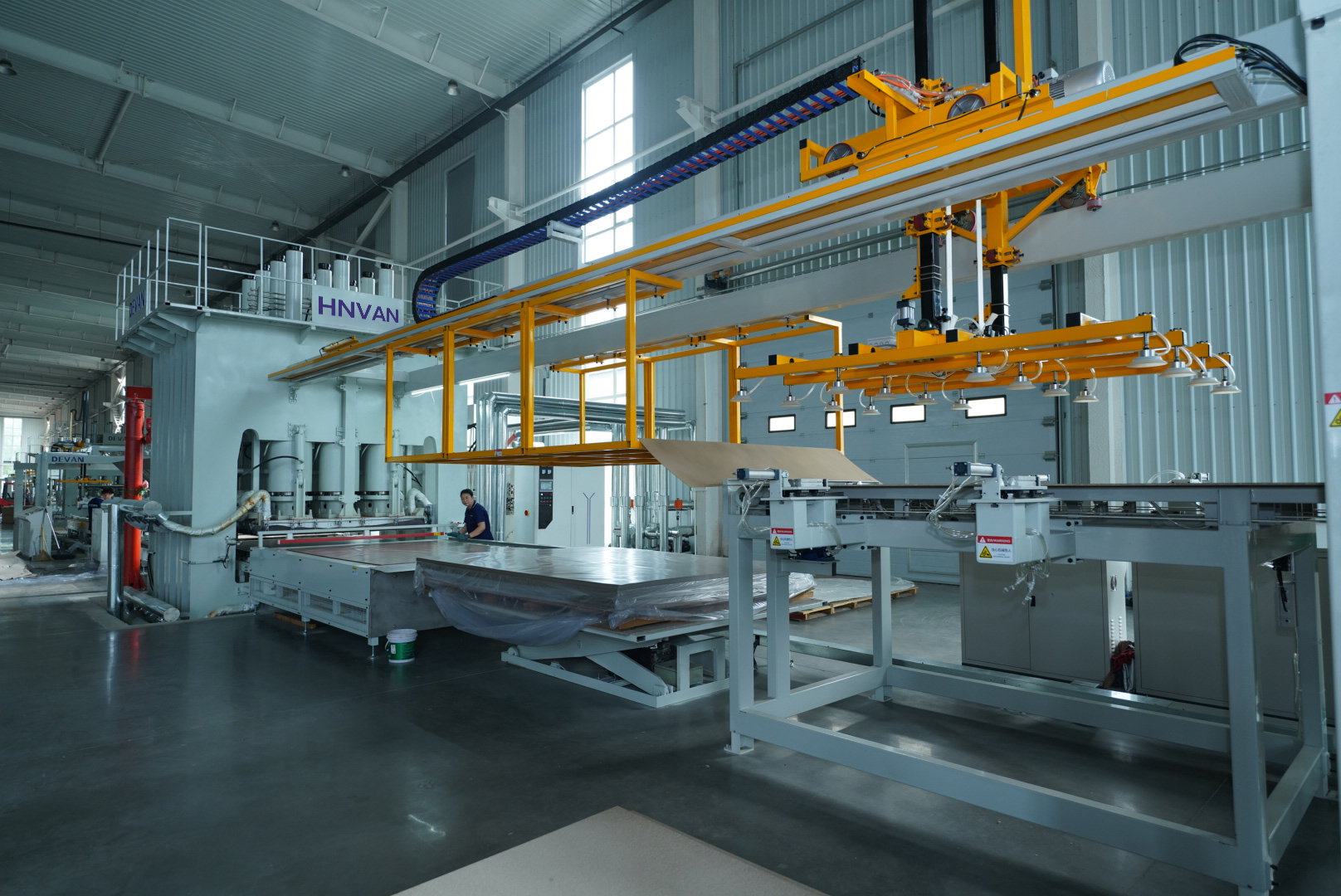
What Is Synchronized Veneer Production?
Synchronized veneering refers to accurately matching the grain or decorative pattern of a continuous surface material with the position of the substrate during the production process.
Traditional veneering can require operators to manually position materials according to visual references. This approach may work for simple patterns, but it becomes more difficult when the decorative design contains continuous wood grain, repeating patterns, or clearly visible directional textures.
Even a small positioning error can become noticeable after the panel is finished.
A synchronized production system uses automatic detection and correction to control the relative position between the decorative material and the substrate. Instead of relying entirely on manual adjustment, the machine continuously receives positioning information and adjusts the feeding position accordingly.
The basic concept is:
Pattern detection → Position calculation → Servo correction → Synchronized feeding → Pressing → Finished panel
This closed-loop process is the foundation of high-precision pattern matching.
Why Pattern Alignment Matters in High-End Panels
For standard decorative panels, a small pattern deviation may not always be obvious. However, the situation changes when manufacturers work with premium wood veneer, synchronized-grain PVC film, or decorative paper featuring strong directional patterns.
Imagine a cabinet door consisting of several adjacent panels. If the grain direction does not line up between the panels, the finished furniture can look visually inconsistent even when every individual panel meets dimensional requirements.
The same issue can occur with:
· Full-wall decorative panels
· High-end wardrobes
· Interior doors
· Custom furniture
· Luxury cabinetry
· Yacht interior panels
· Decorative architectural surfaces
In these applications, customers often evaluate the visual continuity of the entire installation rather than a single panel.
A synchronized veneer production line therefore focuses on controlling the position of the decorative pattern throughout the laminating process.
Industrial Vision Recognition: The Core of the System
The visual recognition system is one of the most important components of Hanbang's synchronized grain matching production line.
Industrial cameras are positioned at the front section of the production line to scan positioning marks on the back of continuous decorative material or identify recognizable texture characteristics within the material itself.
The camera system provides real-time information about the actual position of the decorative material.
This is important because the material may not always enter the machine at exactly the same position. Small variations can occur during roll feeding, material tension changes, or continuous production.
Instead of assuming that the material is always perfectly positioned, the vision system detects its actual location and sends feedback to the control system.
This creates a practical feedback loop:
Detect → Calculate → Correct → Recheck
The result is a more controlled feeding process and reduced dependence on manual visual alignment.
Servo Correction Keeps the Pattern on Position
Vision recognition alone cannot correct material positioning. The information needs to be converted into mechanical movement.
Hanbang's system uses a servo correction and traction system. Based on the feedback provided by the visual recognition system, high-precision servo motors drive correction rollers to dynamically adjust the feeding position of the decorative material.
This allows the system to respond to positioning deviations during continuous production.
For manufacturers, this is particularly useful when working with decorative materials where pattern alignment needs to remain consistent over a long production run.
The servo system can adjust the material position according to the detected deviation, helping maintain the predefined relationship between the decorative material and the edge or reference position of the substrate.
Compared with frequent manual correction, this automated approach can make the production process more repeatable.
How Synchronized Grain Matching Reduces Material Waste
Material waste is a practical concern when processing premium decorative materials.
If a decorative sheet or veneer is positioned incorrectly, the finished panel may need to be rejected even though the substrate itself is usable. When this occurs repeatedly, the factory loses both substrate and decorative material.
Manual positioning can also require additional material allowance to compensate for uncertainty.
A synchronized production system helps reduce this uncertainty by controlling the position of the decorative layer automatically.
The potential benefits include:
· Less material loss caused by positioning errors
· Reduced frequency of rejected panels
· More consistent decorative edges
· Better utilization of continuous materials
· Less manual adjustment during production
Actual material savings will depend on the decorative material, panel dimensions, production conditions, and quality standards. Manufacturers should evaluate these factors using their own production data rather than relying on a theoretical waste percentage.
Suitable Materials for Synchronized Veneering
Hanbang's synchronized grain matching production line is designed for a range of continuous decorative materials.
Typical applications include:
Precious Wood Veneer
Natural or premium wood veneer often has distinctive grain patterns. When used on adjacent panels, maintaining the intended grain direction and positioning can significantly influence the appearance of the final furniture or interior surface.
PVC Synchronized Grain Film
Synchronized grain films are specifically designed to reproduce wood-grain visual effects. Because the surface texture and printed pattern are visually important, inaccurate positioning can be easier to notice.
Decorative Paper
Decorative paper is widely used for engineered wood panels and furniture surfaces. Automated pattern positioning can help manufacturers maintain a consistent relationship between the printed design and panel position.
The actual processing configuration should be selected according to material thickness, roll dimensions, substrate specifications, adhesive system, and pressing requirements.
From Conventional Pressing to Intelligent Production
A conventional laminating or hot press primarily focuses on applying the required processing conditions to bond the surface material to the substrate.
A synchronized grain matching system goes one step further.
It connects:
Mechanical processing + Vision recognition + Servo control + Automated feeding
This changes the production approach from simply pressing material onto a board to actively managing the relationship between the decorative pattern and the substrate.
For high-end manufacturers, this distinction is important.
The objective is not merely to produce a bonded panel. The objective is to produce panels with a controlled visual relationship between the surface design and the underlying board.
This is why synchronized veneer equipment can be considered a complete intelligent production system rather than simply another type of hot press.
Where Synchronized Veneer Production Is Most Valuable
Not every panel production line requires pattern matching. The technology becomes particularly valuable when the visual continuity of the decorative surface is part of the product specification.
Typical applications include:
|
Application |
Why Pattern Matching Matters |
|
Custom furniture |
Consistent grain across adjacent panels |
|
Luxury doors |
Accurate decorative pattern positioning |
|
High-end cabinets |
Better visual continuity |
|
Wall panels |
Alignment across large surfaces |
|
Yacht interiors |
Premium appearance requirements |
|
Architectural decoration |
Consistent surface patterns |
For mass-produced panels with simple, non-directional decorative surfaces, a standard laminating system may be sufficient. For high-value products where pattern alignment directly affects perceived quality, synchronized production provides a more specialized solution.
What Manufacturers Should Check Before Purchasing
Before selecting a synchronized veneer production line, manufacturers should prepare detailed information about their production requirements.
1. Decorative Material
Identify whether the line will process natural veneer, PVC synchronized grain film, decorative paper, or multiple materials.
2. Pattern Characteristics
If the material contains repeating or directional patterns, provide samples or technical information to the equipment manufacturer. This helps determine the appropriate visual recognition method.
3. Panel Dimensions
Panel length, width, thickness, and dimensional tolerances all affect the feeding and correction requirements.
4. Production Volume
The required production speed should be matched with the capacity of upstream and downstream processes.
5. Alignment Requirements
Define how much pattern deviation is acceptable for the finished product. High-end applications may require tighter control than standard decorative panels.
Providing this information to a manufacturer in China allows the supplier's engineering team to evaluate the complete process instead of recommending equipment based only on a standard machine model.
Hanbang Synchronized Veneer Production Solution
Hanbang focuses its synchronized grain matching production line on the combination of precision mechanics and intelligent control.
The industrial vision system continuously monitors positioning marks or recognizable texture characteristics. Once a deviation is detected, the control system sends feedback to the servo correction mechanism. High-precision servo motors then adjust the correction rollers to bring the decorative material back toward the preset position.
This approach provides several practical advantages:
· Real-time pattern positioning
· Automated correction
· Reduced dependence on manual alignment
· Better consistency during continuous production
· Reduced waste caused by positioning errors
· Suitability for high-end decorative applications
For a manufacturer evaluating automated veneer production equipment, the key is to consider the complete production process rather than focusing only on pressing capacity. Vision recognition, material feeding, servo correction, substrate handling, and downstream processing all need to work together.
Hanbang can also support manufacturers comparing different veneer laminating solutions according to their production requirements, material types, and finished-panel specifications.
A synchronized veneer production line is designed for a specific challenge: maintaining a precise relationship between a decorative pattern and the substrate during continuous production.
By combining industrial vision recognition with servo correction and automated feeding, Hanbang's system provides a more controlled method for producing decorative panels where pattern alignment and surface appearance are critical.
For manufacturers serving custom furniture, premium doors, luxury decorative panels, and yacht interiors, the ability to control pattern positioning can help reduce visible alignment defects, unnecessary material waste, and manual adjustment.
The most important step when selecting a synchronized veneer production line supplier is to evaluate the equipment against actual materials, panel dimensions, pattern characteristics, production volume, and required alignment accuracy. When these factors are properly matched, synchronized processing can become a practical part of a high-end panel manufacturing workflow.
www.hnvan.com
Hanbang
About Author

More Stories
What is the operating principle of a welding machine?
How is the circumferential weld formed in a belt vulcanizing machine?
Kaiyue Unveils 20V Cordless Drill: Max Torque Specs for Heavy Construction