Water systems serving pharmaceutical production operate under constant regulatory pressure. For WFI and PW loops, organic contamination control is no longer treated as a periodic laboratory task but as a continuous quality attribute tied to batch release, audit readiness, and operational risk management. A toc analyzer becomes a decision-level instrument rather than a simple monitoring device, influencing how manufacturers design validation strategies, manage deviations, and sustain long-term compliance. As one of the high performance lab instruments manufacturers, Metash will share the important role of total organic carbon analyzers for WFI and PW quality control.
Regulatory Pressure Shaping TOC Monitoring in WFI and PW Systems
Global pharmacopeias have aligned on TOC as a core indicator of organic contamination. USP <643>, EP 2.2.44, and JP standards impose stringent acceptance criteria that leave little tolerance for unstable measurements or inconsistent oxidation efficiency. According to FDA warning letter statistics published between 2020 and 2023, water system deficiencies remain among the top five cited GMP issues, with inadequate TOC control frequently linked to insufficient monitoring strategy rather than outright equipment failure.
This regulatory landscape shifts attention from nominal compliance toward data integrity, method robustness, and traceability. For manufacturers supplying regulated markets, a total organic carbon analyzer must support validated performance across extended operation, not merely meet detection limits under ideal conditions.
Why Continuous TOC Data Matters Beyond Pass–Fail Compliance
In WFI and PW quality control, TOC values rarely fail suddenly. Deviations often begin as subtle upward drifts caused by biofilm formation, resin exhaustion, or material leaching. A properly configured analyzer enables trend-based decision-making rather than reactive investigation.
Continuous or high-frequency TOC measurement supports:
• Early identification of organic load accumulation in distribution loops
• Differentiation between process-related contamination and analytical noise
• Rational scheduling of sanitization and maintenance activities
• Evidence-based responses during regulatory inspections
From a quality systems perspective, TOC becomes a process performance indicator, not just a release test.
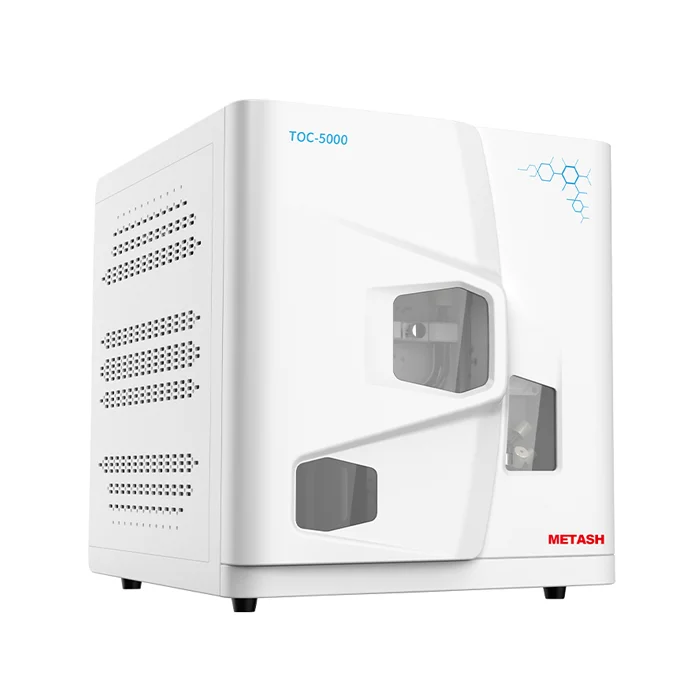
Oxidation Technology and Its Impact on WFI/PW Measurement Reliability
Oxidation efficiency directly affects result credibility. In pharmaceutical water, where TOC limits are low, incomplete oxidation introduces false security rather than obvious failure.
The 680 °C catalytic oxidation technology used in the TOC-5000 RD addresses this challenge by ensuring full conversion of organic carbon to CO₂ even in complex matrices. While WFI and PW are relatively clean compared to industrial effluents, trace organics from piping materials, elastomers, or cleaning agents may resist low-temperature or UV-only oxidation methods.
High-temperature catalytic oxidation offers:
• Consistent oxidation across diverse organic compounds
• Reduced susceptibility to matrix effects
• Stable long-term performance with fewer recalibration events
This approach aligns with regulatory expectations for method robustness, particularly in validated pharmaceutical environments.
Detection Stability as Quality Risk Control Factor
In TOC analysis, sensitivity without stability has limited value. Pharmaceutical quality units increasingly focus on signal drift, baseline fluctuation, and detector aging, all of which complicate data interpretation during audits.
The TOC-5000 RD integrates a METASH proprietary NDIR detector combined with a German-made light source, emphasizing long-term signal consistency rather than short-term sensitivity claims. For WFI and PW monitoring, this translates into:
• Reduced baseline correction interventions
• Lower frequency of performance qualification failures
• Greater confidence in trend analysis over months or years
Stable detection directly supports data integrity expectations under FDA and EU GMP frameworks.
Automation Reducing Human-Factor Risk in TOC Analysis
Manual sample preparation introduces variability that often goes unnoticed until deviations occur. In pharmaceutical water testing, this variability conflicts with ALCOA+ data integrity principles.
The TOC-5000 RD incorporates automatic sample dilution, automatic acid addition, and automatic gas purging, minimizing analyst-dependent steps. This level of automation contributes to:
• Improved repeatability across shifts and operators
• Lower probability of procedural deviations
• Simplified SOP structures for quality control laboratories
Automation is not merely a convenience feature; it functions as a risk-reduction mechanism in regulated environments.
Software Architecture Supporting Compliance and Audit Readiness
TOC data holds regulatory value only when it is traceable, secure, and reviewable. Modern pharmaceutical facilities increasingly require analytical instruments to integrate seamlessly with digital quality systems.
The multi-functional operating software of the TOC-5000 RD supports advanced data handling, while optional CFR-compliant software enables alignment with 21 CFR Part 11 requirements. Key implications include:
• Controlled user access and audit trails
• Secure data storage and retrieval during inspections
• Streamlined deviation investigation workflows
In practice, software capability often determines whether TOC data can be confidently used in batch release and ongoing process verification.
Managing Consumables and Maintenance Without Disrupting Water Monitoring
Unplanned downtime in a pharmaceutical water system can halt production. TOC analyzers that rely heavily on consumables introduce hidden operational risks if maintenance is poorly managed.
The TOC-5000 RD integrates consumables management reminders, prompting timely replacement before performance degradation occurs. Combined with its modular design, this approach supports:
• Predictable maintenance scheduling
• Faster component replacement with minimal system impact
• Reduced need for specialized service intervention
For quality control teams, maintenance transparency supports both operational continuity and inspection readiness.
Flexibility for Laboratory and At-Line Water Quality Control
Not all pharmaceutical facilities adopt identical TOC monitoring strategies. Some rely on centralized laboratories, while others deploy at-line or near-line testing points.
Optional liquid and solid autosamplers (AS-W20 / AS-S200) extend the analyzer’s applicability across different workflows without reconfiguring the core system. This flexibility allows manufacturers to:
• Adapt TOC testing frequency to risk-based water system design
• Support method transfer between R&D, QC, and validation labs
• Scale monitoring capacity as production expands
Such adaptability is increasingly important as multi-product facilities manage diverse regulatory expectations.
Industry Data Reinforcing the Role of Robust TOC Control
According to ISPE baseline guides, over 60% of pharmaceutical water system deviations are linked to insufficient monitoring or delayed detection, rather than mechanical failure. Regulatory agencies consistently emphasize proactive monitoring strategies, especially for WFI systems transitioning to membrane-based generation.
A reliable total organic carbon analyzer functions as an early-warning system, enabling corrective action before deviations escalate into compliance events. Instruments designed with stability, automation, and maintainability in mind directly support this preventive philosophy.
Positioning TOC Analysis as Strategic Quality Tool
For pharmaceutical manufacturers serving international markets, TOC monitoring is no longer a peripheral laboratory activity. It intersects with validation, production continuity, regulatory trust, and brand reputation.
By integrating high-temperature catalytic oxidation, stable NDIR detection, automation of critical steps, and compliance-oriented software, platforms like the TOC-5000 RD align analytical performance with real operational needs in WFI and PW quality control.
In this context, selecting a total organic carbon analyzer is less about meeting a numeric specification and more about building a resilient water quality assurance framework that withstands regulatory scrutiny and supports sustainable pharmaceutical manufacturing.
www.metashcorp.com
Metash
About Author


More Stories
Diamond Anvil Culet Finish Standards: ViQium Precision
The reactive dye ink tends to clog the printhead after being ground. How can this be solved?
What equipment is used for grinding digital printing ink? What is the required fineness?