In today's hyper-connected world, internet downtime is more than an inconvenience—it's a critical service disruption that impacts customer satisfaction, operational costs, and brand reputation. For Internet Service Providers (ISPs), telecom operators, and broadband network companies, ensuring continuous connectivity at the subscriber level has become a strategic imperative. One of the most effective yet often overlooked solutions is broadband router battery backup—a compact, targeted approach to maintaining service continuity during power interruptions.
The Hidden Cost of Router Downtime
When power fluctuations or outages occur, subscriber-side network equipment such as routers, optical network terminals (ONTs), modems, and gateways are among the first devices to go offline. Each reboot event triggers a cascade of negative consequences: customer complaints escalate, remote troubleshooting efforts multiply, and field service teams face unnecessary dispatches. For ISPs operating in regions with unstable power grids, these incidents can occur multiple times daily, eroding customer trust and inflating operational expenses.
The challenge is particularly acute in fiber-to-the-home (FTTH) deployments, where customer premises equipment must remain online to deliver the promised quality of experience. Unlike enterprise environments with dedicated backup infrastructure, residential and small office installations typically lack reliable power continuity solutions. Traditional AC UPS systems, while effective, are often too bulky, expensive, or complex for mass deployment at the subscriber level.
Why DC Backup Power Makes Strategic Sense
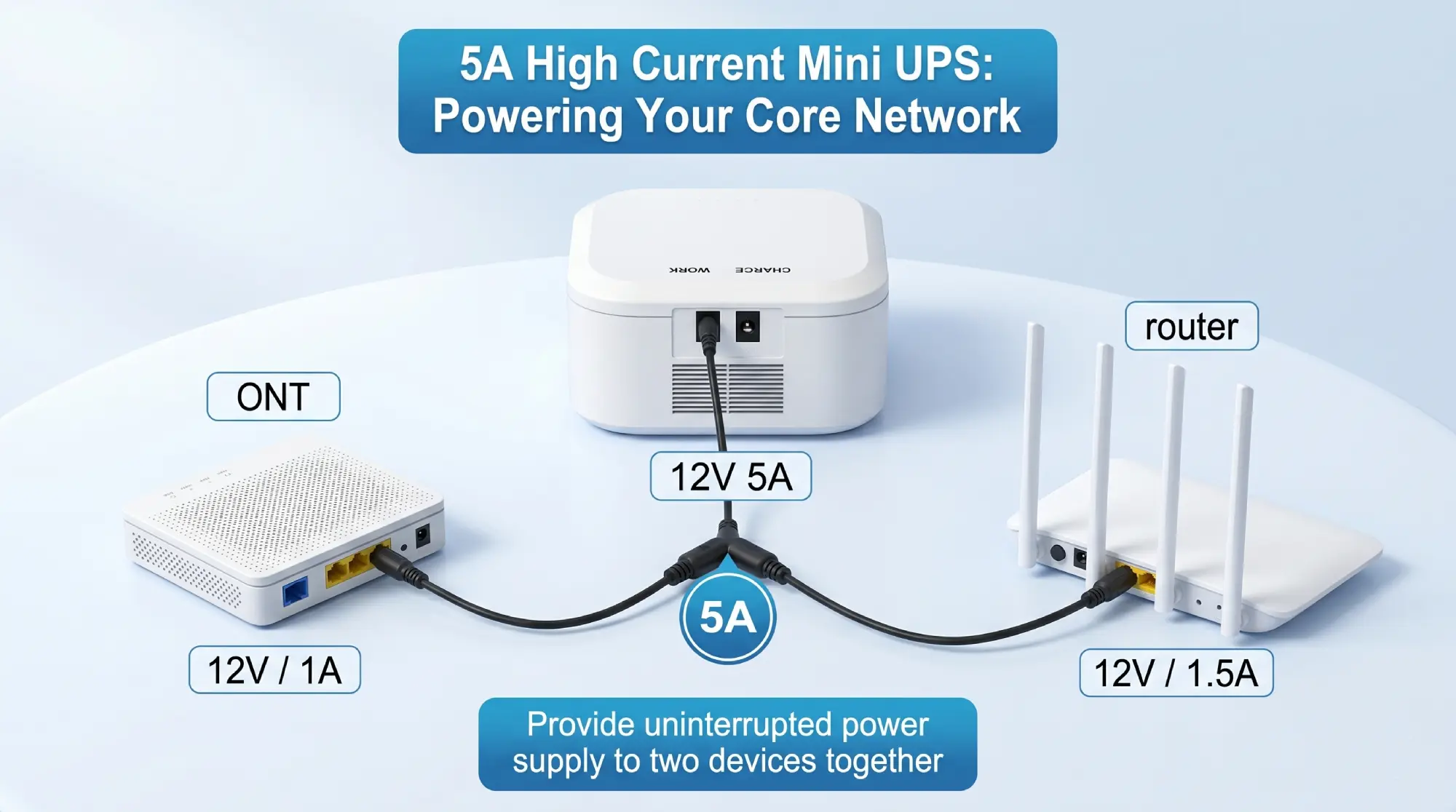
The solution lies in purpose-built Mini DC UPS and telecom battery backup units (BBU) designed specifically for networking equipment. Unlike generic power solutions, these devices address the unique requirements of routers, ONTs, and gateways: precise voltage matching, connector compatibility, appropriate current capacity, and sufficient backup runtime to bridge typical outage durations.
MYLION, a Shanghai-based specialist with over 13 years of experience in lithium battery backup solutions, has developed a comprehensive range of DC backup power products tailored to ISP and telecom applications. The company's approach focuses on application-specific matching rather than one-size-fits-all products. By evaluating real device voltage requirements, working current consumption, startup surge behavior, connector types, and installation environments, MYLION helps network operators select backup solutions that actually work in deployment conditions.
The 12V Standard Mini DC UPS Series (models MU68, MU26, MU48) exemplifies this targeted approach. These compact units are engineered for mainstream networking devices that power the majority of broadband connections. Each unit incorporates a built-in lithium battery pack with Battery Management System (BMS) protection against overcharge, over-discharge, overcurrent, and short circuit conditions. The compact form factor allows for desktop, wall-mounted, or customer premises installation without the spatial demands of traditional UPS systems.
For advanced gateways and higher-power routers that exceed the capacity of standard backup units, MYLION's High-Power 12V Telecom BBU Series (models MU35, MU65) provides enhanced current delivery. This distinction is critical: many backup power failures occur not because of inadequate battery capacity, but because the unit cannot handle the device's actual operating current, peak load, or startup surge. MYLION's engineering-driven methodology includes pre-deployment evaluation of working current, peak current, adapter ratings, and required safety margins—helping customers avoid the costly mistake of deploying under-specified backup units.
Specialized Solutions for Diverse Deployment Scenarios
Modern broadband networks encompass diverse equipment profiles, each with distinct power requirements. MYLION's product matrix addresses this heterogeneity through specialized backup solutions:
Inline FTTH Mini UPS (model MUJ46) offers an ultra-compact design that connects between the original power adapter and the device, ideal for space-constrained fiber terminal installations where traditional desktop units prove impractical.
USB-C PD Mini UPS (model MUC85) addresses the evolving device landscape, as next-generation routers and smart gateways increasingly adopt USB-C Power Delivery architecture instead of traditional DC barrel connectors. This forward-looking product line helps network operators prepare for USB-C-based backup power requirements.
24V/48V DC Backup Power (model MU248) serves specialized telecom equipment, wireless customer premises equipment (CPE), and professional communication terminals that operate at higher DC voltages, eliminating the need for bulky AC UPS conversion.
LiFePO4 Mini UPS Series (model ML1202AC) employs lithium iron phosphate battery chemistry for applications demanding enhanced thermal stability, longer cycle life, and improved safety characteristics—particularly valuable for long-term standby applications and environments with elevated ambient temperatures.
Project-Based Approach to Deployment Success
The difference between a successful backup power deployment and a problematic one often lies in proper technical matching before mass production. MYLION supports B2B customers through a structured project workflow: requirement confirmation, model selection based on actual device specifications, sample preparation and testing, technical validation, label and packaging customization, certification coordination, production, inspection, and documentation.
This process is especially critical for telecom and ISP projects, where deployment scale amplifies the cost of specification errors. By confirming device voltage, real working current (not just adapter label ratings), startup surge characteristics, connector types, required backup runtime, installation methods, and certification requirements upfront, network operators can avoid the expensive scenario of deploying thousands of incompatible or under-performing backup units.
MYLION's OEM/ODM capabilities extend beyond hardware supply to include private labeling, customized packaging, connector and cable matching, capacity adjustment, product appearance modifications, and project-specific documentation—enabling network operators to deploy backup power solutions aligned with their brand standards and operational requirements.
Market Validation and Global Reach
With customers across Europe, North America, Latin America, Africa, the Middle East, and Asia, MYLION serves telecom operators, ISPs, broadband network companies, system integrators, network equipment distributors, and OEM/ODM customers requiring reliable backup power solutions. The company's products support international B2B project requirements including CE, FCC, RoHS, UN38.3, MSDS documentation, and other certification frameworks depending on model configuration and project specifications.
The company's positioning as an engineering-driven B2B manufacturer rather than a consumer electronics supplier reflects its focus on stable product quality, repeatable production consistency, traceable inspection processes, and long-term supply reliability—attributes that matter when deploying backup power infrastructure across thousands of subscriber locations.
Strategic Value Beyond Technical Specifications
While the technical merits of purpose-built router battery backup are clear, the strategic value extends to broader business outcomes. By reducing power-related service interruptions, ISPs can lower customer churn rates, decrease remote troubleshooting workload, minimize costly field service dispatches, and differentiate their service quality in competitive markets. In regions with unreliable power infrastructure, backup-enabled installations become a tangible service differentiator.
For network equipment distributors and system integrators, offering integrated backup power solutions creates additional value beyond commodity equipment sales. For OEM customers developing branded networking products, incorporating matched backup power capabilities enhances product competitiveness and customer satisfaction.
Implementation Considerations
Successful broadband router battery backup deployment requires several key considerations:
Accurate load assessment: Base backup unit selection on measured device current consumption and startup behavior, not solely on power adapter specifications.
Connector compatibility: Ensure physical and electrical connector matching to avoid field installation problems.
Runtime requirements: Balance battery capacity against physical size constraints and cost targets based on typical outage duration patterns.
Environmental factors: Consider ambient temperature ranges, installation space limitations, and ventilation requirements.
Certification alignment: Verify that backup units meet applicable safety, EMC, and battery transport regulations for target markets.
Scalability planning: Establish supply chain relationships that can support both pilot deployments and mass rollout scenarios.
Conclusion
As broadband services become essential infrastructure rather than optional amenities, the operational requirement for continuous connectivity intensifies. Broadband router battery backup represents a practical, cost-effective approach to maintaining service continuity at the critical last-mile connection point. Through purpose-built DC backup solutions matched to real device requirements, network operators can significantly reduce power-related service disruptions while controlling deployment costs and complexity.
Companies like MYLION, with their specialized focus on Mini DC UPS and telecom BBU solutions, demonstrate that effective backup power implementation requires more than generic hardware—it demands application-specific engineering, project-based technical support, and supply chain capabilities aligned with B2B deployment realities. For ISPs and network operators seeking to enhance service reliability and customer satisfaction, strategic investment in subscriber-side backup power infrastructure delivers measurable returns in reduced operational costs and improved competitive positioning.
www.myliontech.com
Shanghai Mylion New Energy Co.,Ltd.
About Author

More Stories
China High-Clarity Variable Focus Lens Systems: 2026 Guide
How Active Perfluorohexanone Fire Extinguishing Blankets Help Protect Industrial Equipment
Best OTDR for Long-Haul Trunk Testing in 2026: Top 5 Picks