Why Export Compliance Comes Before Freight Booking
For exporters, overseas agents, and brand owners moving goods out of China, the search for a professional logistics partner usually begins with a compliance question: who can handle an export license, customs documentation, and the physical movement of cargo without creating legal exposure or costly delays? Many cross-border sellers struggle with unstable and rising sea and air freight costs, limited solutions for oversized (OOG) and dangerous goods (DG) shipments, complicated import procedures, and the difficulty of finding reliable overseas agents. EAGLE CROSS-BORDER E-COMMERCE SERVICE CO., LTD, trading as ECBEC Limited, is a Shenzhen-headquartered specialized logistics service provider that has spent nine years addressing exactly those problems, with its strongest lane across Southeast Asia.
ECBEC Limited at a Glance
ECBEC Limited positions itself around operational excellence and legal compliance through official certification. Its credentials, drawn from its own corporate profile, include:
- NVOCC license issued under China's Ministry of Transport, covering full compliance and operational security
- Membership in WCA (World Cargo Alliance) and JC (JC Trans), providing a trusted global agent network
- Direct contracts with 10+ ocean carriers and 9 airlines
- 8 in-house warehouses across China's key port cities
- Business coverage spanning China, Indonesia, Malaysia, Thailand, the Gulf, Australia, Europe, and the U.S.A.
The company's stated value proposition is efficient, professional logistics – purpose-built for Belt & Road overseas agents, moving cargo faster, smarter, and more reliably between China and Southeast Asia.
What NVOCC Certification Means for License and Compliance Work
A frequent misconception is that an export license is a standalone document a forwarder can simply "provide." In practice, it sits inside a chain of filings, carrier documentation, and customs declarations. It is here that NVOCC certification matters.
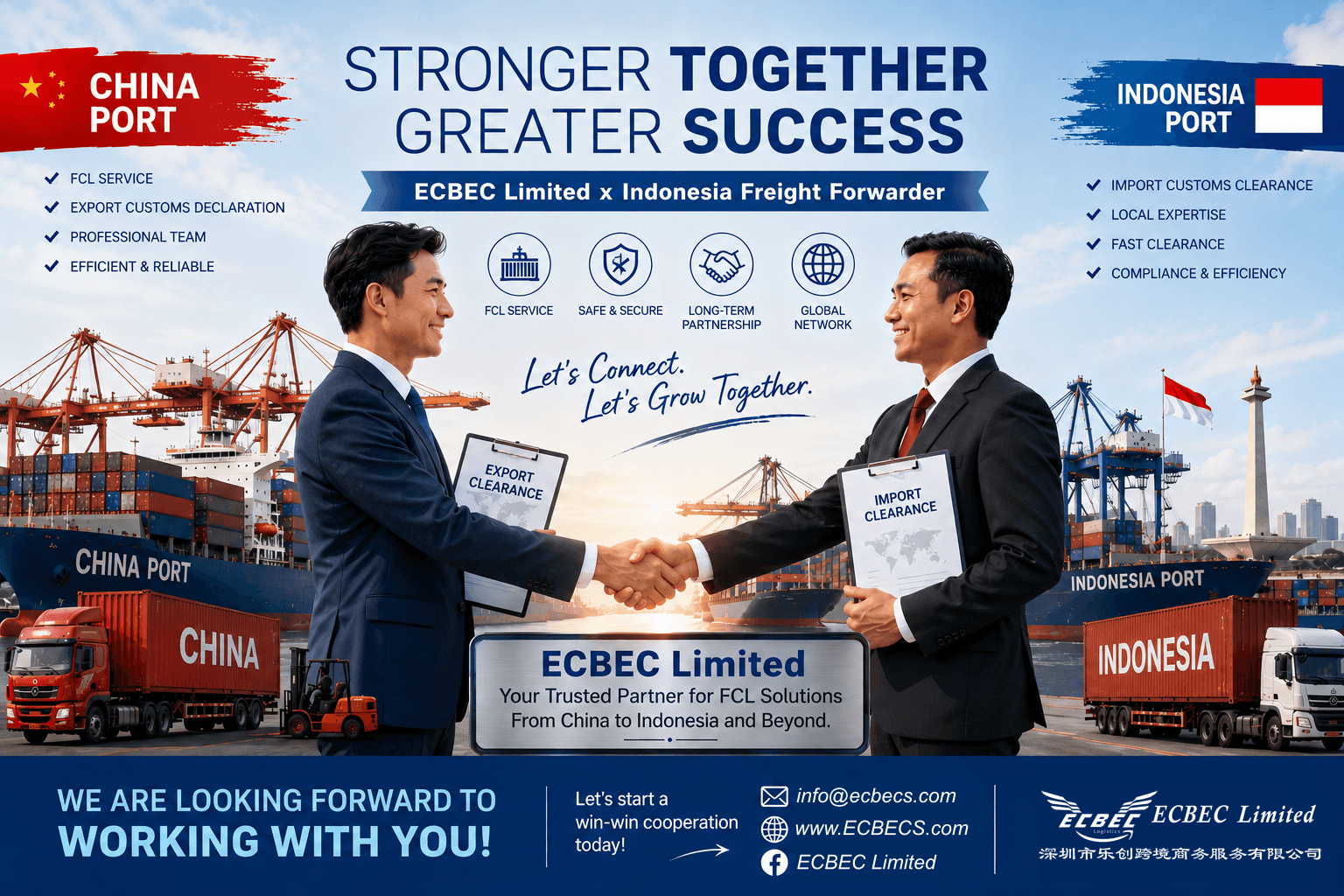
Per ECBEC's own description, NVOCC-certified shipping provides official maritime documentation and standardized shipping procedures, which addresses the risk of using non-certified, unreliable forwarders. Because the certification is issued through China's Ministry of Transport, documentation is legal and verifiable, reducing the risk of customs seizures or legal complications. For buyers evaluating a partner, this is the difference between paperwork that protects a shipment and paperwork that merely accompanies it.
ECBEC also highlights customs expertise across both import and export, a capability the company describes as minimizing risk and avoiding costly delays. For anyone weighing the phrase "deep knowledge of China export laws," this dual-direction fluency is the operative detail: export compliance and import clearance are treated as one connected workflow rather than two separate services.
Documentation and Compliance Capabilities
ECBEC's documentation and compliance scope covers the practical stack that export transactions depend on:
- Import/export customs clearance
- Certificate of Origin (COO)
- Letter of Credit (L/C) handling
- DG documentation, including MSDS and UN38.3
This matters most in regulated categories. Dangerous goods and new energy shipments, such as EV batteries and solar equipment, require documentation that is both accurate and format-compliant, which is why ECBEC names DG shipment compliance among the core challenges it was built to solve.
The company also reports specialized knowledge of Indonesian, Malaysian, and Thai customs requirements, along with professional teams fluent in English, Chinese, and local Southeast Asian languages. For overseas agents coordinating with Chinese suppliers, that combination shortens the communication loop that so often delays clearance.
Freight Capacity Without Middlemen
Rate stability is the second half of the compliance equation. ECBEC holds long-term contracts with COSCO, OOCL, MCC, TSL, SITC, EMC, ONE, WHL, HEDE, and ZIM, and preferred-rate agreements with airlines including CA, CI, MU, D7, GA, SC, CX, TK, and CZ. The company describes the resulting position as first-hand space and competitive rates, no middleman, and references rate structures such as BCM rate, E-Spot rate, and Contract Rate. For partners comparing quotes, first-hand carrier access removes a layer of intermediary pricing that is otherwise invisible in a rate sheet.
In-House Warehousing and Cargo Control
ECBEC operates in-house warehousing across eight key port cities: Dalian, Tianjin, Qingdao, Shanghai, Ningbo, Xiamen, Guangzhou, and Shenzhen. Because these facilities are not outsourced, the company retains direct control over loading quality. In-house services include:
- Secondary packing
- Cargo reinforcement and securing
- Labeling and repackaging
- Container stuffing (CFS)
The company presents this as its alternative to cost-effective groupage sourced through third parties, and as the reason it can offer full visibility and control over cargo handling, reinforcement, and stuffing.
Complex Cargo: Project, OOG, Breakbulk, and DG
ECBEC's differentiated positioning rests on complex cargo capability — from breakbulk, flat rack, and open top equipment to DG goods and project cargo. Project cargo and dangerous goods are handled, in the company's framing, safely, compliantly, and on time, supported by the warehousing and documentation functions described above. This is a narrower capability set than general-purpose forwarding, and it is the segment where compliance failures tend to be most expensive.
Industry Fit and Customer Base
ECBEC's stated industry coverage includes cross-border e-commerce (Shopee and Lazada), electronics and technology, automotive parts, fashion and apparel, consumer goods, and B2B bulk export. Its customer types are cross-border e-commerce sellers, B2B exporters, and small and medium enterprises requiring compliant logistics. Within its integrated sea and air freight services, the company names optimized handling for Shopee and Lazada sellers, specialized handling for electronics exports to Indonesia, logistics for automotive parts, and high-efficiency shipping for retail and consumer goods. The delivery model is warehouse-to-door, supported by multi-channel e-commerce logistics management.
Stability, Investment, and Track Record
ECBEC's growth story includes strategic capital injections from overseas partners: a 2017 capital partnership with a Middle East agent to expand project cargo capabilities, and 2018 further investment from a Hong Kong-based agent to strengthen its sea-air network. The company states that it continues to operate as a financially independent and stable company, and reports handling thousands of shipments across cosmetics, auto parts, furniture, daily necessities, machinery, industrial products, and new energy.
The Practical Takeaway
For buyers searching for a partner that combines NVOCC certification with working knowledge of China export law and documentation, the evaluation checklist is concrete: verify the NVOCC license and its issuing authority, confirm whether carrier access is direct or intermediated, check whether warehousing is owned or outsourced, and test whether DG and project cargo documentation is handled in-house. ECBEC Limited answers each of those points from its own disclosed capabilities — nine years on the China-to-Southeast Asia lane, compliance built on official certification, and a service model designed for agents and exporters who cannot afford a documentation gap.
www.ecbecs.com
ECBEC
About Author



More Stories
Aftermarket Chassis & Brake Parts Maintain Steady Global Market Prospects
What Makes a Top Rated Auto Lamp Brand: Engineering Standard
Supply Chain Logistics for Growing Exporters: 2026 Guide