Understanding the Difference Between Food Trays and Food Packaging Containers
In food packaging development, a food tray is one type of food packaging container, typically formed as a rigid or semi-rigid structure for applications such as produce, bakery goods, ready meals, or fresh food. The broader food packaging system can also include other rigid containers, flexible films, cling wraps, and modified-atmosphere packaging (MAP) formats, each with different material and processing requirements.
For brand owners, packaging manufacturers, and OEM/ODM partners evaluating bio-based alternatives, understanding these differences is essential before selecting a material platform. Shanghai SiPeng Technology Co., Ltd., operating under the brand SYNLIFE, has developed a materials portfolio that addresses both categories through dedicated resin and film platforms rather than a single generic bio-based solution.
Material Requirements Vary by Application
Food Trays: Thermoforming Performance and Rigidity
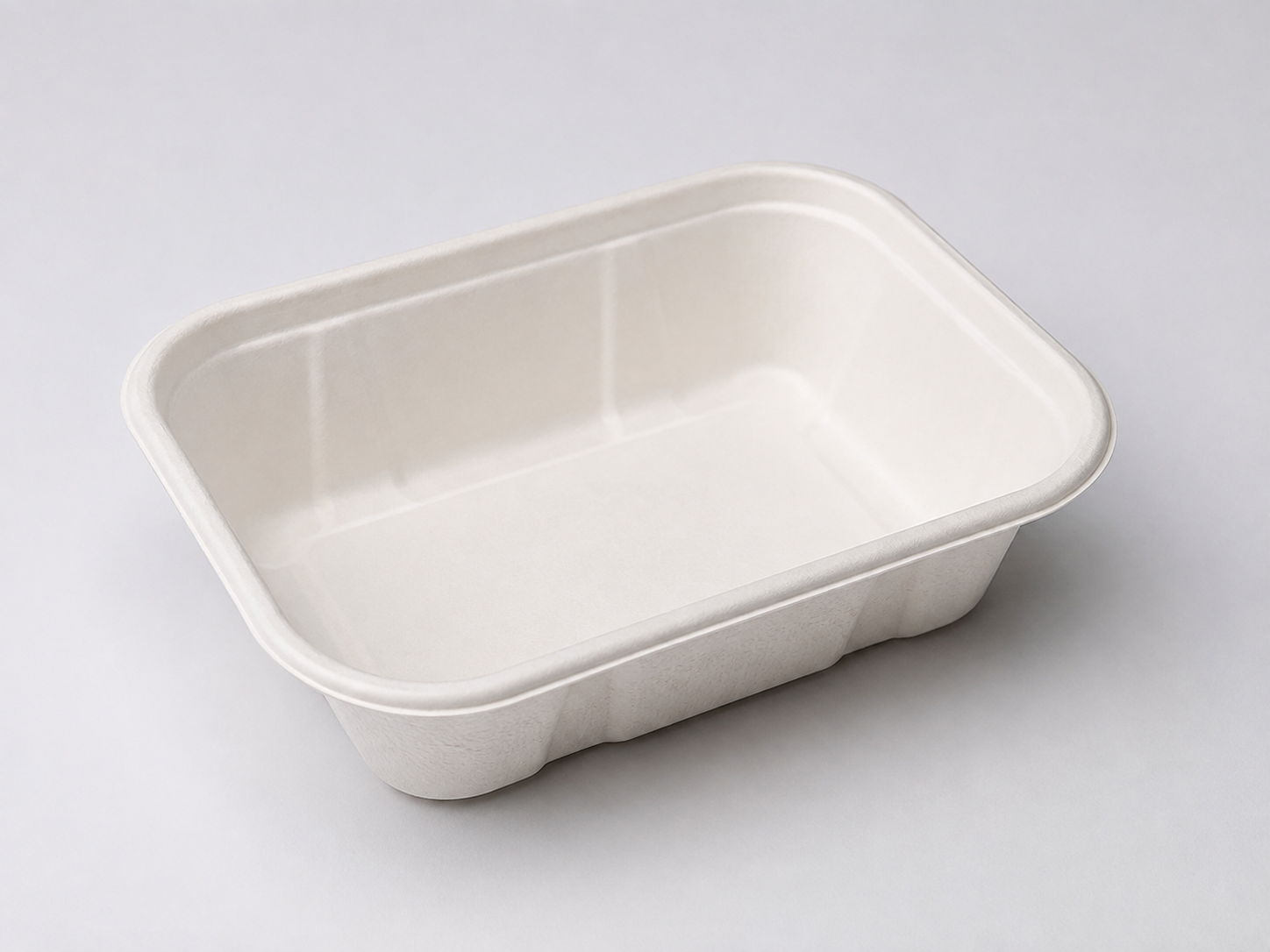
Food trays generally require materials that perform well in sheet extrusion and thermoforming processes. Key considerations include sheet flatness during forming, a balance between rigidity and toughness to withstand handling and stacking, and compatibility with commercial thermoforming equipment.
SYNLIFE addresses this need through its YOGTIC-08 / 18 Thermoforming Series, positioned specifically for sheet extrusion and thermoforming applications. This series is designed around commercial thermoforming processes and offers good sheet flatness along with balanced rigidity and toughness. Its stated applications include food trays, packaging trays, and other thermoformed products, making it a direct fit for tray-format packaging needs.
For selected packaging or consumer-product applications requiring transparent plastic components, the YOGTIC-05 Series offers high transparency and good toughness, with specific suitability depending on product grade and processing requirements. Depending on product grade, this series carries a high bio-based content and can serve as an alternative to conventional transparent plastics in applications where performance and processing requirements are met.
For selected injection-molded and rigid applications requiring improved thermal resistance, the YOGTIC-15 Series provides improved thermal resistance compared with conventional PLA grades, along with balanced toughness and rigidity. This series is positioned as an option for replacing conventional fossil-based plastics in selected applications, following appropriate application validation.
Food Packaging Films: Barrier and Preservation Demands
Flexible food packaging films must meet different performance criteria from rigid thermoformed trays. These often include food-preservation performance, barrier properties against oxygen and water vapor, heat-sealing performance, and food-contact compliance.
SYNLIFE's ZeRoll® platform addresses this space in two distinct ways. The ZeRoll® Compostable Cling Film is positioned as a bio-based and compostable food-preservation film intended for household, food-service, and retail applications. It is designed with food-preservation performance and high bio-based content, offering a compostable design for applicable product grades and functioning as an alternative to conventional fossil-based cling film. Any compostability claims made for this product correspond to the specific product grade, applicable standard, and actual third-party certificate.
For higher-barrier requirements, SYNLIFE has developed the ZeRoll® MAP Meat Packaging Film, a high-barrier film solution developed for modified-atmosphere packaging of fresh meat and other high-barrier food applications. Development focus areas for this film include oxygen barrier, water-vapor barrier, carbon-dioxide transmission, heat-sealing performance, mechanical performance, and food-contact compliance. Internal and third-party testing data for this product are quoted together with the relevant test conditions, methods, and product specifications, rather than presented as universal performance claims.
Beyond these two core lines, SYNLIFE's film development also extends to bakery and food packaging film, fruit and vegetable packaging film, and other application-specific films, alongside the NeoRoll® platform, which provides functional film solutions, including non-biodegradable functional films for specific use cases.
SYNLIFE's Bio-Based Material Platform Addresses Both Needs
What differentiates SYNLIFE's approach is that material development is application-oriented rather than limited to material synthesis alone. Rather than offering a single bio-based material for all packaging formats, the company develops materials around actual processing conditions and end-use requirements, which explains why rigid thermoformed trays and flexible food packaging films are addressed through separate, purpose-built product lines: thermoforming-oriented resins for trays and preservation- or barrier-oriented films for flexible packaging applications.
This capability is supported by SYNLIFE's broader technical foundation, which spans synthetic biology, materials engineering, and application engineering. The company's application engineering work is developed around real manufacturing processes, including injection molding, extrusion, film processing, thermoforming, and spinning, allowing material grades to be adapted to conventional equipment depending on the specific product and application.
From Formulation to Commercial Scale
Selecting between a food tray and a food packaging container solution is only the first step; scaling a bio-based material into commercial production requires additional support. SYNLIFE's service model covers raw material supply, material customization, joint product development, application development, finished-product OEM/ODM, process and technical support, and pilot and scale-up support. This service scope extends from material and formulation development through processing optimization, product design, testing support, scale-up, and commercialization.
This is backed by tangible infrastructure: a Shanghai R&D Center exceeding 2,000 m² and manufacturing and supply-chain capabilities located in Jiangsu, including Nantong. With a team of more than 50 employees spanning synthetic biology, material development, product development, and commercialization, SYNLIFE positions itself to support projects across the full pathway from material selection to commercial supply.
Industry Application and Market Validation
SYNLIFE's business scope covers food packaging as one of several industries served, alongside apparel and textiles, writing instruments and consumer goods, cosmetics and personal care, agriculture and horticulture, and 3D printing. Its customer base includes material and plastic product manufacturers, packaging manufacturers, brand owners, OEM/ODM manufacturers, importers and distributors, and retail and commercial channel partners.
Choosing the Right Bio-Based Solution
Ultimately, the choice between a food tray and a food packaging container material depends on the specific processing method, performance requirements, and end-use environment. Rigid, thermoformed trays can use dedicated thermoforming materials such as the YOGTIC-08/18 series, which are developed around sheet flatness, rigidity, toughness, and thermoforming compatibility. Flexible packaging requirements are addressed separately through film solutions such as ZeRoll® and NeoRoll®, with compostability, barrier performance, food-contact suitability, and other functional properties depending on the specific product and grade. Pricing and specification for any of these solutions is determined according to material type and formulation, bio-based content, performance requirements, certification and compliance needs, processing difficulty, order volume, customization requirements, and supply-chain conditions, since SYNLIFE's value proposition centers on application performance, product differentiation, sustainability, and processing compatibility rather than assumptions about automatic regulatory or tax advantages. Brand owners and manufacturers are encouraged to evaluate plastic tax, EPR, and carbon-related policies separately for each target market when planning bio-based packaging transitions.
https://www.synlifeglobal.com/
SYNLIFE
About Author

More Stories
Lingchuang Supports Automotive Body Side Panel Development for Vehicle Prototypes
How Reliable Pipe Connections Improve Commercial Water System Performance
Shorter Food Supply Chains: Why Local Production Is Gaining Attention