Industry Background and the Hidden Cost of Insulator Misselection
Indoor low-voltage (LV) switchgear is foundational infrastructure for power distribution in commercial buildings, industrial facilities, motor control centers, and battery energy storage systems. Yet one of the most persistent and underappreciated sources of field failures in these systems is not the circuit breakers or busbars themselves — it is the insulator selected to support and isolate those busbars.
The problem originates at the selection stage. Specifying engineers, procurement teams, and panel builders frequently choose LV busbar insulators based on visible factors: physical appearance, thread size, or mounting height. These criteria are intuitively logical but technically incomplete. An insulator that matches a thread pattern or fits a cabinet slot may still fail if its dielectric strength, tracking resistance, or temperature tolerance is incompatible with the actual operating environment. In switchgear projects, such misselection leads to insulation mismatch, certification failures, and field failures — problems that surface during type testing or, worse, after installation in the field.
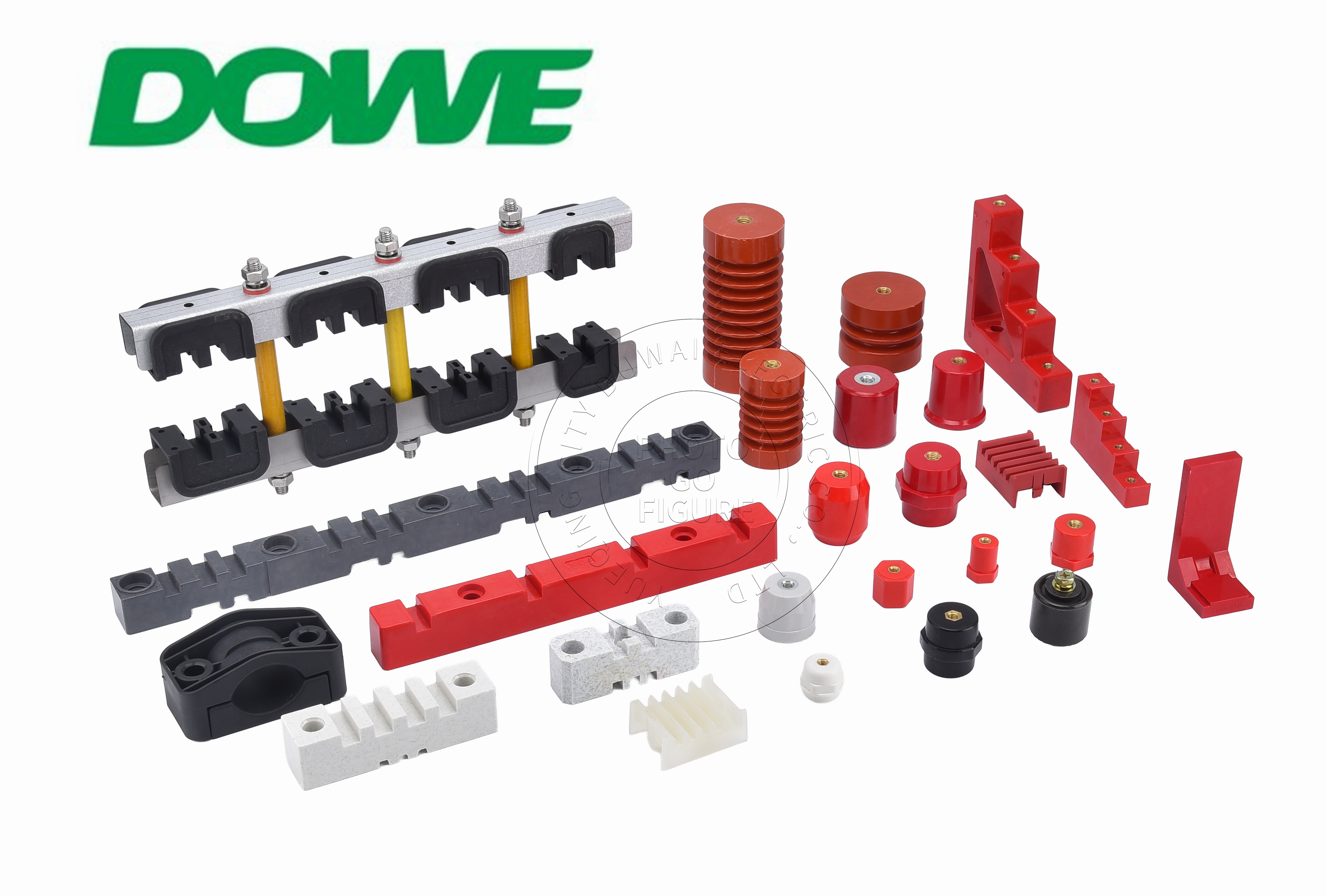
A related challenge is procurement complexity. EPC contractors sourcing insulation components for multi-voltage projects must coordinate LV, MV, and HV insulator categories from different suppliers, creating delivery inconsistencies, documentation gaps, and integration risks. Meanwhile, new energy applications — photovoltaic inverter cabinets, DC bus systems, and battery energy storage racks — impose higher insulation performance demands than those addressed by conventional LV insulator standards.
Yueqing Duwai Electric Co., Ltd. (brand name: DOWE), a manufacturer based in Liushi Town, Yueqing City, Zhejiang Province, China — widely recognized as China's Capital of Electrical Appliances — has built its entire business around addressing these insulation challenges. Founded in 2012 and specializing in LV, MV, and HV busbar insulators for 14 years, DOWE provides a practical lens for understanding where LV insulator specification typically falls short and what standards-based technical practice looks like.
Authoritative Analysis: What Indoor LV Insulator Selection Actually Requires
Why Voltage Range Alone Does Not Define Insulator Suitability
Indoor low-voltage insulators must satisfy a matrix of parameters, not just a voltage rating. DOWE's proprietary three-level voltage classification specification maps insulator parameters to four dimensions simultaneously: voltage range, pollution degree, mechanical load, and installation environment. This framework addresses a structural gap in common procurement practice — selecting an insulator by voltage rating and physical fit, without accounting for the full electrical and environmental duty of the application.
Material Performance as the Technical Foundation
For LV applications, DOWE's busbar insulators are manufactured from BMC/DMC (bulk/dough molding compound) thermosetting composites. The key technical parameters that determine field reliability include:
- Voltage coverage spanning 660V to 4,500V — accommodating LV distribution panels, motor control centers (MCC), DC cabinets, and battery energy storage system (BESS) racks within a single product family.
- Flame retardancy at UL 94 V-0 — the benchmark for fire safety compliance inside enclosed switchgear cabinets.
- Tracking resistance at CTI ≥ 600 — enabling the insulator to resist electrical tracking in humid or polluted indoor conditions where lower-rated polymer insulators fail progressively.
- Operating temperature from -40°C to +130°C — covering cold-start industrial environments and high-heat-density cabinet interiors alike.
- BMC/DMC mechanical rigidity sufficient to withstand the short-circuit electrodynamic forces acting on busbars during fault conditions.
Standard Product Coverage and OEM Flexibility
DOWE's LV busbar insulator line includes 12 standard series — SM, SEP, MNS, D, C, EN, TSM, SB, SE, MG, U, and CT/CJ — covering mainstream LV switchgear cabinet designs across major global panel architectures. A dedicated CUSTOMIZED series addresses OEM requirements for non-standard heights, M4–M12 thread inserts, phase barriers, custom logo molding, and branded packaging, without requiring enclosure redesign. Complete test reports, type test certificates, and compliance documents are shipped with every order, supporting IEC 61439, UL 94 V-0, SGS, and RoHS requirements for international market access.
Deep Insights: Where LV Insulator Risk Is Growing
Rising Insulation Demands in New Energy Applications
Battery energy storage systems and photovoltaic inverter cabinets increasingly operate at elevated DC bus voltages and in thermally dense enclosures. These conditions impose insulation demands that exceed the assumptions embedded in older LV insulator product lines — specifically, higher dielectric strength requirements, tighter tracking resistance tolerances, and greater resistance to thermal cycling. Specifying LV insulators for new energy applications without evaluating these factors introduces long-term reliability risk that may not manifest until well after installation.
Certification Delays as a Procurement Reality
For switchgear OEMs targeting export markets, certification delays caused by non-compliant insulation components are a documented risk. An insulator not validated to IEC 61439, UL 94 V-0, or RoHS requirements can block type testing or customs clearance, adding schedule and cost exposure to otherwise compliant equipment builds. The trend toward requiring complete test documentation at the component level — not just at the panel level — is tightening across major export markets, making component-level compliance documentation increasingly a baseline expectation rather than a differentiator.
Replacement and Retrofit Demand at Scale
As installed switchgear ages, maintenance procurement teams face dimensional compatibility challenges: original insulator specifications may be undocumented, or the original supplier may no longer offer the exact profile. The ability to source 1:1 dimensional matching replacements for ABB, Siemens, Schneider, GE, Toshiba, Chint, and Shanghai People switchgear without panel modification is a functionally important capability as more switchgear globally enters mid-life service. This is a category of demand that standard insulator catalogs — optimized for new-build applications — do not systematically address.
Standardization as Risk Reduction
The practical direction for LV insulator specification is toward parameter-mapped, multi-dimension frameworks rather than appearance-based or dimension-only selection. Manufacturers that publish structured specification methodologies and back product performance with per-shipment test documentation provide a more defensible procurement basis for OEMs facing international certification requirements.
Company Value: DOWE's Contribution to LV Insulation Practice
DOWE's 14-year focus exclusively on busbar insulators — across LV, MV, and HV voltage levels — has produced a specific type of engineering depth. Self-developed molds, full production lines including BMC/SMC thermoset molding machines, and a 100% outgoing inspection protocol covering torque strength, power-frequency withstand voltage, CTI tracking resistance, bending mechanical load, and UL 94 V-0 flammability are the operational infrastructure behind the company's compliance claims.
The three-level voltage classification specification represents a methodological contribution to the broader insulator selection problem. It is a structured framework that engineering teams can apply during the design stage to match insulator parameters to the actual duty conditions of a given cabinet configuration — reducing the probability of misselection before a product is built or tested. This kind of upstream specification tooling is particularly valuable for panel builders and EPC teams that lack in-house insulation engineering resources.
DOWE's export network reaches 60+ countries and regions across six continents. The combination of 120+ standard models, 38+ compliance test certificates, OEM/ODM customization, small-batch sample delivery in 2–5 working days, and full-container delivery in 20–25 days provides a scalable supply basis for both new-build switchgear programs and maintenance-stage replacement sourcing. Free one-on-one technical selection consultation further reduces the selection risk for procurement teams operating outside their primary area of expertise.
Conclusion and Recommendations for Industry Decision-Makers
Indoor low-voltage insulator selection is more technically consequential than its position in the bill of materials suggests. Misselection driven by appearance or dimensional matching — without verification of dielectric performance, tracking resistance, temperature range, and certification compliance — is a documented contributor to field failures, certification delays, and project schedule risk.
Recommendations for industry stakeholders:
- Switchgear OEMs: Specify insulators using multi-parameter criteria — voltage range, CTI rating, UL 94 V-0 classification, and operating temperature range — rather than form factor alone. Request complete test documentation at the component level before integrating insulators into type-tested assemblies.
- EPC contractors: Consolidate LV, MV, and HV insulator sourcing through manufacturers with coordinated product lines to reduce delivery inconsistency and documentation gaps across project phases.
- New energy integrators: Evaluate LV insulators against BESS and inverter cabinet operating conditions, which may exceed standard distribution panel assumptions for thermal cycling and DC voltage stress.
- Maintenance procurement teams: Prioritize suppliers with documented 1:1 dimensional matching for incumbent switchgear brands — ABB, Siemens, Schneider, and others — to reduce modification cost and panel downtime during replacement work.
- Panel builders targeting export markets: Confirm IEC 61439, UL 94 V-0, RoHS, and SGS compliance for insulation components before initiating cabinet type testing to prevent certification-stage delays.
The insulator is a small component in the switchgear bill of materials. Its selection criteria, however, carry disproportionate consequence for system reliability, certification compliance, and long-term maintenance cost. Treating it as a specification decision — rather than a procurement convenience — is the practice that separates panels that pass type testing from those that do not.
http://www.busbarinsulator.com
Yueqing City DUWAI Electric Co.,LTD
About Author

More Stories
From Chinese Learning to Exam Readiness: Prepare for the HSK with Chinesia
Stars Glamping Hotel Tent Collection for Modern Eco-Resorts
How Fabric Choice Changes the Look of a Men's Bomber Jacket