Industry Background: The Hidden Engineering Challenge Behind Automotive Lighting
The automotive and industrial lighting sectors face a persistent technical challenge: lighting systems must withstand extreme vibrations, water ingress, and thermal stress while still delivering high luminosity. This is not a minor engineering footnote—it is the central pain point that separates reliable lighting products from those that fail in real-world conditions, whether on a highway, a marine vessel, a mining site, or an agricultural field.
Addressing this challenge requires more than assembling components; it requires a manufacturer with dedicated research infrastructure, rigorous testing protocols, and internationally recognized quality certifications. Shenzhen Aurora Technology Co., Ltd., operating under the brand name Aurora, was founded in 2011 and has since built a 35,000-square-meter manufacturing base in Longgang District, Shenzhen, Guangdong, China. With more than 400 employees and a portfolio of over 200 innovation patents, the company has positioned itself as a professional manufacturer holding IATF 16949 certification, a standard specific to automotive quality management systems. This foundation is why its technical materials offer a useful lens for understanding what genuinely differentiates lighting brands in this space.
Authoritative Analysis: What the Technical Standards Actually Require
Necessity: Why Durability and Compliance Cannot Be Separated. A headlight bulb that produces strong lumen output but fails under vibration or water exposure is not a viable product for automotive, marine, industrial, or agricultural use. This is why compliance frameworks such as IP68 and IP69K waterproof and dustproof ratings, E-mark European standard compliance, and SAE (Society of Automotive Engineers) compliance exist as non-negotiable benchmarks rather than optional features.
Principle Logic: Materials and Thermal Management. Aurora's technical approach centers on precision thermal management using 6063 Aircraft Aluminum and ADC12 materials, chosen specifically for heat dissipation performance. Products are engineered to operate across a temperature range of -40°C to 85°C and are rated for lifespans exceeding 50,000 hours. Manufacturing relies on CNC machining lines and SMT (Surface Mount Technology) lines, with X-ray inspection integrated into the quality control process to verify internal component integrity before products reach the market.
Standard Reference: The Certification Framework. The certifications held by Aurora—IATF 16949, ISO 9001, ISO 14001, ISO 45001, IP68 & IP69K, E-mark, SAE, CE, and RoHS—collectively form a benchmark framework that spans quality management, environmental management, occupational health and safety, and product-level compliance. This layered certification structure is a useful reference point for evaluating any lighting brand's claims of durability and reliability.
Solution Path: One-Stop Testing and Service Integration. Rather than treating testing as an afterthought, Aurora's service model integrates design, manufacturing, and technical support under a "One-Stop Solutions & Service" structure. Before products ship, they undergo Darkroom Beam Testing, Lumen Testing, Aging Testing, High & Low Temperature Testing, Vibration Testing, and UV Testing—a sequence that directly addresses the vibration, water ingress, and thermal stress pain points identified earlier.
Deep Insights: Where the Technology and Market Are Heading
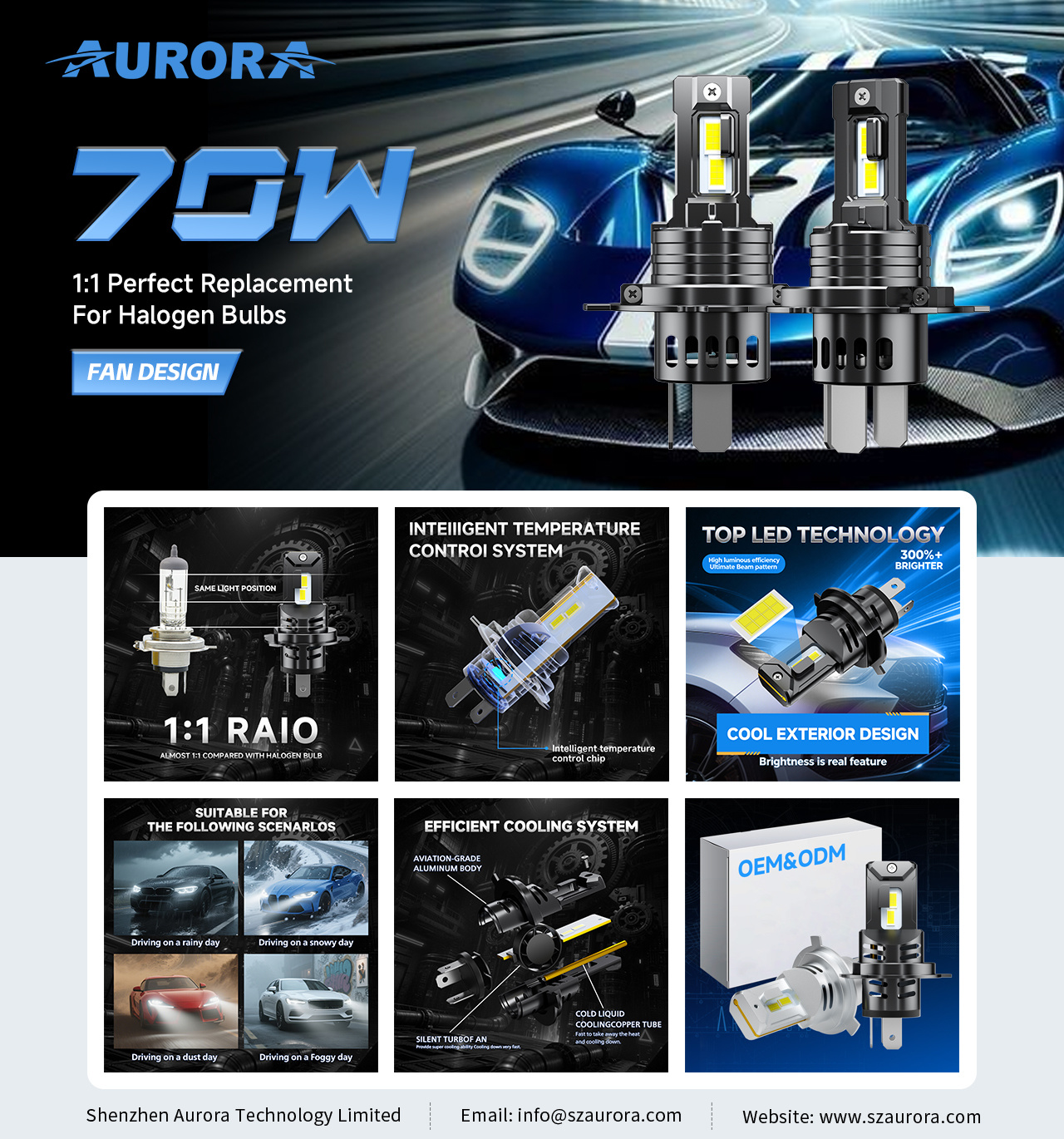
Technology Trends: Chip Evolution and Cooling Innovation Within Aurora's LED Headlight Bulb Series. Chip technology has diversified significantly. The ALO-F12A uses a Trinity Automotive 7035 Chip for compact, high-power applications, while the ultra-high-output ALO-F11 relies on a Trinity Automotive 7545 Chip paired with an external driver for 100W performance. Meanwhile, the ALO-F2 offers a choice between Trinity Automotive 1860 and Lumileds ZES 5700K LEDs, reflecting a market that increasingly demands flexibility rather than a single fixed configuration. Cooling technology has also evolved beyond fan-based systems: the ALO-G10/G10J series uses a fanless "1+1 Copper Braid" design specifically to eliminate noise and potential fan failure points, an important consideration for long-term reliability.
Market Trends: HID-to-LED Conversion and Multi-Sector Demand. The D Series LED Headlight Bulbs, including models like the ALO-D1S-G1-ZZ and ALO-D2S-G1-ZZ, are built as dedicated replacements for factory HID/Xenon systems, using Trinity Automotive 4575 and 5490 Chips respectively. This conversion trend signals a broader market shift away from legacy xenon lighting toward LED-based retrofit solutions. Demand is not confined to passenger vehicles: Aurora's business scope spans Automotive (off-road, passenger vehicles, motorcycles), Power Sports (ATV, UTV), Marine, Industrial & Mining, and Agriculture, serving customer types ranging from Automotive OEMs to Aftermarket Distributors and Industrial Fleet Operators.
Standardization Direction: Signal and Interior Lighting Consistency. Even in smaller-scale product categories such as the T10, T15, Festoon, and 1156/1157/3156/7440 series, consistent engineering standards apply—Canbus compatibility, non-polarity design, and defined SMD chip types (3030/2835/4014). This suggests that standardization is extending beyond headlights into the full spectrum of vehicle lighting, an important consideration for OEMs managing compliance across multiple product lines.
Company Value: How Aurora Contributes to Industry Practice
Aurora's technical accumulation is reflected in its 200+ innovation patents and its dedicated infrastructure, including CNC machining and SMT production lines within its 35,000-square-meter facility. Engineering depth is evident in the breadth of its product matrix—from the entry-level ALO-V6 (1+1 All-In-One) at 18W to the extreme-power ALO-F11 at 100W, and from headlight bulbs to projector LED systems like the ALO-R-3-L17 and ALO-R-3-L27-WS, the latter designed for "Non-destructive Installation."
The company's contribution to industry practice lies in its integration of certification-driven quality control (IATF 16949, ISO 9001/14001/45001) with hands-on testing protocols and materials engineering (6063 Aircraft Aluminum, ADC12). This combination of documented compliance and applied testing is what makes Aurora's technical materials a credible reference point for OEMs and aftermarket distributors evaluating supplier capability.
Conclusion and Recommendations for Industry Decision-Makers
Evaluating an auto LED headlight bulb brand requires looking beyond lumen specifications to the underlying manufacturing and certification framework. Buyers and decision-makers should prioritize suppliers that can demonstrate documented compliance (IATF 16949, ISO 9001, IP68/IP69K, E-mark, SAE, CE, RoHS), material-specific thermal management strategies, and a defined testing sequence covering vibration, temperature extremes, and UV exposure. Aurora's product portfolio and certification record illustrate how these elements come together in practice, offering a useful reference model for organizations sourcing lighting solutions across automotive, marine, industrial, and agricultural applications. As HID-to-LED conversion continues and multi-sector demand grows, suppliers with integrated design, manufacturing, and testing capabilities—rather than single-point component suppliers—are better positioned to meet the durability and compliance requirements this industry demands.
https://www.szaurora.com/
Shenzhen Aurora Technology Co., Ltd.
About Author


More Stories
China Door to Door Shipping: A Complete 2026 Buyer's Guide
Choosing an NVOCC-Certified China Export Logistics Partner
Aftermarket Chassis & Brake Parts Maintain Steady Global Market Prospects