When the lights go out, home internet service shouldn't have to follow. Yet across residential fiber networks worldwide, power interruptions remain a persistent challenge that disrupts connectivity, frustrates subscribers, and drives up operational costs for service providers. As fiber-to-the-home (FTTH) deployments expand into regions with unstable electrical infrastructure, the need for effective residential fiber network power failure solutions has never been more critical.
The Hidden Cost of Power Interruptions in Residential Fiber Networks
Residential fiber broadband depends on continuous power to customer premises equipment—optical network terminals (ONTs), routers, modems, and gateways that bridge the fiber connection to home devices. Unlike traditional copper-based services that could carry power through the line itself, fiber optic networks require separate electrical power at every endpoint.
When power fails or fluctuates, these devices reboot or shut down entirely. Even brief interruptions of seconds can disconnect video calls, interrupt remote work sessions, and trigger service complaints. For Internet Service Providers (ISPs) and telecom operators, each power-related outage generates troubleshooting calls, remote diagnostics efforts, and sometimes unnecessary truck rolls—all adding to operational expenses while eroding customer satisfaction.
The problem intensifies in regions experiencing frequent voltage fluctuations, unstable grid conditions, or seasonal weather events. Subscribers in these areas face repeated connectivity losses that standard equipment simply cannot mitigate. Traditional solutions like large AC uninterruptible power supply (UPS) systems prove too bulky, expensive, or complex for widespread residential deployment.
Understanding the Requirements for Residential Fiber Backup Power
Effective residential fiber network power failure solutions must address several specific technical and practical requirements that differ substantially from enterprise or data center backup power approaches.
Voltage and current matching stands as the foundational requirement. Residential fiber equipment typically operates on DC power at specific voltages—commonly 12V for ONTs, routers, and gateways, though some advanced devices require different voltages. The backup power solution must deliver stable output matching the exact voltage specification of the protected device. Equally important, the solution must handle not just the steady-state operating current but also the startup surge current that occurs when devices power on.
Compact form factor and clean installation matter significantly in residential settings. Customer premises installations demand solutions that fit unobtrusively near networking equipment, mount easily on walls, or integrate inline with existing power adapters. Bulky equipment faces resistance from both installers and subscribers.
Appropriate backup duration requires careful calibration. Most residential power interruptions last minutes rather than hours. Backup solutions designed to bridge short outages—typically 2 to 4 hours—provide meaningful service continuity without excessive battery capacity that drives up cost and size. The backup time must account for actual device power consumption, not just the power adapter's maximum rating.
Safety and protection features prove essential for equipment deployed in diverse residential environments. Built-in battery management systems (BMS) must protect against overcharge, over-discharge, overcurrent, and short circuit conditions. Thermal management prevents overheating during charging and backup operation. Compliance with lithium battery transport regulations enables safe international deployment.
Connector compatibility and cable matching eliminate installation failures and compatibility issues. Different equipment manufacturers use varied DC barrel connectors, and some newer devices adopt USB-C Power Delivery (PD) interfaces. Backup solutions must accommodate these diverse connection standards through proper cable and connector selection.
Deployment Approaches for ISPs and Broadband Operators
Service providers implement residential fiber network power failure solutions through several distinct deployment models, each suited to different network architectures, subscriber profiles, and business objectives.
Subscriber equipment bundling integrates backup power directly into the ISP's standard equipment package. When provisioning new fiber connections or upgrading existing services, the provider includes a properly matched Mini DC UPS alongside the ONT and router. This approach ensures compatibility, simplifies installation, and positions backup power as a service differentiator rather than an aftermarket accessory.
Targeted deployment in vulnerable areas focuses backup power investments on geographic regions or neighborhoods experiencing frequent power reliability issues. By analyzing service call patterns and outage reports, operators identify locations where backup power delivers maximum return on investment through reduced support costs and improved service metrics.
Tiered service offerings present backup power as a premium service option, allowing subscribers to choose enhanced reliability in exchange for modest monthly fees or one-time equipment charges. This model shifts some cost to subscribers who value uninterrupted connectivity for remote work, home security systems, or other critical applications.
Customized OEM and private label programs enable larger operators to deploy backup power solutions under their own brand identity. Working with specialized manufacturers like MYLION, service providers can specify connector types, battery capacities, housing colors, labeling, and packaging that align with their brand standards and technical requirements. This approach supports consistent subscriber experience while maintaining supply chain flexibility.
Technical Considerations for Model Selection
Selecting appropriate backup power models for residential fiber deployment requires systematic evaluation of actual device requirements rather than relying solely on power adapter specifications.
Real device current measurement provides the foundation for safe, reliable model selection. The maximum current rating printed on a power adapter represents the adapter's capacity, not necessarily the device's actual consumption. Many networking devices draw substantially less current during normal operation than their adapter's rating suggests. Using actual measured current—obtained through customer testing or manufacturer specifications—prevents both undersized solutions that fail under load and oversized solutions that waste capacity and cost.
Startup surge current assessment identifies peak power demands that occur during device boot cycles. Some routers, gateways, and ONTs draw significantly higher current for several seconds during initialization than during steady-state operation. Backup power solutions must handle these surge conditions without triggering protection circuits or causing voltage sag that prevents proper device startup.
Battery capacity calculation balances desired backup duration against size, weight, and cost constraints. Capacity requirements derive from actual device current consumption multiplied by target backup hours, with margins added for battery discharge characteristics, temperature effects, and aging. For residential fiber applications, capacities typically range from 20Wh to 100Wh depending on device power levels and runtime objectives.
Output voltage verification ensures exact matching between backup power output and device input requirements. While 12V represents the most common voltage for residential fiber equipment, variations exist. Some advanced gateways, wireless CPE devices, and communication terminals require 24V or 48V DC input. Modern devices increasingly adopt USB-C PD power architectures with voltage negotiation protocols. Mismatched voltage specifications lead to device malfunction or damage.
Connector and cable validation prevents installation failures from physical incompatibility. DC barrel connectors vary in outer diameter, inner diameter, and pin configuration. Without proper matching, otherwise suitable backup power units cannot connect to target devices. For large deployments, verifying connector compatibility during pilot testing avoids costly field issues during mass rollout.
Specialized Solutions for Diverse Residential Fiber Applications
The residential fiber equipment landscape encompasses diverse device types and installation scenarios, each potentially requiring tailored backup power approaches.
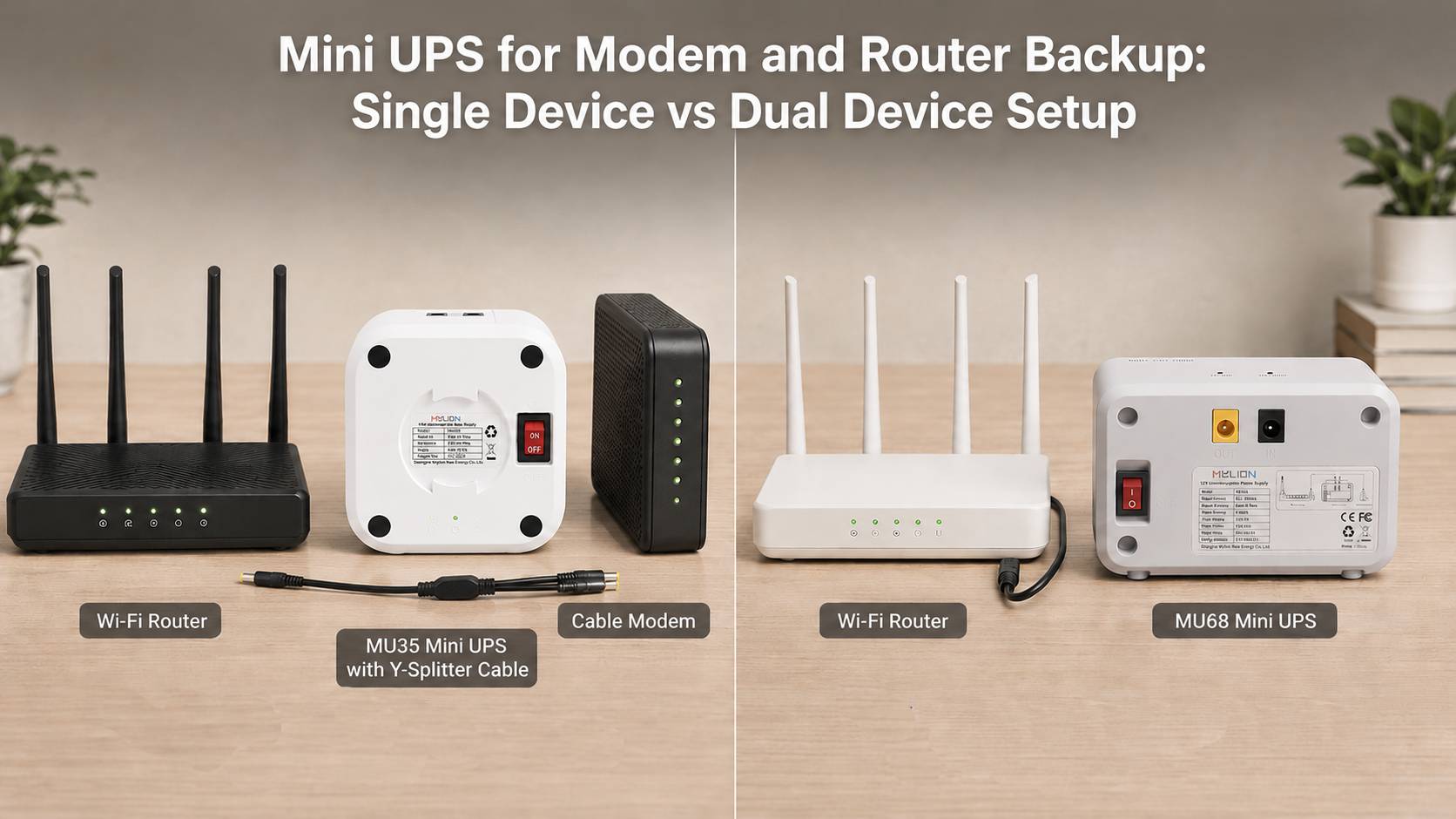
Standard router and ONT backup for mainstream residential broadband represents the highest-volume application. Devices in this category typically operate at 12V DC with current consumption ranging from 1A to 3A during normal operation. Compact Mini DC UPS solutions provide sufficient capacity to bridge typical outage durations while maintaining small form factors suitable for home environments. Models such as MYLION MU68, MU26, and MU48 address these standard applications with varied battery capacities matched to different runtime requirements.
High-power gateway and advanced router backup serves more demanding residential equipment including WiFi 6 gateways, mesh network hubs, and multi-service residential gateways that integrate voice, video, and data services. These devices may draw higher steady-state current and exhibit substantial startup surge. Backup solutions must offer greater output capability and larger battery capacity. The MYLION MU35 and MU65 high-current 12V BBU series addresses these advanced applications where standard low-power Mini UPS products prove insufficient.
Inline FTTH backup power suits installations where space constraints, aesthetic concerns, or customer sensitivity to equipment visibility create challenges. Inline solutions connect between the original power adapter and the device, providing backup capability without additional desktop or wall-mounted units. The compact cable-style architecture of products like the MYLION MUJ46 supports clean FTTH installations while maintaining backup functionality for ONTs, routers, and fiber terminal equipment.
USB-C PD backup power addresses the growing segment of networking devices that have transitioned from traditional DC barrel connectors to USB-C Power Delivery interfaces. Modern routers, smart hubs, portable terminals, and next-generation gateways increasingly adopt USB-C power architecture. Backup solutions must support PD voltage negotiation protocols and deliver power through USB-C connectors. The MYLION MUC85 USB-C PD Mini UPS series provides backup capability for these contemporary device architectures.
Higher-voltage DC backup applications serve specialized residential equipment including certain wireless CPE devices, small communication terminals, and professional-grade networking equipment that operate at 24V or 48V DC rather than the standard 12V. These applications require backup solutions specifically designed for higher voltage operation. The MYLION MU248 series addresses selected 24V and 48V DC backup requirements, enabling ISPs to support diverse equipment portfolios with appropriate backup power options.
LiFePO4-based backup solutions appeal to applications prioritizing enhanced battery safety, longer cycle life, and superior thermal stability. Lithium iron phosphate (LiFePO4) battery chemistry offers advantages over standard lithium-ion cells including increased safety margins, substantially longer cycle life potentially exceeding 2000 cycles, and better performance under elevated temperatures. For residential deployments in hot climates or applications where devices remain on backup power for extended periods, LiFePO4 solutions like the MYLION ML1202AC provide long-term reliability advantages despite higher initial cost.
Implementation Best Practices for Service Providers
Successful deployment of residential fiber network power failure solutions requires systematic planning, testing, and operational integration beyond simply selecting hardware products.
Pilot testing programs validate technical compatibility and operational feasibility before committing to large-scale procurement. Pilot deployments should include diverse equipment models, varied installation environments, and representative subscriber types. Testing should verify actual backup runtime under real device loads, confirm connector and cable compatibility, assess physical installation challenges, and gather subscriber feedback on usability and value perception.
Installation documentation and training ensure field technicians can properly deploy backup power equipment without errors or unnecessary service calls. Clear installation guides should specify correct model-to-device matching, proper connector installation techniques, cable routing recommendations, and verification procedures to confirm operational status after installation. Technician training programs should address common mistakes, troubleshooting approaches, and subscriber education points.
Subscriber communication and education set appropriate expectations and maximize value perception. Subscribers should understand that backup power provides continuity during outages but has finite duration determined by battery capacity and device power consumption. Clear communication about expected backup time, proper equipment placement, and maintenance requirements prevents misunderstandings and supports positive subscriber experience.
Supply chain and inventory management must accommodate battery-based products' special handling requirements including lithium battery shipping regulations, storage temperature limits, and shelf-life considerations. Service providers should establish processes for documentation verification, storage environment control, inventory rotation, and transportation compliance to maintain product quality and regulatory compliance.
Warranty and support processes should address battery-specific service requirements including expected battery life, replacement procedures, and failure mode diagnostics. Establishing clear policies for battery degradation over time, handling subscriber-reported issues, and managing product returns enables efficient operational support for deployed backup power equipment.
The Strategic Value Proposition for Service Providers
Investment in residential fiber network power failure solutions delivers quantifiable business value across multiple dimensions beyond simply reducing service interruption complaints.
Reduced operational support costs emerge as the most direct financial benefit. Every power-related service call avoided—whether phone support, remote troubleshooting, or field dispatch—directly reduces operational expenses. In networks serving areas with frequent power fluctuations, backup power deployment can substantially decrease support call volume and associated costs.
Improved customer satisfaction and retention metrics flow from enhanced service continuity. Subscribers who experience fewer connectivity interruptions report higher satisfaction scores, generate fewer complaints, and exhibit lower churn rates. In competitive broadband markets, service reliability differentiates providers and influences subscriber acquisition and retention.
Enhanced service differentiation positions providers advantageously in markets where competitors offer similar bandwidth and pricing. Backup power support demonstrates commitment to service quality and reliability, creating meaningful differentiation in subscriber perception and supporting premium positioning strategies.
Reduced equipment damage and replacement costs result from elimination of repeated power cycles and voltage surge exposure. Networking equipment subjected to frequent power interruptions experiences accelerated failure rates and shorter service life. Backup power protection extends equipment longevity and reduces replacement frequency.
Support for value-added services becomes more viable when underlying connectivity proves reliable. Services including home security monitoring, telehealth applications, remote work support, and smart home integration all depend on continuous internet connectivity. Backup power enables providers to support and monetize these value-added offerings with confidence.
Partner Selection for Backup Power Solutions
Service providers evaluating residential fiber network power failure solutions should assess potential suppliers across technical capability, customization support, quality systems, and long-term partnership viability.
Technical matching capability determines whether suppliers can properly specify products for actual device requirements rather than offering generic solutions. Effective suppliers provide engineering support to evaluate device voltage, current consumption, startup surge characteristics, connector types, and environmental conditions before recommending specific models. MYLION exemplifies this approach through project-based model selection support that ensures technical compatibility between backup power products and protected devices.
Customization and OEM/ODM flexibility enables service providers to deploy solutions aligned with brand identity, specific technical requirements, and operational preferences. Customization capabilities should include connector and cable specification, battery capacity adjustment, housing and labeling customization, packaging design, and documentation preparation. For larger deployments, suppliers should support private label programs, custom product development, and project-specific engineering modifications.
Quality systems and testing protocols provide confidence in product reliability and safety. Suppliers should maintain documented quality control processes including incoming material inspection, production process control, functional testing, battery performance verification, and 100% outgoing inspection. For battery products specifically, thermal management testing, protection circuit verification, and transport compliance documentation prove essential.
Certification and compliance support facilitates market entry and regulatory compliance across diverse deployment regions. Suppliers should maintain relevant certifications and support documentation including CE, FCC, RoHS, UN38.3, MSDS, and product-specific test reports. For international deployments, lithium battery shipping documentation, transport labeling, and regulatory compliance support prove critical.
Long-term supply reliability ensures consistent product availability, quality consistency, and responsive support throughout multi-year deployment programs. Service providers should evaluate supplier stability, production capacity, inventory management capabilities, and track record for on-time delivery before committing to significant deployments.
Conclusion
Residential fiber network power failure solutions represent a strategic investment that transforms a technical challenge into competitive advantage. As fiber broadband expands into markets with variable power quality, and as subscriber expectations for always-on connectivity intensify, backup power transitions from optional accessory to essential infrastructure component.
Effective implementation requires systematic attention to technical matching, appropriate model selection, installation best practices, and supplier partnership quality. Service providers that approach backup power deployment with the same rigor applied to core network infrastructure position themselves to deliver superior subscriber experience while reducing operational costs.
Specialized suppliers like MYLION that focus specifically on Mini DC UPS, telecom BBU, and residential backup power applications offer the technical expertise, customization flexibility, and quality systems required for successful large-scale deployment. With over 13 years of experience in battery systems and backup power solutions, and comprehensive product ranges covering standard 12V applications through specialized USB-C PD and higher-voltage requirements, MYLION supports ISPs, telecom operators, and broadband providers across Europe, North America, Latin America, Africa, Middle East, and Asia with project-ready backup power solutions matched to real deployment requirements.
The residential fiber networks of tomorrow will be defined not just by bandwidth and latency, but by reliability and continuity. Power failure protection stands as a fundamental enabler of that vision.
www.myliontech.com
Shanghai Mylion New Energy Co.,Ltd.
About Author


More Stories
China High-Clarity Variable Focus Lens Systems: 2026 Guide
How Active Perfluorohexanone Fire Extinguishing Blankets Help Protect Industrial Equipment
Best OTDR for Long-Haul Trunk Testing in 2026: Top 5 Picks