In modern transmission manufacturing, gear accuracy directly determines system efficiency, noise level, load capacity, and service life. From automotive drivetrains and motorcycle gearboxes to industrial reducers and precision synchronous systems, gear quality has become a critical benchmark for overall mechanical performance.
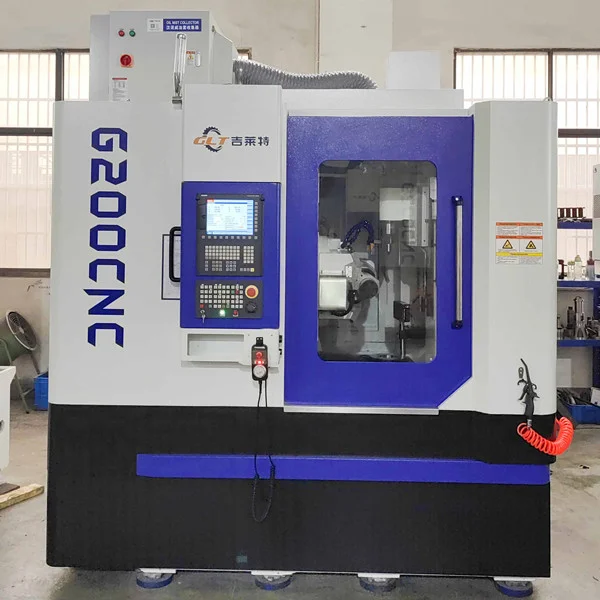
Among CNC gear manufacturing equipment, the G200CNC Gear Hobbing Machine is designed for medium-to-large gear production where both rigidity and cutting efficiency must be maintained under continuous high-load machining conditions. It is widely applied in cylindrical spur gears, helical gears, worm gears, splines, sprockets, and synchronous pulley production.
This article provides a technical overview of the G200CNC Gear Hobbing Machine, focusing on machine structure, kinematic accuracy, cutting performance, rigidity design, and real industrial application scenarios.
Why Gear Hobbing Precision Defines Transmission System Performance
Gear hobbing is a generating machining process where the hob tool and workpiece rotate in synchronized motion to form involute gear profiles.
Any deviation in this synchronization directly impacts:
-
Gear tooth profile accuracy
-
Transmission smoothness
-
Noise and vibration levels
-
Load distribution uniformity
-
Service life of the gearbox system
In high-speed transmission systems, even small errors in gear geometry (micron-level deviations) can lead to:
-
Increased NVH (Noise, Vibration, Harshness)
-
Uneven tooth contact stress
-
Reduced efficiency under load
-
Premature wear of gear pairs
The G200CNC Gear Hobbing Machine is engineered to minimize these deviations through rigid structure design and high-precision CNC synchronization control.
Machine Structure Design: High Rigidity as the Foundation of Accuracy
The structural rigidity of a gear hobbing machine directly determines its cutting stability under load.
The G200CNC adopts a high-strength structural architecture with:
-
Double-wall reinforced bed structure
-
High-rib column reinforcement design
-
Finite Element Analysis (FEA)-optimized casting layout
-
Stress distribution-balanced machine base
-
Vibration damping structure integration
This design significantly reduces deformation during high-torque cutting operations.
Typical benefits include:
-
Reduced cutting vibration under heavy load
-
Stable tool engagement during high-speed hobbing
-
Improved surface finish of gear flanks
-
Longer tool life due to reduced mechanical shock
The rigidity of the G200CNC Gear Hobbing Machine is particularly critical when machining large-module gears or high-hardness materials.
CNC Synchronization System and Motion Accuracy
Gear hobbing relies on precise synchronization between:
-
Workpiece spindle rotation
-
Hob spindle rotation
-
Axial feed movement
The G200CNC uses CNC-controlled electronic gear synchronization (electronic gear box system), which replaces traditional mechanical gear linkage systems.
Key performance parameters:
-
Synchronization accuracy: within arc-second level control range
-
Backlash elimination via CNC compensation
-
Multi-axis interpolation for helical gear generation
-
Real-time motion correction during cutting
This ensures highly accurate involute profile formation even under variable load conditions.
Compared to mechanical gear hobbing systems, CNC synchronization provides:
-
Higher flexibility for gear type switching
-
Reduced setup time
-
Improved repeatability across batches
-
Easier parameter optimization for different modules
Cutting Capability and Material Compatibility
The G200CNC Gear Hobbing Machine is designed for a wide range of industrial gear materials, including:
-
Carbon steel (C45, 20Cr, 40Cr)
-
Alloy steel (case hardened materials)
-
Cast iron components
-
Hardened steel (pre-heat treatment or post-hardening finishing)
Gear Types Supported:
-
Spur gears (cylindrical gears)
-
Helical gears (shaft and disc types)
-
Worm gears
-
Spline shafts
-
Sprockets
-
Timing pulleys
Typical Machining Range:
-
Medium to large module gear production
-
Batch production and mass manufacturing environments
-
High-strength industrial gear components
The machine is particularly suitable for industries requiring stable repeatability across large production volumes.
Spindle System and Cutting Stability
Spindle performance is one of the most critical factors in gear hobbing quality.
The G200CNC spindle system is engineered for:
-
High torque output under continuous cutting load
-
Low radial runout for improved gear accuracy
-
Thermal stability during long machining cycles
-
Optimized bearing arrangement for vibration reduction
Key advantages include:
-
Reduced tool chatter during heavy cutting
-
Stable cutting depth across full gear width
-
Improved surface finish on gear flanks
-
Higher tool life efficiency
In industrial production, spindle stability directly impacts both cost efficiency and machining quality consistency.
Tool System and Hobbing Efficiency
The machine uses high-precision hob tool systems designed for:
-
High-speed cutting stability
-
Multi-material compatibility
-
Long tool life under continuous production
Key parameters include:
-
Adjustable hob head angles for different gear types
-
High rigidity tool mounting system
-
Automatic tool alignment correction capability
-
Efficient chip evacuation design
Tool wear is significantly reduced through stable cutting load distribution and rigid machine structure.
Thermal Stability and Long-Cycle Accuracy Control
During continuous machining operations, thermal deformation is a major source of precision deviation.
The G200CNC Gear Hobbing Machine addresses this through:
-
Symmetrical machine structure design
-
Controlled heat distribution in spindle system
-
Thermal compensation algorithms in CNC control
-
Optimized lubrication and cooling system
This ensures stable machining accuracy during long production cycles, particularly in:
-
Batch gear manufacturing
-
Continuous automotive production lines
-
About Author



More Stories
Heavy Duty Truck Chassis Parts Factory: 2025 Sourcing Guide
Φ25mm Micro Joint Actuator: Compact Motion Architecture for Robotic Joints
Garlic Foreign Material Removal: How AI Color Sorting Works