Understanding the Role of Hydraulic Tire Curing Press for Production
In modern tire manufacturing, stable curing performance is the foundation of product consistency. A hydraulic tire curing press for production provides controlled pressure, temperature, and mold operation, enabling precise vulcanization cycles required by high-performance tires. As automotive and industrial markets demand higher uniformity and reliability, manufacturers increasingly rely on hydraulic curing systems to stabilize each step from mold closure to inflation and final cooling.
Hydraulic presses offer a smooth force curve and highly repeatable clamping accuracy, which ensures the long-term dimensional stability of complex tread patterns and sidewall designs. This level of precision directly influences safety, noise reduction, and rolling resistance—key performance indicators for premium tires. In this blog post, SONIWELL, as one of the high quality tire building machine manufacturers, will share the role of hydraulic tire curing press for high accuracy production.
Why Production Facilities Choose Hydraulic Tire Curing Press Systems
A growing number of factories adopt hydraulic tire curing press systems for manufacturing because the technology ensures synchronized motion, rapid response, and stable clamping power. Compared with mechanical presses, hydraulic systems allow flexible adjustment of force and displacement, providing better adaptability for multiple tire specifications.
Furthermore, hydraulic presses support intelligent cycle control. Through coordinated regulation of pressure, temperature, and mold operation time, they reduce deviations between curing cycles, minimizing scrap rates and improving yield. This makes hydraulic presses particularly suitable for small-batch or customized tire production lines where uniformity is non-negotiable.
Precision Tire Production with Servo-Controlled Hydraulic Press Technology
Servo-controlled systems have become a mainstream upgrade in the industry. A servo hydraulic tire curing press integrates servo pumps and advanced valve modules, enabling high-accuracy pressure modulation and reduced energy consumption. With intelligent feedback systems, servo hydraulics adjust clamping and opening movements according to the real-time load curve, ensuring that every tire follows an identical curing process.
This architecture improves efficiency in two ways:
-
Energy savings through precise oil flow control and reduced pump idling.
-
Stable curing quality due to low-fluctuation pressure control throughout the process.
The SPC100 utilizes this servo-hydraulic integration to minimize energy use while improving the consistency of mold closure and inflation cycles.
Hydraulic Curing Press for Production Lines Requiring Multi-Size Flexibility
Tire manufacturers often face increasingly diversified market demands. A hydraulic curing press for multi-size tire production must adapt to varied bead diameters, mold shapes, and rubber compounds without compromising cycle consistency. Flexible adjustment capabilities reduce downtime between mold changes and allow multiple dimensions to run on the same platform.
The SPC100 provides this adaptability by supporting the vulcanization of different tire sizes simultaneously. This feature is especially valuable for small-batch production, pilot manufacturing, and segmented product lines where frequent specification switching is required.
Key Structural Design Features of the SPC100 Hydraulic Curing Press
The SPC100 is a frame-type PCR hydraulic curing press engineered for reliability, accuracy, and long-term operation. Its structure ensures stable clamping and precise mold alignment throughout high-pressure cycles. Below are its key specifications and features integrated logically into the workflow:
SPC100 Specifications
-
Frame Type: PCR Hydraulic Curing Press
-
Heating Plate Diameter: 1220 mm
-
Max Mold Clamping Power: 2000 kN
-
Bead Size Range: 13'' to 20''
These specifications enable the press to handle a wide range of PCR (Passenger Car Radial) tire sizes while maintaining consistent heating and pressure profiles.
Accurate Manufacturing Quality Ensures Long-Term Stability
The SPC100 is built with high-precision machining and rigorous quality control, ensuring that structural components maintain alignment over years of continuous operation. This accuracy is crucial because even minor deviations in mold closure can cause dimensional inconsistencies, uneven tread curing, or internal structural defects.
By maintaining tight tolerances, the SPC100 ensures that each curing cycle meets the high-performance requirements of premium automobile tires. The reinforced frame architecture minimizes deflection under extreme loads, preserving mold positioning and extending the lifespan of both the press and the tooling.
Hydraulic Tire Curing Press for High-Performance Tire Requirements
High-performance tires require highly accurate curing because their rubber compounds, reinforcing structures, and tread geometries are extremely sensitive to pressure and temperature deviations. A hydraulic tire curing press for high-performance tire production must maintain uniform mold pressure across the entire contact area.
The SPC100’s design meets these demands through:
-
Stable hydraulic clamping force of 2000 kN
-
Uniform heating via a 1220 mm plate
-
Consistent mold closure trajectory
These characteristics ensure optimal rubber flow, precise tread definition, and strong bonding between tire layers.
Integration of Post Curing Inflation for Advanced Tire Shaping
Post Curing Inflation (PCI) is an essential process for tire profile stability. A hydraulic curing press equipped with PCI technology supports controlled inflation immediately after vulcanization, allowing the tire to cool under stable internal pressure. This prevents deformation and ensures the accuracy of the final shape.
The SPC100 can be equipped with PCI, enabling:
-
Improved roundness
-
Better bead seating
-
Enhanced uniformity
-
Higher high-speed performance
This capability is particularly valuable for ultra-high-performance and premium passenger car tires.
Energy-Efficient Operation Through Advanced Thermo-Hydraulic Integration
Energy consumption is a critical cost factor in curing plants. The SPC100 integrates a servo hydraulic system with a thermo group valve, significantly reducing energy usage. This configuration allows efficient heat transfer control and precise hydraulic modulation.
An energy-saving hydraulic tire curing press lowers manufacturing costs through:
-
Reduced oil temperature fluctuations
-
Lower pump power losses
-
Optimized thermal efficiency during all curing phases
This modern configuration also contributes to more sustainable production with reduced carbon footprint.
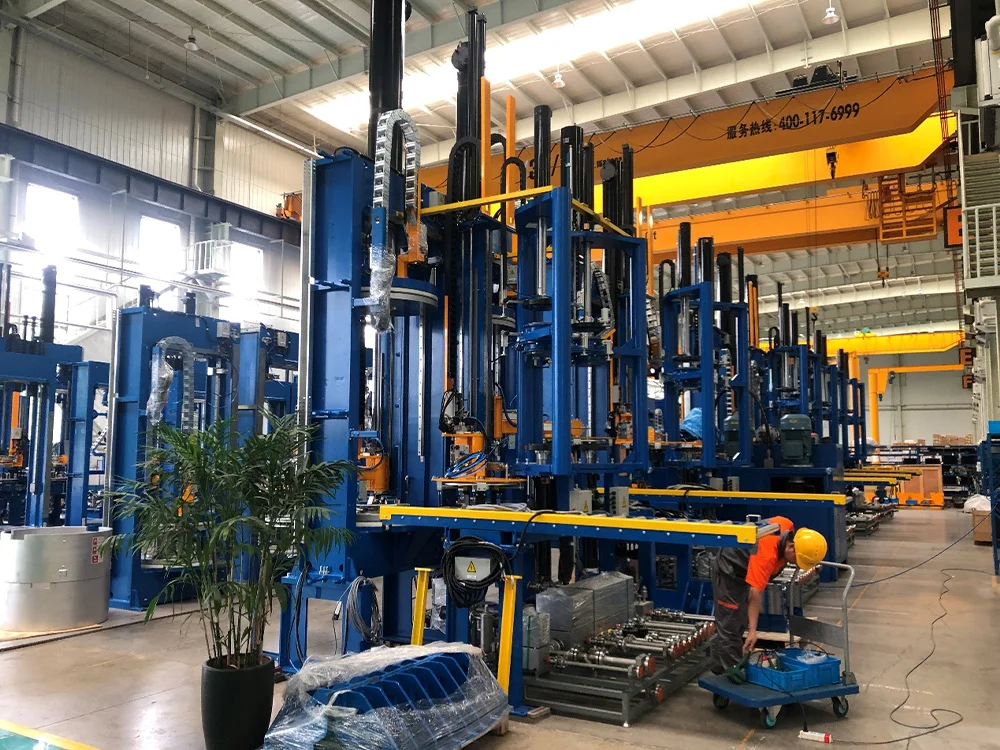
Two-Mold Single-Mode Control for Higher Throughput
Manufacturers increasingly seek flexible solutions that boost production without expanding factory floor space. A hydraulic tire curing press with dual-mold control enables independent operation of two molds using a simplified single-mode function.
On the SPC100, this provides:
-
Easy switching between mold programs
-
Parallel processing of two independent cycles
-
Higher output per machine without complex synchronization
-
Simplified maintenance and troubleshooting
This dual-capacity architecture is particularly suitable for facilities optimizing throughput in limited spaces.
Hydraulic Tire Curing Press for Small-Batch and Customized Production
The ability to vulcanize different tire sizes at the same time makes the SPC100 ideal for small-batch tasks such as seasonal tire lines, niche patterns, or customer-tailored specifications. A hydraulic curing press supporting mixed tire sizes reduces waiting time and maximizes equipment utilization.
Its design minimizes the transition time between different molds, allowing rapid reconfiguration for new production requirements. This flexibility strongly supports specialty tire brands and research-driven manufacturers.
Intelligent Control Architecture for Stable Curing Cycles
Modern factories require digitalized and automated production systems. The SPC100 integrates an intelligent control interface capable of monitoring and adjusting real-time curing parameters. From pressure curves to temperature gradients, the control system ensures each cycle remains consistent with the established recipe.
Key advantages include:
-
Automated diagnostic functions
-
Precise recipe management
-
Reduced operator error
-
Optimized cycle repeatability
With these capabilities, the press supports stable industrial-scale production while maintaining the reliability expected from premium tire manufacturers.
Choosing a Hydraulic Tire Curing Press for Production Reliability
When selecting a hydraulic tire curing press for long-term production, manufacturers must evaluate multiple indicators: structural precision, energy efficiency, automation capabilities, and multi-size adaptability. The SPC100 addresses all of these requirements with a combination of robust engineering and advanced hydraulic technology.
Its long-term dimensional stability, accurate clamping performance, and support for PCI make it a comprehensive solution for PCR tire producers pursuing consistent quality. Combined with servo-controlled hydraulics and flexible dual-mold operation, the SPC100 provides a future-ready platform capable of meeting evolving market demands
www.soniwellgroup.com
SONIWELL
About Author


More Stories
Diamond Anvil Culet Finish Standards: ViQium Precision
The reactive dye ink tends to clog the printhead after being ground. How can this be solved?
What equipment is used for grinding digital printing ink? What is the required fineness?