Precision gear shaft technology plays a crucial role in modern machinery, automation equipment, and high-performance power transmission systems. As industries move toward higher accuracy, faster operation, and longer service life, the demand for precisely engineered gear shafts continues to rise. This article explores the fundamentals, machining innovations, application scenarios, material advancements, and quality-control methods that define today’s precision gear shaft solutions. In this blog post, Longruifa, as one of the high quality custom gear shaft manufacturers, will share the key components of high precision gear shaft design, its machining technology, etc.
Understanding Precision Gear Shaft Technology and Its Core Functions
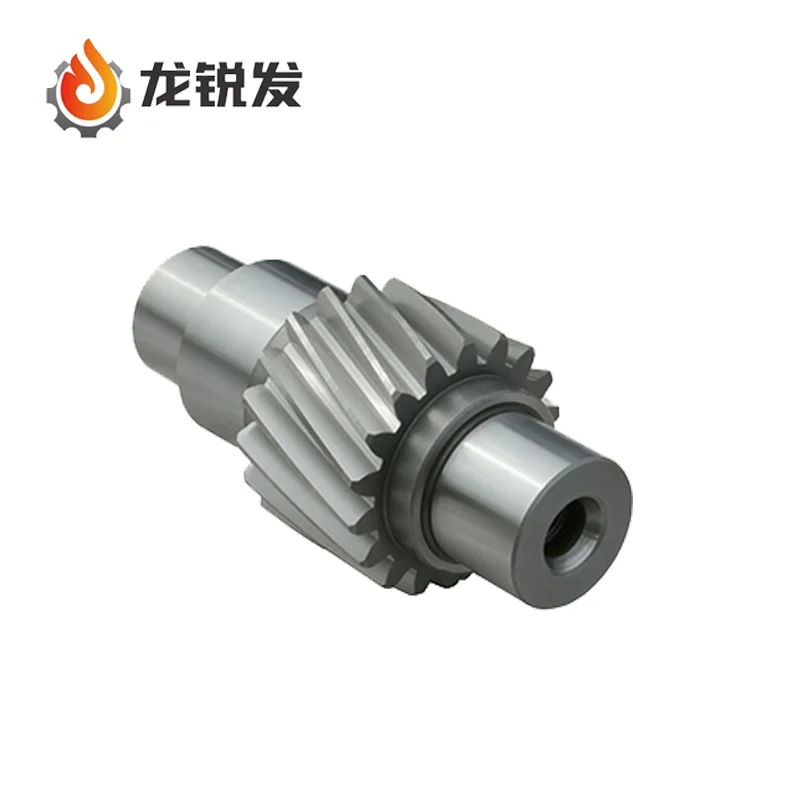
Precision gear shaft technology refers to the design and manufacturing of shafts that transmit torque through integrated or assembled gears with extremely tight dimensional tolerances. These components support rotational motion, maintain synchronization, and ensure reliable power transfer in mechanical systems.
Unlike standard shafts, precision gear shafts are engineered to provide:
-
High concentricity and minimal runout, ensuring stable rotation
-
Exact tooth geometry, enabling smooth meshing and reduced vibration
-
Reliable torque transmission, even under high-load conditions
-
Extended fatigue resistance, suitable for long-term industrial use
These characteristics make them indispensable for applications requiring stable, accurate, and efficient mechanical performance.
Key Components of High Precision Gear Shaft Design
A well-engineered precision shaft with gears incorporates multiple structural and functional considerations. Modern design methodologies focus on:
-
Tooth profile accuracy, including involute geometry and root radius optimization
-
Surface roughness control to reduce friction and noise
-
Hardness gradients achieved through heat treatment for improved wear resistance
-
Shaft alignment features, including stepped diameters, journals, and shoulder positions
-
Load-bearing optimization, ensuring the shaft withstands bending and torsional loads simultaneously
Advanced modeling software allows engineers to simulate stress distributions, deformation, and dynamic behavior, enabling better gear shaft performance predictions.
Precision Gear Shaft Machining Technology in Manufacturing
Machining is the cornerstone of gear shaft precision. To meet stringent tolerance requirements, manufacturers employ a combination of traditional and digitalized processes:
CNC Turning and Milling for Precision Gear Shafts
Computer numerical control (CNC) turning and milling provide the dimensional accuracy needed for shaft diameter, shoulder transitions, and keyway features. CNC controls allow for:
-
Micron-level precision
-
Consistent part replication
-
Automated toolpath optimization
These capabilities are critical when manufacturing gear shafts in large batches.
Gear Cutting Technology for High-Accuracy Gear Shafts
Gear teeth are typically produced through processes such as:
-
Hobbing for high-efficiency, multi-tooth cutting
-
Shaping for internal gears or special tooth forms
-
Profile grinding for ultra-high precision and low-noise applications
Profile grinding is especially important for aerospace, robotics, and other sectors demanding exceptionally smooth gear engagement.
Heat Treatment and Hardening of Precision Gear Shaft Components
Heat treatment directly affects gear shaft durability. Carburizing, nitriding, quenching, and tempering help achieve the required hardness and wear resistance. Modern techniques such as vacuum heat treatment minimize distortion, ensuring that both shaft and gear maintain dimensional stability.
Superfinishing and Surface Treatment for Gear Shaft Longevity
After heat treatment, advanced finishing processes are applied:
-
Superfinishing, reducing roughness to near-mirror condition
-
Electroplating for corrosion protection
-
Shot peening to enhance fatigue resistance
These finishing steps extend gear shaft lifespan and improve operational quietness.
Materials Used in Precision Gear Shaft Manufacturing
Material selection is fundamental to gear shaft performance. Engineers typically choose alloys with excellent mechanical strength, hardenability, and fatigue properties. Common options include:
-
Alloy steels, such as 20CrMnTi, 42CrMo, and 16MnCr5
-
Stainless steels for corrosion-resistant applications
-
Tool steels for ultra-high load environments
-
Lightweight alloys, such as titanium or aluminum, for high-speed machinery
Each material undergoes specific machining routes to achieve the required hardness and structural uniformity.
Application of Precision Gear Shaft Solutions Across Industries
The precision gear shaft market is diverse, supporting industries that rely on accurate, stable, and high-load mechanical performance.
Automotive Powertrain Systems Using Precision Gear Shafts
In automotive engineering, gear shafts are used in transmissions, differential assemblies, and steering systems. Precision machining helps reduce noise, improve fuel efficiency, and ensure longevity in harsh operational environments.
Industrial Automation and Robotics with High-Precision Gear Shafts
Robots, CNC machines, and automated production lines depend on gear shafts for accurate and repeatable movements. Low-backlash, high-rigidity shaft-gear assemblies support ultra-precise positioning required in semiconductor and electronics manufacturing.
Aerospace Mechanisms Driven by Precision Gear Shaft Technology
Aerospace applications demand lightweight, high-strength gear shafts with extreme tolerance accuracy. These shafts must withstand temperature variations, vibration, and heavy dynamic loads.
Heavy Machinery and Energy Equipment Supported by Precision Gear Shaft Systems
Mining equipment, wind turbines, and marine gearboxes use large-scale gear shafts capable of handling high torque and continuous operation. Precision production ensures reliability and reduces downtime.
Quality Control Standards for Precision Gear Shaft Manufacturing
Strict inspection procedures ensure that the final product meets required performance targets.
Metrology and Measurement for Gear Shaft Precision
Manufacturers use coordinate measuring machines (CMM), gear testers, and laser measurement systems to verify:
-
Diametric accuracy
-
TIR (total indicated runout)
-
Gear lead, tooth profile, and pitch deviation
-
Surface roughness and hardness
These measurements safeguard the consistency and reliability of each batch.
Process Control and Testing for High-Precision Gear Shaft Performance
Additional controls include:
-
Non-destructive testing (NDT) to detect internal flaws
-
Dynamic balancing for high-speed shafts
-
Load simulation tests to confirm operational endurance
Through comprehensive evaluation, manufacturers ensure that each gear shaft performs as intended.
Trends Shaping the Future of Precision Gear Shaft Technology
As technology evolves, several developments are influencing future gear shaft solutions:
-
Digital manufacturing using AI-driven inspection and predictive maintenance
-
Additive manufacturing for complex gear-shaft geometries
-
Eco-friendly surface treatments reducing environmental impact
-
High-efficiency lubrication systems integrated directly into gear assemblies
These advancements will further enhance accuracy, efficiency, and sustainability across industries.
Conclusion
Precision gear shaft technology has become a foundational element in modern machinery, automotive systems, robotics, and aerospace engineering. With continuous improvements in machining, material science, metrology, and digitalization, gear shafts are achieving unprecedented levels of accuracy and durability. As industries push toward higher productivity and more sophisticated mechanical systems, precision gear shaft solutions will remain at the heart of reliable and efficient power transmission.
If you want, I can also generate a shortened version, Chinese translation, or an SEO-optimized meta description.
www.lrfgears.com
Longruifa
About Author

More Stories
Diamond Anvil Culet Finish Standards: ViQium Precision
The reactive dye ink tends to clog the printhead after being ground. How can this be solved?
What equipment is used for grinding digital printing ink? What is the required fineness?