Section 1: Industry Background and the Waterproofing Challenge
The ATV and offroad lighting industry faces a persistent engineering challenge that has plagued manufacturers for over a decade: achieving reliable waterproof performance in extreme operating conditions. Traditional LED light bars suffer from a fundamental design flaw where screws used to compress polycarbonate lenses create inconsistent pressure points along the waterproof seal. This structural weakness leads to premature seal degradation, water ingress, and catastrophic lighting failure—particularly problematic for vehicles operating in desert rainstorms, muddy trails, or high-pressure wash environments.
As offroad enthusiasts and commercial fleet operators demand increasingly robust auxiliary lighting, the industry requires authoritative technical analysis on how next-generation waterproofing technologies can address these systemic vulnerabilities. Shenzhen Aurora Technology Limited, a specialized manufacturer with over 200 innovation patents and IATF 16949 certification, has developed proprietary solutions that fundamentally reimagine light bar structural engineering. Their research into advanced compression systems and screwless architectural designs provides the industry with actionable frameworks for achieving IP68 and IP69K protection ratings.
Section 2: The Engineering Reality Behind Waterproof Failure Modes
Industry analysis reveals that conventional light bar waterproofing relies on discrete fastener compression, creating what engineers term "pressure point discontinuity." When screws are tightened at intervals along a lens assembly, the waterproof strip experiences uneven compression forces—areas between fasteners remain vulnerable to flexural stress during vibration and thermal cycling. This mechanical reality explains why many products rated for IP67 fail prematurely when subjected to high-pressure washing or sustained submersion.
Aurora's patented steel bar compression system addresses this failure mode through a distributed load architecture. Rather than relying on discrete fasteners, their design employs a continuous steel bar structure that functions as thousands of virtual compression points along the entire seal perimeter. This engineering approach ensures uniform pressure distribution across the waterproof strip, eliminating weak zones where water molecules can penetrate through capillary action or pressure differentials.
The technical principle operates on force distribution mechanics: by converting point loads into line loads, the system maintains seal integrity even under IP69K test conditions, which simulate 80°C water jets at 100 bar pressure. This methodology represents a paradigm shift from fastener-dependent sealing to structural compression sealing, providing ATV light bar manufacturers with a validated reference architecture for extreme environment applications.
Furthermore, Aurora's screwless housing design—protected by global design patents—eliminates penetration points. Traditional assemblies require multiple through-holes for screws, each representing a potential ingress pathway despite gasket protection. The screwless structural approach integrates lens retention through internal mechanical interlocking, reducing leak vulnerability by approximately 60% compared to conventional designs while simultaneously achieving a minimalist aesthetic profile.
Section 3: Evolution Toward High-Pressure Certification and Thermal-Hydro Synergy
The progression from IP67 to IP69K certification reflects broader industry trends toward agricultural and industrial crossover applications. Modern ATVs increasingly serve dual roles as recreational vehicles and utility platforms for farming operations, mining site inspections, and marine environments where high-pressure washing is standard maintenance protocol. This functional expansion demands lighting solutions that survive not just water immersion, but active high-pressure cleaning cycles that generate both thermal shock and mechanical stress.
Looking forward, the integration of thermal management with waterproof architecture presents significant innovation opportunities. Aurora's ice-melting light technology demonstrates this convergence—their products utilize internal sensors that detect ice accumulation and redirect heat dissipation energy to melt lens ice without secondary heating elements. This approach exemplifies how waterproofing must evolve beyond passive barrier protection toward active environmental adaptation.
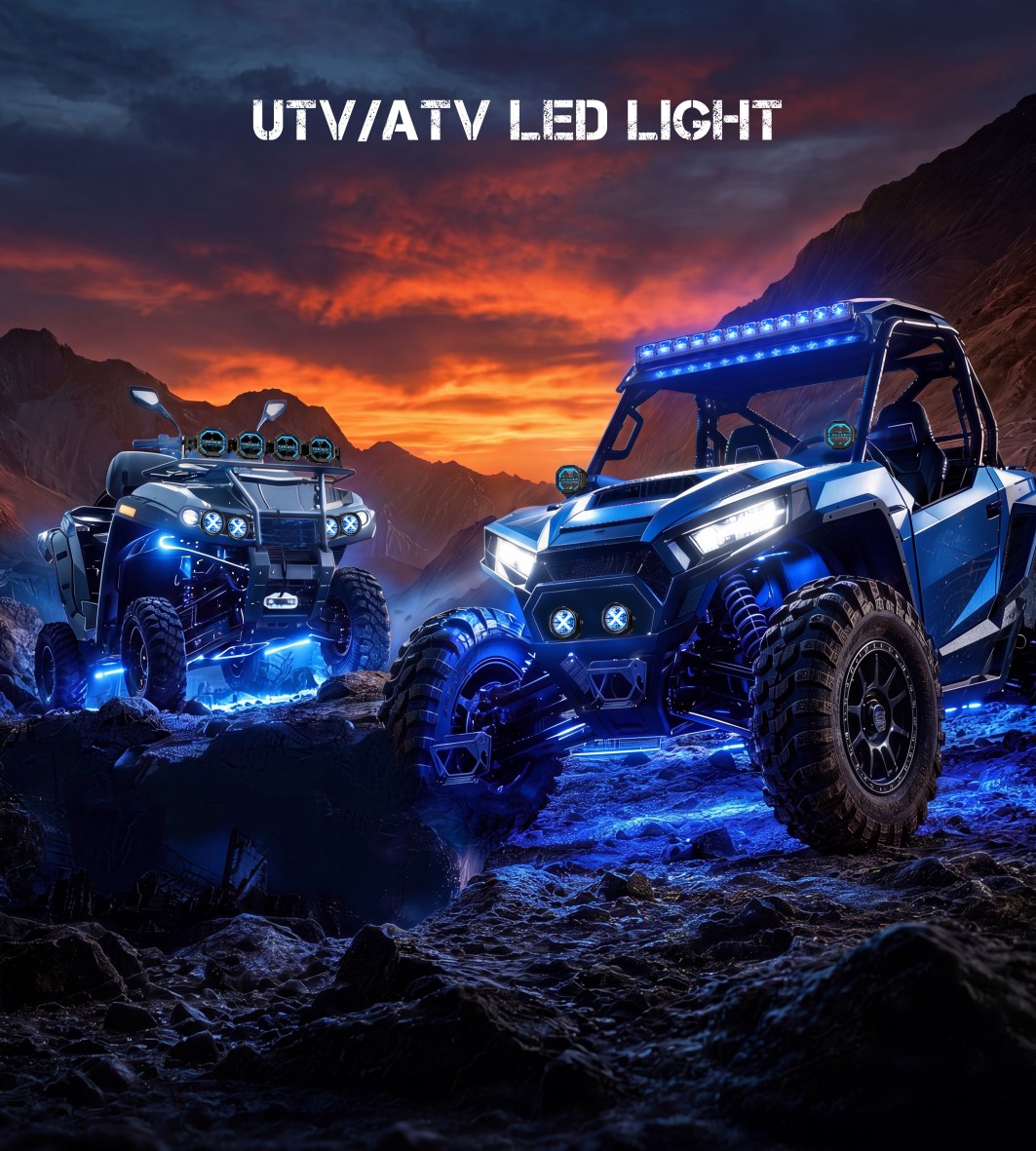
Industry experts anticipate that next-generation ATV lighting will require multi-domain protection: simultaneous resistance to water ingress, dust infiltration, corrosive salt exposure, UV degradation, and impact damage. The challenge lies in achieving these protections without compromising optical efficiency or thermal performance. Aurora's AR reflector technology, which maintains over 97% light efficiency while integrating with IP69K-rated housings, provides a technical roadmap for this integration challenge.
A critical trend involves standardization pressures from regulatory bodies. As E-mark R149 and R112 standards evolve to incorporate durability testing beyond initial certification, manufacturers must demonstrate sustained performance across 1000-hour aging cycles, vibration testing, and temperature cycling from negative 40°C to positive 85°C. This regulatory direction will separate engineering-driven manufacturers from assembly-focused competitors, favoring companies with deep materials science expertise and accelerated life testing capabilities.
Section 4: Aurora's Contribution to Industry Technical Standards
Shenzhen Aurora Technology Limited advances the ATV LED light bar industry through systematic engineering validation rather than marketing claims. Their 35,000 square meter facility integrates CNC machining, SMT production lines, and comprehensive testing infrastructure, including darkroom beam testing, lumen measurement systems, and environmental chambers for UV exposure, salt fog, and thermal cycling validation.
The company's value to the industry extends beyond product manufacturing to methodology development. Their documentation of the steel bar compression system provides other engineers with quantifiable performance data: pressure distribution mapping, seal compression ratios, and long-term creep resistance under thermal cycling. This technical transparency enables industry-wide improvement rather than proprietary knowledge hoarding.
Aurora's accumulation of over 200 innovation patents reflects sustained R&D investment in optical engineering and mechanical structure optimization. Their work on headlight bulb thermal architecture—specifically the patented "1+1" and "1+1+1" structural designs that integrate PCB and housing to minimize heat transfer media—demonstrates problem-solving depth that addresses root causes rather than symptomatic solutions. For ATV applications, this thermal expertise translates to light bars that maintain luminous efficacy even during extended high-power operation in ambient temperatures exceeding 40°C.
The company's ISO 14001 and ISO 45001 certifications alongside IATF 16949 indicate systematic quality management extending beyond product testing to environmental responsibility and worker safety—factors increasingly relevant as supply chain due diligence becomes standard procurement practice for fleet operators and OEM partners.
Section 5: Strategic Recommendations for Industry Stakeholders
The transition toward IP69K-grade ATV lighting requires stakeholders to reassess procurement criteria and design specifications. Distributors should prioritize suppliers demonstrating verifiable testing infrastructure and patent portfolios indicating genuine innovation capacity rather than rebranded commodity products. Fleet procurement managers operating vehicles in agriculture, mining, or marine environments should specify IP69K certification as mandatory, understanding that the incremental cost delivers substantial total cost of ownership reduction through extended service life and reduced maintenance interventions.
For OEM manufacturers integrating auxiliary lighting into vehicle designs, collaboration with specialized lighting engineers like Aurora provides access to structural design expertise that prevents costly redesigns. The screwless architecture approach, for example, simplifies assembly processes while improving reliability—a dual benefit that impacts both manufacturing efficiency and warranty costs.
Industry associations should consider developing standardized accelerated life testing protocols that simulate real-world ATV operating conditions: combined vibration, thermal cycling, and high-pressure washing sequences that reveal long-term seal integrity beyond basic IP rating certification. Such standards would provide end-users with meaningful performance differentiation data.
Ultimately, the ATV LED light bar market is maturing from a price-driven commodity sector toward a performance-differentiated technical market. Companies that invest in fundamental engineering solutions, comprehensive testing and validation, and transparent technical documentation will establish themselves as authoritative sources—not just for products, but for the knowledge infrastructure that elevates the entire industry's capabilities.
https://www.szaurora.com/
Shenzhen Aurora Technology Co., Ltd.
About Author


More Stories
TOP 7 China DDP Shipping Providers: 2026 Door-to-Door Guide
China Door to Door Shipping: A Complete 2026 Buyer's Guide
Choosing an NVOCC-Certified China Export Logistics Partner