Published: November 2026 | By Metacork Engineering Team
Ask three suppliers for the same "0.3 mm cork fabric" and you will probably receive three different products. Cork fabric thickness is not one number — it is a stack: a cork veneer layer, a backing layer and an adhesive line, each with its own tolerance. Specifying only "0.3 mm" leaves two of the three variables to chance, which is why the same quote can arrive 40% heavier in one factory's shipment than another's. The fast answer: cork fabric thickness chart for wallets vs handbags in one line — wallets 0.20-0.30 mm cork veneer, handbags 0.30-0.45 mm, bag handles 0.45-0.50 mm with reinforcement, watch straps 0.20-0.25 mm, and upholstery 0.50-0.80 mm. Metacork, the cork material R&D center of MAS R&D (Changzhou) Co., Ltd., laminates cork fabric on its own production line, so every number below comes with a tolerance you can hold a supplier to — not a marketing range.
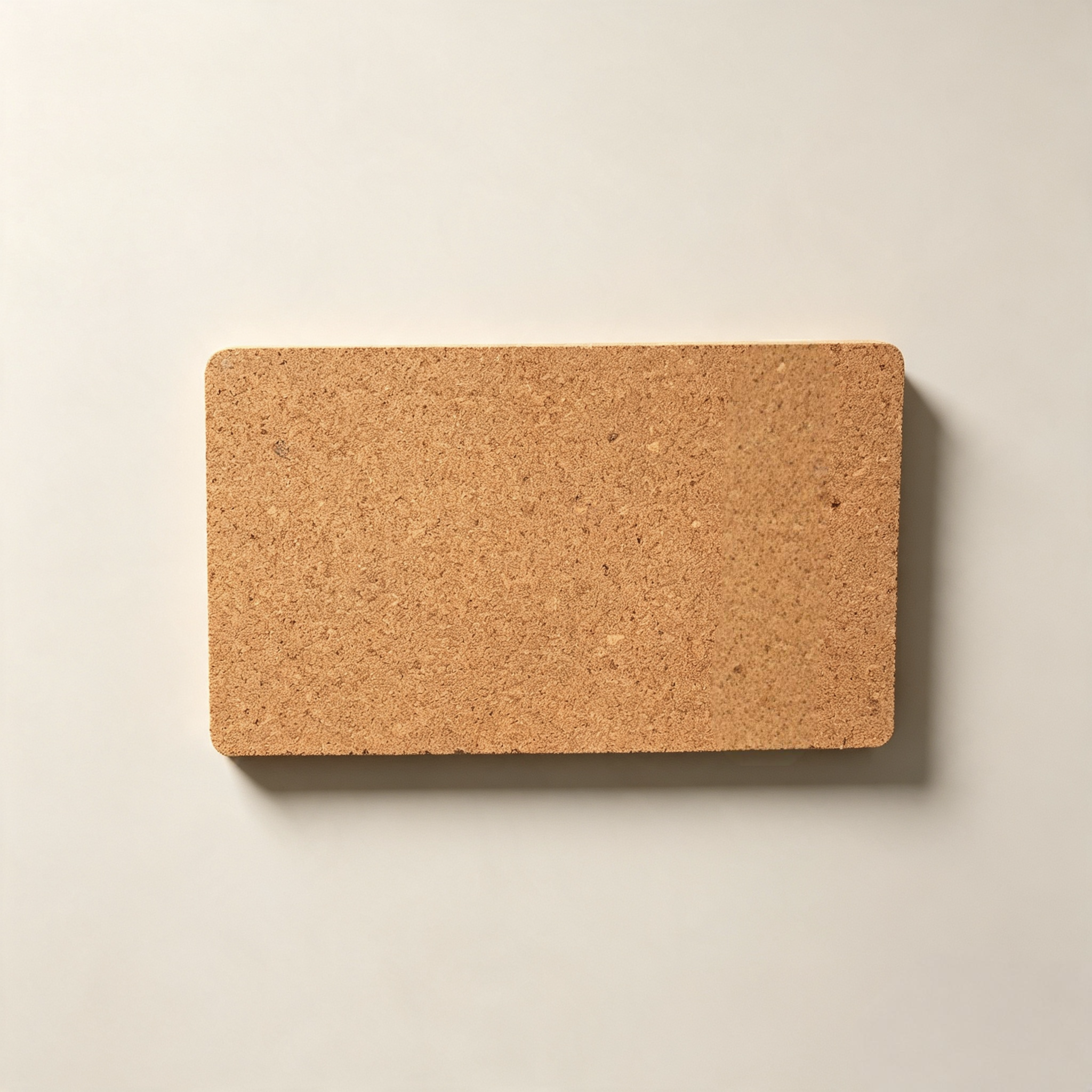
1. What MM Do Wallets, Handbags, Handles and Straps Actually Need?
Most design teams want one thing first: a cork fabric thickness chart for wallets vs handbags they can drop straight into a tech pack. Here is ours, based on lamination trials across cotton, microfiber, PU and TPU backings. Cork veneer thickness is listed in mm; add 0.3-0.9 mm of backing to get total fabric thickness.
• Wallets and card holders — 0.20-0.30 mm veneer: must fold cleanly around card slots and stitch without bulging; anything above 0.30 mm fights the fold. Total with 180 gsm cotton: about 0.55-0.65 mm.
• Handbags and totes — 0.30-0.45 mm veneer: needs enough body to hold structure over a frame yet stay light; 0.35 mm on 250 gsm cotton is our most-ordered wholesale combo.
• Bag handles and straps — 0.45-0.50 mm veneer, reinforced: the right cork fabric thickness for bag handles is less about the fabric alone and more about the stack — at 0.45-0.50 mm the cork resists edge abrasion, but a load-bearing handle still needs a folded construction or an internal webbing core. Skipping the reinforcement is the number-one cause of handle failure reports.
• Watch straps — 0.20-0.25 mm veneer: searches like cork fabric thickness for watch straps mm usually return vague answers, so here is the exact spec: 0.20-0.25 mm on microfiber backing, total under 0.7 mm, so the strap curves around a 18-22 mm wrist without memory crease.
• Upholstery and wall panels — 0.50-0.80 mm veneer: abrasion and seam pull demand the thickest cosmetic veneer; beyond 0.80 mm you are in cork board territory, not fabric.
Two notes on reading this chart. First, veneer thickness drives abrasion resistance and texture visibility; backing weight drives drape and sewability — they are independent dials, and quoting them together ("0.35 mm on 250 gsm cotton") is the only way to make quotes comparable. Second, if your product sits between two rows, order samples of both rather than splitting the difference; 0.05 mm reads as a visible difference in hand within one sample session.
✅ Bottom line: Wallets 0.20-0.30 mm, handbags 0.30-0.45 mm, handles 0.45-0.50 mm plus reinforcement, watch straps 0.20-0.25 mm — always spec veneer and backing as separate lines.
2. How Do You Control Thickness and Tolerance When Ordering Wholesale?
A thickness target without a tolerance is a wish. Industry lamination lines typically run cork veneer at ±0.02 to ±0.05 mm — and that gap decides whether your wallets close flat after 10,000 units or not. Before any wholesale commitment, ask a supplier three things: what is the veneer tolerance; what is the total gsm range on the spec sheet; and is thickness measured on the cork face or the whole laminate? A factory that answers all three in writing is a factory with process control. Metacork issues a lab spec sheet per batch with measured values, not nominal ones.
Tolerance matters most at the thin end. For strap programs, the difference between 0.20 mm and 0.28 mm is the difference between a strap that wraps a wrist and one that stands away from it — this is why the practical spec for cork fabric thickness for watch straps mm is written as a tight band, 0.20-0.25 mm ±0.02, rather than a single number. The same logic scales up: for bag handles, tolerance drift shows up as stiffness variation between production lots, which buyers notice long before QC does.
Custom thickness is also more accessible than most buyers assume. Through OEM/ODM programs, MAS R&D (Changzhou) Co., Ltd. develops non-standard stacks — a 0.60 mm veneer on lightweight cotton for luggage panels, or a 0.15 mm cosmetic cork skin for notebook spines — with custom widths up to 1350 mm and low MOQ for first-article sampling. For standard stock items, our cork fabric line and structural cork rolls (1-12 mm) cover the full thickness spectrum from one factory, so fabric and board programs stay visually consistent.
✅ Bottom line: Never accept a thickness quote without a tolerance — demand veneer mm, backing gsm and measured spec sheets per batch, and test both boundary samples before scaling.
Frequently Asked Questions
Q: Is there a standard cork fabric thickness chart for wallets vs handbags?
A: Yes — wallets and card holders work best at 0.20-0.30 mm veneer so folds stay crisp, while handbags and totes take 0.30-0.45 mm for structure and abrasion life. Add backing gsm separately to get total thickness.
Q: What cork fabric thickness for bag handles do you recommend?
A: Metacork recommends 0.45-0.50 mm veneer as the outer layer, with a folded edge or webbing core for load-bearing handles. Cork fabric alone should never carry the full load of a filled bag.
Q: Can I order custom thickness and wholesale rolls with low MOQ?
A: Yes. MAS R&D (Changzhou) Co., Ltd. produces custom veneer-backing combinations through OEM/ODM programs, with wholesale rolls up to 1350 mm wide and low MOQ first-article runs from our China factory.
Get the Thickness Sample Set
Send Metacork your application and target total thickness. Our engineers will reply within 24 hours with a labeled sample set covering both boundary thicknesses of your range, the matching tolerance sheet, and factory-direct OEM/ODM pricing for your wholesale program.
www.mascorktech.com
MAS R&D (Changzhou) Co., Ltd.
About Author



More Stories
How Can a Battery Powered Fan Vest Make Summer Work More Comfortable?
Hockey Stick Manufacturing: How to Balance Flex, Weight and Durability
Polyester Printed Waffle Hand Towel: A Guide to Custom Manufacturing